

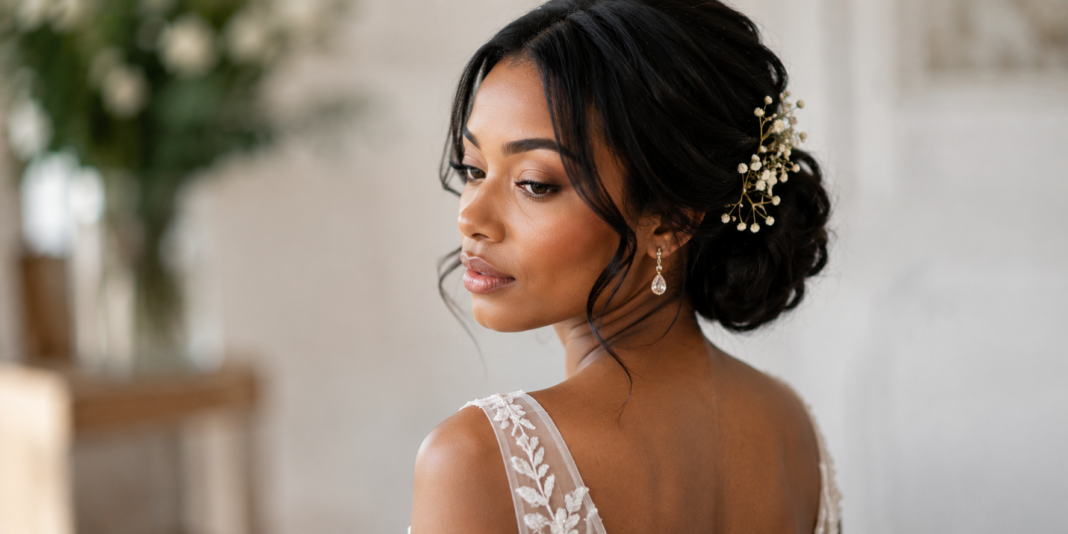

Wedding hair advice tends to focus on what’s beautiful in photographs. What it rarely addresses is what’s comfortable to wear for twelve hours, what actually stays put, and what you’ll still love when you look at the pictures twenty years from now.
The Trial Is Not Optional
The most important thing to know about wedding hair is that a trial run with your chosen stylist is not a luxury add-on — it is an essential part of the process, not least because it’s the only way to know before the day itself whether the style you’ve chosen actually suits you in three dimensions, in motion, and over several hours. Photographs of a hairstyle, however many you collect, tell you nothing about how it will look on your specific hair texture, how it will respond to your scalp’s oil production, how it will feel after three hours of dancing, or whether the weight of the pins will cause a headache you’ll be managing during your vows.
Book the trial at least six to eight weeks before the wedding — early enough to change course if the style doesn’t work, but close enough that your hair is at a similar length and condition to how it will be on the day. Wear or bring the earrings and neckline you plan to wear, because these change the visual context of the hair entirely. Take photographs from every angle, including candid movement shots, not just the posed mirror photo. And ask your stylist honestly how long the style is expected to hold and what you can do to touch it up if needed.
What Your Hair Type Actually Needs
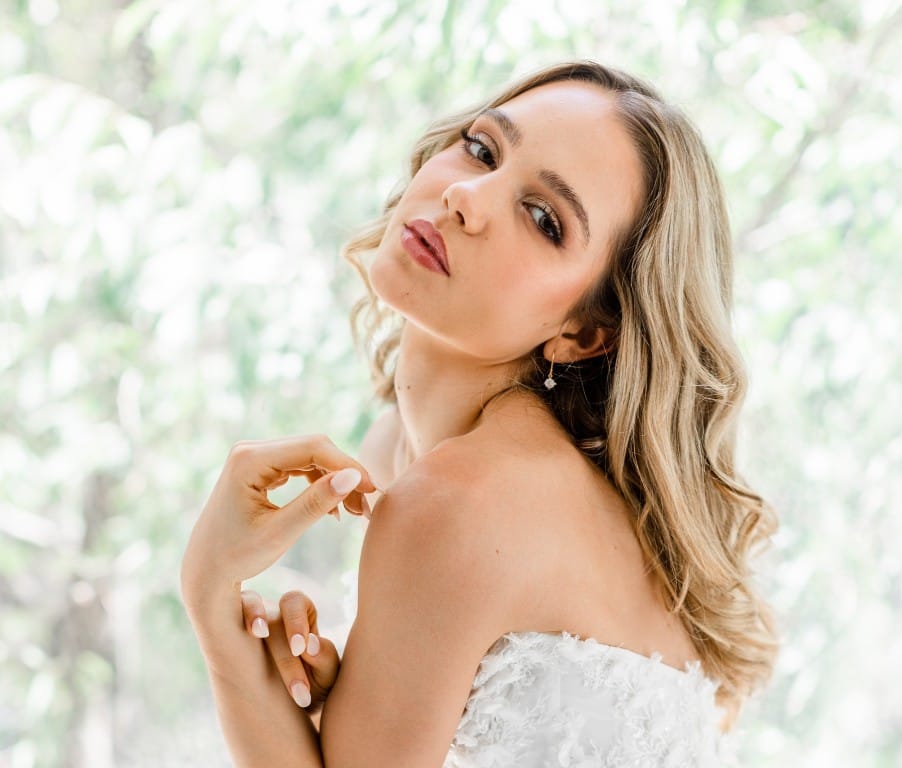
Fine hair and thick hair require genuinely different approaches, and choosing a style that fights your natural texture rather than working with it creates constant maintenance needs throughout the day. Fine hair can support intricate updos but needs significant texture — salt spray, volumizing mousse, backcombing, or braiding before pinning — to give it the grip and body that holds structure. Without texture, pinned styles on fine hair tend to slip within hours. Thick hair holds structure naturally but can become heavy and uncomfortable in very tight or dense updos; styles with some looseness and movement are often more comfortable for long wear.
Curly hair deserves particular consideration. Styles that fight the natural curl pattern — blown out, heat-straightened, or set into styles designed for straight hair — require significant maintenance throughout the day and often deteriorate faster than styles that honor the natural texture. Working with your curls rather than against them produces a result that is both more durable and, increasingly, more celebrated aesthetically.
The Longevity Question
A hairstyle that looks beautiful at ten in the morning but has noticeably degraded by the time the reception dinner is served is a common disappointment that good planning can prevent. Ask your stylist specifically which elements of your chosen style are the most vulnerable to humidity, dancing, wind, and the embrace of approximately two hundred people. Loose pieces around the face are usually the first to fall. Braided elements hold significantly longer than loosely pinned ones. Voluminous blowout styles fade faster than structured sets. If your reception involves outdoor elements, water, or an extended period without climate control, discuss this explicitly and build contingency into the style.
The Twenty-Year Test
Every generation of brides looks back at wedding photographs and identifies the elements that have dated most dramatically — the styles that were unmistakably of their moment in a way that now reads as a time capsule rather than a portrait. This is inevitable, and it’s not inherently a problem. But it’s worth considering how much of your wedding hair choice is driven by what is currently trending versus what is genuinely you. The couples who tend to love their wedding photographs most consistently, looking back decades later, are those whose images look like themselves — their actual taste, their genuine comfort, their authentic aesthetic — rather than a maximized version of whatever the current moment dictated was most beautiful.