

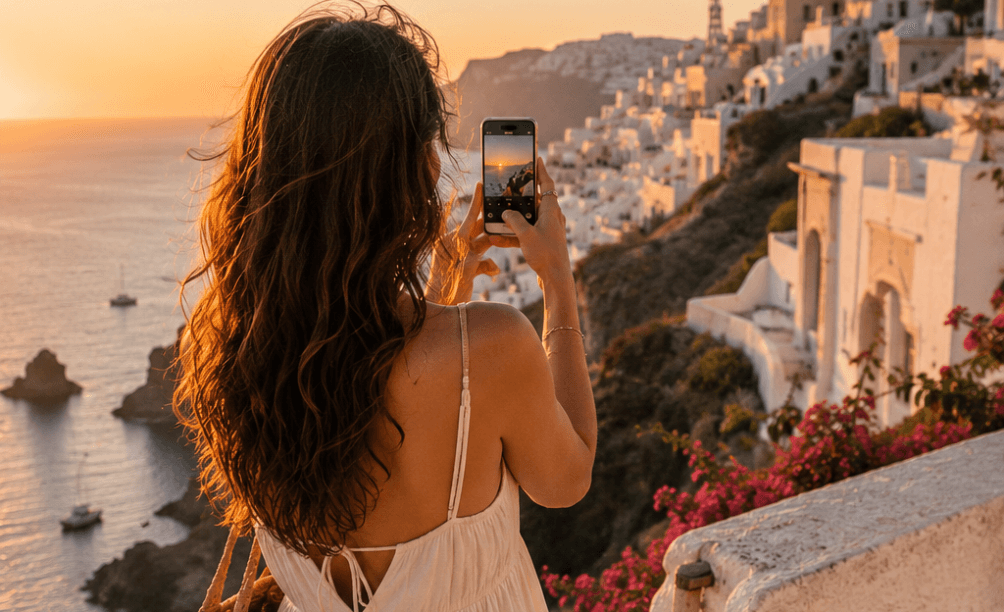
Part of the Egella Style Decoded Series — looking good on holiday, in real life and in every photo.
You’ve spent months planning the perfect trip. You’ve arrived at the most beautiful place you’ve ever seen. Your outfit is right, the light looks incredible, and someone is holding your phone. And the photos look… fine. Not stunning. Not the ones you imagined. Just fine. The gap between fine and frame-worthy isn’t about having a better camera — it’s about knowing the vacation photo ideas that make any phone photo look intentional.
Quick Summary: The 10 techniques in this guide address light, composition, angle, and editing — in that order of importance. Light matters most. Composition matters second. Equipment matters least. If you only do one thing differently on your next trip: shoot during golden hour. That single change produces more improvement than any other technique on this list. Short on time? Techniques 1 (golden hour), 3 (rule of thirds), and 7 (unique angles) cover the highest-impact changes in under 5 minutes of reading.
This guide covers the 10 most effective vacation photo ideas across every destination type, from beach to city to mountain, plus a styling and outfit note that most photography guides miss entirely.
Editor’s Note — Amelia Brooks: The vacation photo that gets the most saves on Pinterest is almost never the technically perfect one — it’s the one where the light is soft, the outfit is right, and the person in the photo looks like they’re actually somewhere. The location does less work than you think. I’ve seen stunning photos taken in a hotel room doorway and terrible photos taken on the Amalfi Coast. The difference is always light and intentionality, in that order. Both are fully achievable with a phone.
The Foundation: Why Light Matters More Than Anything Else
Every great vacation photo idea starts with the same foundation — the right light. The time of day affects image quality more than any camera, lens, or editing filter. The best natural light for travel photography occurs during two windows: golden hour (the 30-60 minutes after sunrise and before sunset) and blue hour (the 20-30 minutes after sunset). During golden hour, the sun is low enough that it adds warmth, dimension, and the soft, flattering quality that makes people and places look genuinely beautiful rather than harsh and flat.
The same beach that looks unremarkable at noon transforms at 6pm. Plan at least one golden hour shoot into every day of your trip — even if it’s just 20 minutes before dinner. The photos from those 20 minutes will be better than everything else from the day combined.
10 Vacation Photo Ideas That Work Every Time
1. Shoot During Golden Hour — The Non-Negotiable
Sunrise and sunset light is warm, directional, and inherently cinematic. It adds dynamic dimension to landscapes and flatters faces in a way that midday sun doesn’t. Set a reminder for 30 minutes before sunset on your phone for every day of your trip. You don’t need to plan an elaborate shot — the light will do the work.
For outfit photography specifically: golden hour light photographs warm tones (cream, sand, terracotta, warm white) most beautifully. The Euro Summer palette was practically designed for golden hour — if you’re wearing linen in warm neutrals, this is the light you want.
2. The Silhouette Shot
Place your subject between the camera and a bright background — a sunset, a backlit window, a lit doorway — and expose for the bright background. Your subject becomes a dramatic silhouette. This works at any skill level because the technical execution is simple: tap the bright area of your screen to expose for it, and the subject automatically darkens into a silhouette.
The silhouette is one of the most saved travel photo formats on Pinterest because it’s graphically striking, works regardless of what you’re wearing, and looks cinematic without requiring any post-editing.
3. The Rule of Thirds — Your Phone’s Hidden Tool
Turn on the grid overlay in your phone’s camera settings (Settings → Camera → Grid on iPhone; Camera → Settings → Grid Lines on most Android phones). The grid divides your frame into thirds both horizontally and vertically. Place your subject at one of the four intersection points rather than the center. The result is a more visually balanced, naturally pleasing composition that reads as intentional rather than snapshots.
This single setting change — turning on the grid and using the intersections — produces immediate, visible improvement in every photo you take for the rest of the trip.
4. Lead Lines for Depth
Find natural lines in your environment — a road, a path, a beach shoreline, a row of trees, a corridor of architecture — and compose your shot so the line starts in the foreground and leads into the distance. This creates depth and draws the viewer’s eye through the image in a way that feels cinematic rather than flat. Lead lines are everywhere once you start looking for them: every street, every beach, every staircase is a potential compositional tool.
5. Shadow Photography
Sun-heavy summer travel destinations are full of shadow opportunities. The shadow of a palm tree on sand, a window grid on a white wall, a hand fan casting patterns — shadows add texture and visual interest to photos that would otherwise be straightforward. Position your subject within or alongside an interesting shadow, or photograph the shadow itself as the main subject with your subject as context.
This technique pairs beautifully with white or cream outfits, which allow the shadow pattern to show clearly against the fabric.
6. Unique Angles — Get Low or Get High
The most consistently overlooked vacation photo idea is simply changing your physical position. Get down to ground level — lying on the beach, crouching on a cobblestone street — for a dramatic low-angle shot that makes ordinary scenes look epic. The sky becomes the background, the subject looks taller, and the overall perspective feels fresh and considered.
Alternatively, hold your phone directly above your head pointing down for an aerial perspective. Flat lays of your beach bag contents, a table at a café, or a spread of market finds photograph beautifully from directly above.
7. The Reflection Shot
Water puddles, still lakes, glass buildings, mirrors, wet sand, and even pools all create reflection opportunities. Compose so the reflection fills the bottom half of the frame and the subject or scene fills the top half. The result is a symmetrical, visually striking image that photographs well even in ordinary lighting.
For location-specific opportunities: still-water pools in Morocco, glass towers in cities, wet sand at low tide at any beach. Reflections are particularly effective at blue hour when the sky has color and the reflection doubles it.
8. The Hotel Room as a Studio
Most people pay significant money for hotel rooms and photograph almost nothing inside them. Your room is a free content studio. Window light creates beautiful, directional portraits — position yourself or your subject facing the window, standing slightly to one side of it, and shoot from the same side as the window. The result looks professional without any equipment.
Overhead shots of flat lays — your outfit laid out, your travel essentials arranged on the bed, a morning coffee setup — are consistently popular on Pinterest and require nothing except your phone and good composition.
9. Scout Before You Shoot
Instagram and Pinterest are excellent pre-trip scouting tools. Search the destination name and look at what local photographers are shooting — they know the locations, the times, and the angles that work. Save the locations you want to visit to Google Maps before you leave home. When you arrive, you’ll already know where to go and roughly when to be there.
One practical addition: visit popular locations at off-peak times. The best travel photos almost always have minimal other people in them — early morning (before 8am) and late afternoon (after 5pm) solve this problem at most major tourist sites.
10. Edit for the Feeling, Not the Filter
The goal of editing travel photos is to make them look like how the place actually felt — not like a filtered, processed version of it. Start with the basics: adjust exposure (brightness), contrast, and white balance. Straighten horizons. Crop distractions from the edges. Then stop.
Over-edited travel photos have a short shelf life — the specific filter or preset trend moves on and the photos look dated. A well-lit, honestly-edited photo of a great location stays relevant indefinitely.
Editor’s Note — Amelia Brooks: The styling detail that most photography guides skip: what you wear in travel photos matters as much as where you stand. Busy prints compete with interesting backgrounds. Very dark colors absorb light and lose detail in photos. The outfits that photograph best in travel settings are the same ones that work for the Euro Summer aesthetic — warm neutrals, simple silhouettes, one interesting detail. A cream linen dress in a Moroccan doorway, navy trousers on a Greek street, a white shirt on any coast. The location provides the color and texture; the outfit should be quiet enough to let it.
Vacation Photo Ideas by Destination
| Destination | Best Techniques | Best Time | Outfit Note |
|---|---|---|---|
| Beach | Silhouette, shadows, reflections in wet sand | Golden hour, sunrise | White or cream — catches light beautifully |
| City | Lead lines, glass reflections, low angles | Blue hour (after sunset) | Simple, solid colors — don’t compete with architecture |
| Mountains | Panoramas, rule of thirds, wide landscapes | Sunrise, golden hour | Earthy tones — olive, camel, warm brown |
| Historic sites | Architecture details, framing through arches | Early morning (fewer crowds) | One color that contrasts the stone or background |
| Hotel / resort | Window light portraits, overhead flat lays | Morning window light | Clean, minimal — the setting provides the interest |
Who This Guide Is Best For
Best for: anyone who shoots travel photos on their phone and wants noticeably better results without buying new equipment, those who want to document their Euro Summer or general travel aesthetic in a way that reflects how the trip actually felt, people who plan their outfits for travel and want to know how to photograph them well.
Less ideal for: those wanting technical camera guidance for DSLR or mirrorless systems — this guide is specifically for phone photography, where the principles are the same but the execution is different.
The Egella Take
The best vacation photo ideas are the ones that require the least equipment and the most intention. Golden hour light, rule-of-thirds composition, a unique angle, and honest editing — these four things, applied consistently, will produce better results than any camera upgrade or editing app. The photos that end up on people’s walls or saved to their Pinterest boards are almost never the technically complex ones. They’re the ones where the light was right and someone was paying attention.
Frequently Asked Questions About Vacation Photo Ideas
How do I take better vacation photos with just my phone?
Three changes: shoot during golden hour, turn on your camera grid and use the rule of thirds, and change your angle rather than shooting at eye level. These three adjustments alone will dramatically improve every vacation photo you take.
What makes a travel photo look professional?
Intentional light, considered composition, and minimal editing. Professional-looking travel photos are about the photographer’s awareness of light and framing — not the equipment. A phone in golden hour light with good composition consistently outperforms a professional camera in midday sun with no composition thought.
How do I take photos of myself on vacation alone?
A small portable tripod (many fold to fit in a jacket pocket) and your phone’s 10-second timer. Scout and frame the shot first, set the timer, and walk into the frame. Take at least 10 shots — the first few will be adjustment shots, the later ones will be better. A Bluetooth remote shutter eliminates the timer awkwardness entirely.
What outfits photograph best in travel photos?
Simple silhouettes in warm neutrals — cream, sand, olive, camel, soft white. These work with almost every travel background and destination. Busy prints compete visually with interesting locations; solid colors let the destination do the work. See our Euro Summer guide and best linen dress picks for specific outfit ideas that photograph particularly well in travel settings.
Every Trip Deserves Beautiful Photos
The techniques in this guide don’t require new equipment, expensive editing software, or a professional photographer. They require attention to light, a willingness to change your angle, and a phone you already own. Apply them consistently and the gap between “fine” and “frame-worthy” closes faster than you’d expect.
Save this guide before your next trip and explore more style guides at egella.com
What’s the best travel photo you’ve ever taken — and what made it work? Tell us in the comments.