



The connection between stress and skin goes much deeper than the occasional breakout before a difficult week. Most people know that stress shows up on their face. Far fewer understand the biology behind it — or how significantly chronic stress affects skin at the cellular level, well beneath what’s visible on the surface.
Quick Summary: Chronic stress triggers a hormone cascade that breaks down collagen, disrupts the skin barrier, drives inflammation, and slows healing — often before a single breakout appears. Understanding the mechanism changes what you can do about it, since skincare alone addresses only the surface of what’s happening.
This guide covers what stress actually does to skin at the cellular level, why the effects go far beyond acne, and the evidence-based interventions that address the root cause rather than just the visible symptoms.
Editor’s Note: Reading the research behind this topic reframed how we thought about “stress skincare” entirely. The standard advice — sheet masks, calming serums — addresses some of the surface symptoms, but the actual mechanism runs much deeper. The interventions that genuinely move the needle on stress-reactive skin are almost entirely systemic rather than topical, which is a harder sell but a more honest one.
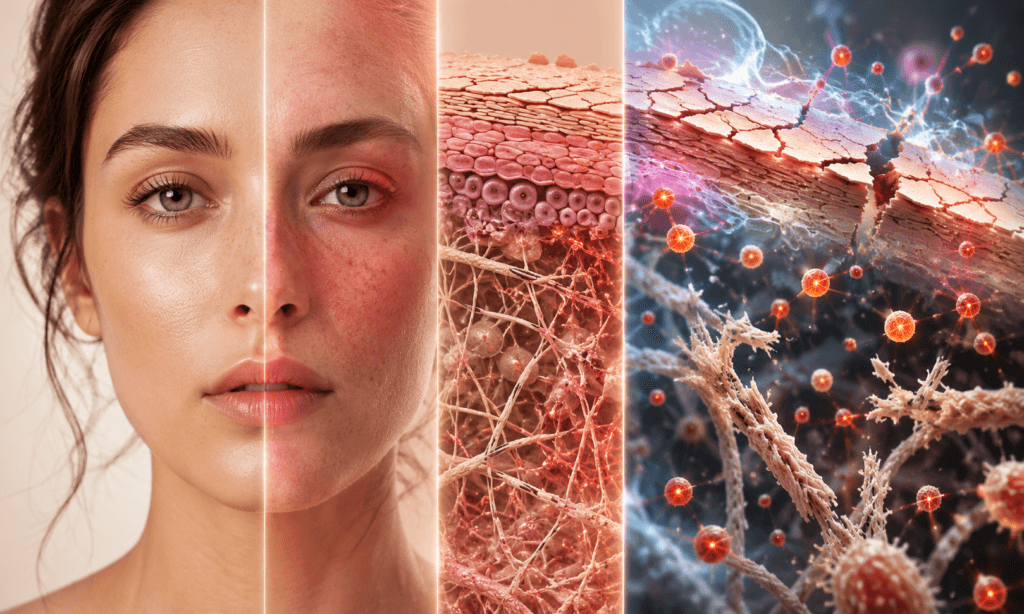
Stress as a Biological Event
Psychological stress triggers a physiological cascade that is ancient, conserved, and entirely indifferent to whether the threat is a predator or a difficult email.
The hypothalamic-pituitary-adrenal axis — the HPA axis — activates, adrenocorticotropic hormone is released, and the adrenal glands respond by producing cortisol and adrenaline. These hormones prepare the body for a threat response: heart rate increases, blood is redirected to major muscle groups, digestion slows, and immune function shifts from its long-term maintenance mode to a short-term, inflammation-ready state. This system is exquisitely well-designed for acute stress. It was not designed for the chronic, low-grade, unrelenting stress that characterizes modern life — and when it runs continuously, the systemic effects accumulate in ways that are measurably visible in the skin.
What Chronic Stress Actually Does to Your Skin
1. Cortisol Breaks Down Collagen
The most significant long-term skin consequence of chronic stress is cortisol-driven collagen degradation. Cortisol directly upregulates matrix metalloproteinases — enzymes whose specific function is to break down the extracellular matrix, including the collagen and elastin fibers that give skin its structural support and elasticity.
In short-term stress responses, this is a functional mechanism that supports tissue remodeling. In chronic stress, it becomes a sustained degradation process. Skin under chronic cortisol exposure loses firmness and elasticity faster than it otherwise would, develops fine lines more readily, and heals more slowly when damaged — because the same enzymatic environment that breaks down existing collagen also impairs the synthesis of new collagen. This is why chronic stress is often described as one of the most significant accelerators of visible skin aging.
2. Stress and Skin Inflammation Operate in a Loop
Stress and skin inflammation operate in a bidirectional loop that can become self-reinforcing in ways that are difficult to interrupt from either end alone. Psychological stress triggers the release of substance P, a neuropeptide that directly induces mast cell degranulation in the skin — releasing histamine, cytokines, and other inflammatory mediators.
In people with conditions like acne, rosacea, eczema, or psoriasis, this stress-induced inflammatory signaling is a well-documented trigger for flares. But the loop runs in both directions: people under significant skin stress from visible breakouts or flares experience elevated psychological stress as a result, which further drives the neuroinflammatory response, which worsens the skin condition. Breaking this loop requires addressing both the physiological and psychological dimensions simultaneously — which is why skincare alone is genuinely insufficient for stress-reactive skin.
3. Chronic Stress Damages the Skin Barrier
One of the less-discussed effects of chronic stress on skin is its direct impact on barrier function. Cortisol suppresses the synthesis of the lipid molecules — ceramides, free fatty acids, and cholesterol — that form the skin’s protective barrier, the structure that prevents moisture loss and keeps environmental irritants out.
A stressed person’s skin is measurably more permeable than the same person’s skin under low-stress conditions. This increased permeability shows up as heightened sensitivity and reactivity, faster dehydration, and greater vulnerability to irritant and allergic reactions from products that would otherwise be tolerated normally. It’s a physiological explanation for the experience many people have of suddenly finding that products they’ve used for years are now irritating them — the products haven’t changed; the barrier state has. This connects directly to why Skin Barrier Repair becomes even more important during high-stress periods.
4. Stress Disrupts Sleep — Which Disrupts Skin Further
Chronic stress and poor sleep form their own reinforcing cycle, and the skin consequences compound. Growth hormone — released primarily during deep sleep — is essential for skin cell repair and collagen synthesis. Cortisol, elevated by stress, suppresses growth hormone release and disrupts sleep architecture. The result is a compounding deficit: less repair happening at night, more degradation happening during the day, with both processes running simultaneously in ways that accelerate visible changes in skin quality over time.
Editor’s Note: A question we hear often is whether topical cortisol-targeting ingredients — like certain peptides or adaptogens marketed as “anti-stress” skincare — can meaningfully address what’s described above. The honest answer is: at the margins, possibly. But the cortisol discussed here is systemic — produced by the adrenal glands and circulating throughout the body — not a surface phenomenon that topical products can meaningfully intercept. They can support barrier function and reduce surface inflammation, which is valuable, but they don’t address the root of the mechanism.
What the Stress and Skin Connection Looks Like in Practice
The effects above don’t always show up as obvious breakouts. Chronic stress and skin damage often presents as a cluster of subtle changes that build gradually:
- Skin that feels drier and more reactive than usual, even without product changes
- Longer healing time for breakouts, cuts, or irritation that would previously have resolved quickly
- A general dullness or loss of the plumpness that comes from healthy collagen levels
- Existing skin conditions — acne, rosacea, eczema — flaring more frequently or more severely
- Increased sensitivity to sun exposure or environmental irritants
What Actually Helps — Evidence-Based, Not Generic
Stress management as a skin intervention sounds like advice that’s easier to give than to receive, and it is. But the mechanisms above are addressable through practices with real evidence behind them — not generic “self-care” recommendations.
Regular physical exercise produces anti-inflammatory effects that directly counteract some of the cortisol-driven inflammation described above. The benefits are visible in skin on a timescale of weeks, not months.
Sleep quality is the most powerful cortisol-regulating tool available, and its skin effects are measurable and significant. Protecting sleep — both duration and quality — is one of the highest-return interventions for stress-reactive skin, arguably more impactful than any topical product.
Mindfulness-based stress reduction practices — formal or informal — have been shown in multiple randomized controlled trials to produce meaningful reductions in inflammatory markers, with documented improvements in acne, psoriasis, and eczema outcomes in study populations.
Diet rich in polyphenols, omega-3 fatty acids, and probiotic foods provides the nutritional substrate for the anti-inflammatory responses that chronic stress chronically depletes.
Topical support — barrier-repairing ingredients like ceramides, gentle cleansers, and reduced use of active ingredients during high-stress periods — helps manage the surface consequences while the systemic work happens. Pairing this with a structured Skin Cycling routine can reduce the risk of over-stimulating already-reactive skin.
These are not soft recommendations. They are the interventions that address the root of what stress does to skin, rather than the surface symptoms.
Who This Information Is Most Relevant For
Most relevant for: anyone whose skin worsens noticeably during stressful periods, people with stress-reactive conditions like acne, rosacea, or eczema, those whose skin suddenly became more sensitive without an obvious product-related cause, and anyone building a Skin Barrier Repair or [[Skin Cycling]] routine who wants to understand the full picture.
Worth noting: if stress-related skin changes are severe, persistent, or accompanied by significant psychological distress, a dermatologist and/or mental health professional offers more targeted support than any skincare routine can provide independently.
Frequently Asked Questions About Stress and Skin
Can stress cause premature skin aging?
Yes — through cortisol-driven collagen breakdown and the suppression of collagen synthesis, chronic stress accelerates the structural changes in skin associated with aging. It’s one of the more significant environmental contributors to visible skin aging that isn’t sun exposure.
Why does my skin suddenly react to products it used to tolerate?
This is often a barrier function change driven by cortisol-suppressed lipid synthesis. The skin becomes measurably more permeable under chronic stress, which means products that were previously tolerated can become irritating — not because the products changed, but because the skin’s ability to buffer them has.
Does reducing stress actually improve skin, or is it just theoretical?
It’s measurable, not just theoretical. Studies on mindfulness-based stress reduction have shown documented improvements in acne, psoriasis, and eczema outcomes. Exercise has demonstrated anti-inflammatory effects visible in skin on a timescale of weeks. The mechanism is real and the interventions produce real results.
Is “anti-stress” skincare worth buying?
Products with barrier-supporting ingredients (ceramides, fatty acids) genuinely help manage the surface consequences of stress-related barrier damage. Products claiming to “block cortisol” or “prevent stress hormones” at a topical level are making claims that don’t reflect how systemic cortisol actually works.
Final Thoughts: Skincare Is Not Enough
Understanding the connection between stress and skin at this level changes what’s worth prioritizing. The topical layer matters — protecting the barrier, reducing active ingredients during high-stress periods, supporting skin while the systemic work happens. But the collagen breakdown, the inflammatory loop, and the barrier disruption that chronic stress drives are systemic events that require systemic responses. Sleep, movement, stress reduction, and diet are not soft lifestyle suggestions. For stress-reactive skin, they are the treatment.
Save this guide, start with one systemic change this week, and explore more skincare guides at egella.com
Does stress affect your skin? Tell us how it shows up for you in the comments below.