

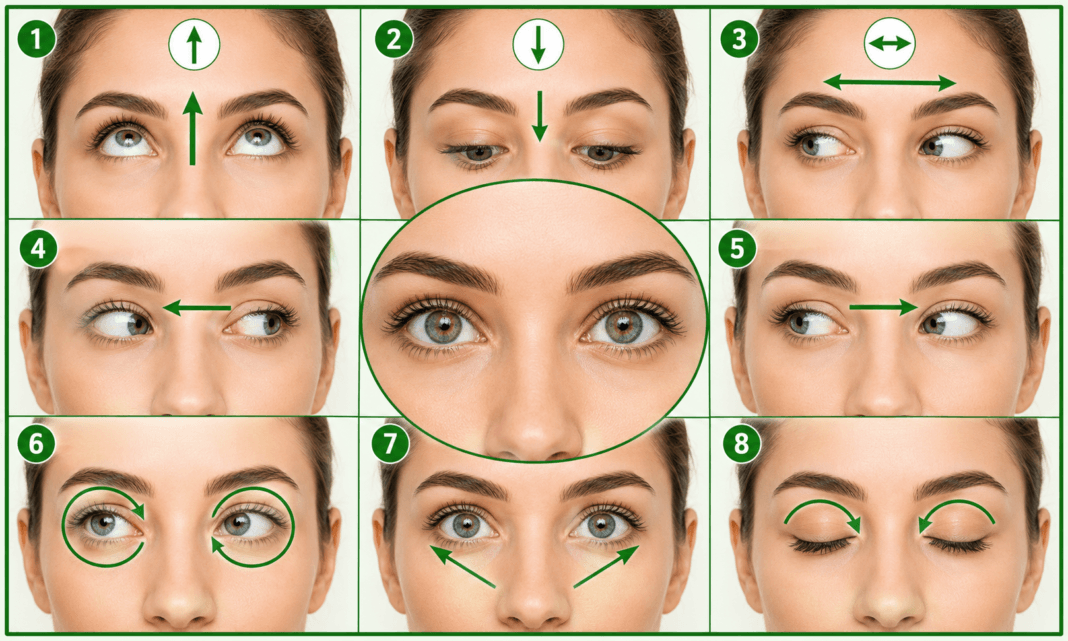
What if you could improve your vision naturally — without glasses, without surgery, and without spending a single dollar? Eye exercises have been used for decades to strengthen the eye muscles, reduce strain, and support clearer vision. And the best part? You can do them anywhere, anytime, in under 10 minutes.
This guide covers 8 proven eye exercises for stronger vision — the exact routine that has helped thousands of people reduce eye fatigue, sharpen focus, and support long-term eye health. Do this daily and see the difference.
Why Eye Exercises Work
Your eyes contain six external muscles that control movement and focus. Just like the muscles in your body, these eye muscles can weaken over time — especially with increased screen time, poor lighting, and lack of movement. Regular eye exercises strengthen these muscles, improve blood circulation around the eyes, and train your brain-eye connection for sharper focus.
Studies suggest that consistent eye exercises can help with eye strain, headaches caused by screen fatigue, difficulty focusing, and early-stage vision changes. While exercises won’t reverse severe conditions like cataracts or glaucoma, they are a powerful tool for maintaining and improving everyday visual performance.
8 Eye Exercises for Stronger Vision — Do This Every Day
Exercise 1 — Gaze Into the Darkness (2 Minutes)
This is the most relaxing and restorative exercise in the entire routine. Start here every time.
How to do it: Close your eyes gently and cup your palms over them to block out all light. Relax your eye muscles completely and gaze into the darkness behind your eyelids. Hold this position for 2 full minutes while breathing slowly and deeply.
Why it works: Modern screens constantly stimulate your retinas with harsh light and rapid movement. This exercise gives your eyes a complete reset — reducing inflammation, relieving tension in the eye muscles, and allowing the optic nerve to rest. Think of it as a full reboot for your visual system.
Best time to do it: First thing in the morning or after prolonged screen use.
Exercise 2 — Side to Side (5 Times)
This movement targets the lateral rectus and medial rectus muscles — the muscles that control horizontal eye movement.
How to do it: Keep your head completely still and look as far to the right as possible. Hold for one second, then move your eyes as far to the left as possible. That is one repetition. Repeat 5 times slowly and deliberately.
Why it works: Most people spend hours staring straight ahead at screens, which means the muscles responsible for side-to-side movement become underused and tight. This exercise stretches and strengthens the horizontal eye muscles, improving peripheral vision and reducing tension headaches.
Tip: Move your eyes as far as they will comfortably go without straining. You should feel a gentle stretch, not pain.
Exercise 3 — Up and Down (5 Times)
This exercise works the superior and inferior rectus muscles — the muscles responsible for vertical eye movement.
How to do it: Keep your head still and look as far upward as possible. Hold for one second, then move your eyes as far downward as possible. Repeat 5 times.
Why it works: Vertical eye movement is even more neglected than horizontal movement in everyday life. Strengthening these muscles helps with reading speed, focus tracking, and reducing the droopy, tired-eye feeling that comes from long work sessions.
Tip: Do this exercise slowly. Fast, jerky movements won’t engage the muscles properly.
Exercise 4 — Diagonal (5 Times)
Diagonal movement engages multiple eye muscles simultaneously, making it one of the most complete exercises in this routine.
How to do it: Move your eyes from the upper-right corner to the lower-left corner. Hold at each extreme for one second. Then switch — upper-left to lower-right. Complete 5 full cycles.
Why it works: The oblique eye muscles, which control diagonal movement, are almost never used in daily screen activity. Training these muscles improves coordination between both eyes and strengthens the overall stability of your visual field.
Exercise 5 — Near and Far Focus (15–30 cm, 5 Times)
This is the most powerful exercise for improving focus and combating digital eye strain. It directly trains your eyes’ ability to shift between distances — the exact skill that deteriorates with heavy screen use.
How to do it: Hold your finger approximately 15 cm (6 inches) from your face. Focus on your fingertip for 3 seconds. Then shift your focus to an object at least 5–10 meters away. Hold for 3 seconds. Bring your focus back to your finger. Repeat 5 times.
Why it works: This exercise trains the ciliary muscle — the tiny internal muscle that controls the lens of your eye. When you stare at a screen all day, this muscle becomes locked in one position and loses its flexibility. Near and far focus is essentially a stretch-and-contract workout for your lens muscle, restoring its natural range of motion.
This is the single most important exercise in this routine. If you only do one, make it this one.
Exercise 6 — Concentration #1 (5 Times)
This exercise trains your eyes to cross and converge toward the nose, strengthening the muscles used for close-up focus.
How to do it: Hold your finger directly in front of your nose. Slowly cross your eyes to focus on your fingertip. Hold the cross-eyed position for 2–3 seconds, then relax your eyes back to normal. Repeat 5 times.
Why it works: Convergence — the ability of both eyes to focus together on a close object — is a skill that weakens with age and screen overuse. Poor convergence leads to double vision, reading difficulties, and eye fatigue. This exercise directly trains that skill.
Tip: If you feel dizzy, slow down. This exercise is intense for people who haven’t done it before. Start with 2–3 repetitions and build up.
Exercise 7 — Concentration #2 (5 Times)
This is the advanced version of the previous exercise, training both convergence and divergence.
How to do it: Start with your finger close to your nose. Slowly move it away from your face while keeping both eyes focused on it. Follow the finger as it moves outward until your arms are fully extended. Then slowly bring it back toward your nose. Repeat 5 times.
Why it works: This exercise trains the full range of eye convergence and divergence — the complete movement spectrum your eyes use when shifting focus between close and distant objects. It directly counteracts the tunnel-vision effect of screen use and builds visual flexibility.
Exercise 8 — Eye Massage #1 (10 Times)
End every session with this massage to release tension, improve circulation, and soothe tired eye muscles.
How to do it: Close your eyes. Using your fingertips, gently press in small circular motions around the eye socket — starting from the inner corner of the eye, moving along the brow bone, around the outer corner, and along the lower orbital bone. Complete 10 full circles with gentle, consistent pressure.
Why it works: The muscles around your eyes accumulate tension throughout the day — especially the orbicularis oculi muscle that surrounds the eye socket. This massage releases that tension, stimulates lymphatic drainage, and increases blood flow to the retina and optic nerve. It also helps reduce puffiness and dark circles over time.
Tip: Use the pads of your fingers, not the tips. Never press directly on the eyeball.
The Complete Daily Eye Exercise Routine at a Glance
| Exercise | Reps / Duration | Primary Benefit |
|---|---|---|
| Gaze Into the Darkness | 2 minutes | Deep eye relaxation & reset |
| Side to Side | 5 times | Horizontal muscle strength |
| Up and Down | 5 times | Vertical muscle strength |
| Diagonal | 5 times | Oblique muscle coordination |
| Near and Far Focus | 5 times | Lens flexibility & focus range |
| Concentration #1 | 5 times | Eye convergence training |
| Concentration #2 | 5 times | Full convergence & divergence |
| Eye Massage #1 | 10 times | Circulation & tension relief |
Total time: Approximately 8–10 minutes
Equipment needed: None
Recommended frequency: Once daily, every morning
How Long Before You See Results?
Most people notice a reduction in eye strain and headaches within the first week of daily practice. Improvements in focus clarity and visual comfort typically appear within 2 to 4 weeks. Longer-term vision changes, if any, generally require consistent practice over 2 to 3 months.
The key word is consistency. Doing these exercises once won’t change anything. Doing them every day for 90 days can genuinely transform how your eyes feel and perform.
Who Should Do These Eye Exercises?
These exercises are beneficial for almost everyone, but they are especially important for:
- People who spend more than 4 hours per day on screens
- Anyone experiencing frequent eye strain, headaches, or blurry vision after screen use
- People over 40 who notice difficulty reading small text up close
- Students and professionals with heavy reading or computer workloads
- Anyone looking to support long-term eye health naturally
Additional Tips to Support Your Eye Health
Follow the 20-20-20 rule. Every 20 minutes of screen time, look at something 20 feet away for at least 20 seconds. This simple habit dramatically reduces daily eye strain accumulation.
Blink more consciously. People blink up to 66% less when staring at screens. Conscious blinking keeps your cornea lubricated and prevents dry eye symptoms.
Optimize your screen settings. Reduce screen brightness to match your environment, increase text size, and use night mode in the evenings to reduce blue light exposure.
Stay hydrated. Dehydration directly affects tear film quality, leading to dry, irritated eyes. Drink at least 8 glasses of water daily.
Eat for your eyes. Foods rich in lutein, zeaxanthin, and vitamin A — like leafy greens, eggs, carrots, and salmon — actively protect your retinal cells from damage.
Final Thoughts: Your Eyes Deserve a Daily Workout
You exercise your body to stay strong. You train your mind to stay sharp. Your eyes deserve the same attention. This 8-exercise routine takes less than 10 minutes and requires absolutely nothing except your commitment to doing it every day.
Start tomorrow morning. Do it before you check your phone. Within a week, you’ll wonder why you didn’t start sooner.
Bookmark this guide, share it with someone who spends too much time on screens, and explore more natural health and wellness tips at egella.com