

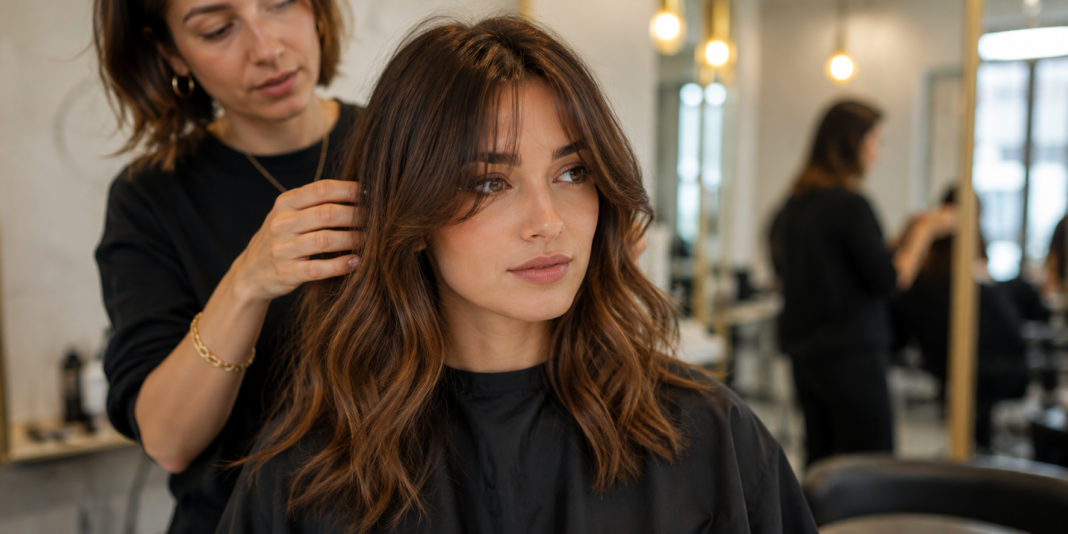

You’ve done everything right. You saved the reference photo. You showed it to your stylist. You walked out of the salon feeling like a million dollars — and then two weeks later, you realized something was slightly off. The cut looked incredible on the influencer and somehow flat on you.
Here’s the truth no one tells you: the most flattering haircut isn’t the most trending one — it’s the one designed for your specific face shape. Once you understand this, everything changes. You stop chasing cuts that were never meant for your face and start working with your natural structure instead of against it.
This guide breaks down exactly what you need to know — no fluff, no vague advice, just clear, actionable guidance for every face shape.
How to Determine Your Face Shape (The Right Way)
Before you can find your perfect haircut, you need to know your face shape with certainty — not guesswork. Here’s the most accurate method:
Pull all your hair completely back from your face using a headband or a slicked-back bun. Stand in front of a well-lit mirror. Now, using a dry-erase marker or a bar of soap, trace the outline of your face directly onto the mirror surface. Step back and look at the shape you’ve drawn.
Alternatively, take a straight-on photograph with your hair pulled back, import it into your phone, and draw the outline digitally. What you’re assessing are four key measurements:
- The width of your forehead at its widest point
- The width across your cheekbones
- The width of your jaw
- The overall length of your face from hairline to chin
The relationship between these four numbers determines your face shape — and your perfect haircut.
The Best Haircuts for an Oval Face Shape
An oval face has balanced proportions with the face slightly longer than it is wide, the cheekbones as the widest point, and a forehead and jaw that are similarly narrow. If this is you, congratulations — you have the face shape that most haircut advice is implicitly designed for.
Why oval face shapes are so versatile: Because the proportions are naturally balanced, there are very few structural concerns to work around. Nearly every cut works beautifully — the classic bob, long layered styles, the pixie, curtain fringe, and the blunt lob all look equally stunning.
What to avoid: The only styles that can work against an oval face are those that add significant width at the sides and flatten the vertical length — very wide, voluminous layers that bracket the face horizontally can disrupt the natural balance you’ve got going for you.
Best cuts for oval faces:
- Classic bob (any length)
- Long layered cut with curtain fringe
- Blunt lob (long bob)
- Pixie cut
- Beachy waves at any length
The Best Haircuts for a Round Face Shape
A round face has a width and length that are approximately equal, full cheeks, and a soft, rounded jawline without much angular definition. The goal here is simple: create the visual impression of length and direct attention toward the center of the face rather than its widest horizontal points.
Your best friend: long layers. Long layers that fall past the jaw and come to a subtle V-shape at the ends are one of the most reliably flattering options for round faces. They add the appearance of vertical elongation while the V-line draws the eye downward — instantly slimming and lengthening the face.
The power of the side part: Deep side parts add asymmetry that visually disrupts the perfect roundness of the face. This single styling change can make a significant difference — even before you touch the cut itself.
What to avoid:
- Chin-length blunt bobs that cut off exactly at the jaw’s widest point
- Full, heavy bangs that shorten the vertical plane of the face
- Very close-cropped styles that expose the full width of the head
- Styles with volume at cheek level — they emphasize width rather than length
Best cuts for round faces:
- Long layers with a V-cut at the ends
- Side-swept bangs
- Long lob with face-framing layers
- Soft curtain fringe (with volume at the roots, not the sides)
- Deep side part with any length
The Best Haircuts for a Square Face Shape
A square face is defined by a strong, angular jawline that is roughly as wide as the forehead, with minimal curve at the temples or chin. The features are often striking and well-defined — think of it as a naturally powerful bone structure that simply needs the right frame.
The goal: Soften the angularity, not eliminate it. Your strong jaw is an asset — the right haircut enhances it rather than fighting against it.
Long waves and curls are your best ally. Soft waves and curls that fall past the jaw work beautifully on square faces because their organic movement contrasts gently with the geometry of the face. The softness of the wave acts as a natural counterpoint to angular structure.
The A-line bob: Shorter at the back and longer toward the front, the A-line bob creates a soft diagonal line rather than cutting across the jaw squarely. This is one of the most flattering structured cuts for square face shapes.
What to avoid:
- Very short cuts that expose the full jawline
- Sharp geometric bobs that mirror the jaw’s angularity
- Blunt, one-length cuts at jaw level — they amplify squareness
- Center parts with straight, flat hair — they frame the jaw too symmetrically
Best cuts for square faces:
- Long waves or curls past the jaw
- A-line bob (longer in front)
- Side-swept fringe
- Soft layered lob
- Wispy, textured ends
The Best Haircuts for a Heart Face Shape
A heart-shaped face has a wider forehead — sometimes including a prominent widow’s peak — and narrows to a more delicate, pointed chin. The structural goal is to create visual width at the lower half of the face to balance the wider upper half.
The chin-length bob is a classic for a reason. The weight of the cut sits exactly where it’s needed — at jaw level — creating the visual width that balances a narrower chin. It’s one of the most consistently flattering cuts for heart face shapes across all hair textures.
Volume below the ear: Medium-length waves with volume in the lower half of the style, wispy fringe that softens the forehead, and cuts with fullness below the ear all achieve the same goal — balancing the wider upper half with visual weight at the bottom.
What to avoid:
- High, voluminous blowouts at the crown — they exaggerate the top-heavy proportion
- Very short sides with volume at the top
- Styles that leave the jaw area completely flat with all volume at the temple
- Very heavy, full bangs that add even more visual weight to the forehead
Best cuts for heart faces:
- Chin-length bob
- Medium waves with lower volume
- Wispy, side-swept fringe
- Lob with fullness below the ear
- Long layers with a side part
Why Hair Texture Matters as Much as Face Shape
Here’s the part most face shape guides skip — and it’s arguably the most important part. Face shape analysis only gets you halfway to a flattering haircut.
Hair texture — including thickness, density, wave pattern, and porosity — determines how any given cut actually behaves in real life. And it can completely change the result.
A curtain fringe is ideal for many round faces in theory. But on fine, straight hair without natural volume, the same fringe can look flat and actually emphasize width rather than reduce it. A V-cut that creates gorgeous length and lightness in thick, straight hair creates a limp, bottom-heavy triangle in fine, layered hair.
The most productive salon conversations happen when you come prepared to discuss both your face shape and your specific hair texture. Your reference photos should feature people who share both characteristics — not just the face shape alone.
When you bring a photo of someone with an oval face and thick, wavy hair to your stylist, and your face is round with fine, straight hair, you are essentially asking for a translation that may not work. The more specific your reference, the closer your result.
A Quick Reference Guide: Face Shape vs. Best Haircut
| Face Shape | Best Cuts | Avoid |
|---|---|---|
| Oval | Almost anything — bob, lob, pixie, layers | Very wide horizontal volume |
| Round | Long layers, V-cut, side part, side-swept fringe | Chin-length blunt bobs, heavy bangs |
| Square | Long waves, A-line bob, side-swept fringe | Geometric bobs, very short cuts |
| Heart | Chin-length bob, lower volume waves, wispy fringe | High volume at crown, very short sides |
Final Thoughts: The Right Haircut Starts with Knowing Your Face
The best haircut you’ll ever get isn’t the one trending on Pinterest right now — it’s the one that was designed for your specific face shape, your hair texture, and the way you actually live your life. Rules exist to give you a starting point, not a ceiling.
Use the face shape framework as your foundation. Bring reference photos that reflect your actual hair texture. Tell your stylist what you love and what you want to change. And remember: the most flattering haircut is always the one that makes you feel like the most confident version of yourself.
Save this guide for your next salon appointment, share it with a friend who’s been stuck in the same haircut for years, and explore more beauty and style guides at egella.com