

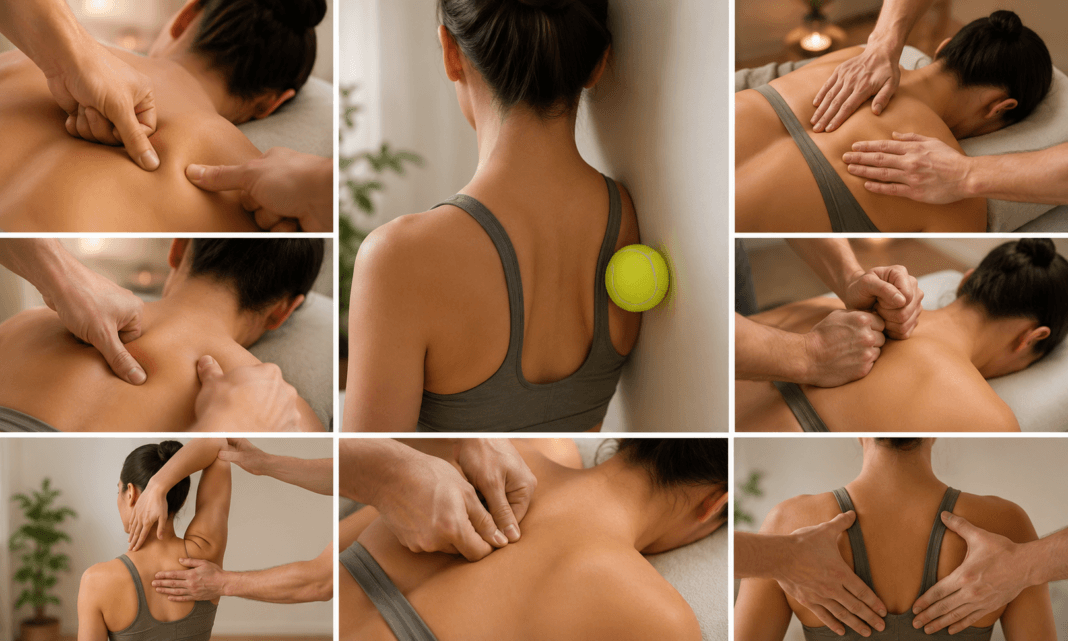

These upper back massage techniques target exactly where desk tension settles: the band of muscle running between your shoulder blades, across the trapezius, and up into the base of the neck. If you’ve ever finished a workday feeling like your upper back has turned to concrete, these seven techniques address that pattern directly — and most of them require nothing more than your hands, a wall, and a tennis ball.
Quick Summary: These 7 upper back massage techniques work from the surface muscles inward, starting with gentle effleurage strokes and building to deeper trigger point work. They target the trapezius, rhomboids, and the muscles along the thoracic spine — the areas most affected by prolonged sitting and forward-leaning posture. Short on time? Start with techniques 1, 4, and 7 for a five-minute version.
This guide covers all seven techniques with clear instructions, the muscles each one targets, common mistakes that reduce their effectiveness, and when self-massage isn’t enough.
Editor’s Note: The biggest mistake we made when trying upper back self-massage for the first time was pressing directly on the spine. Not only did it feel wrong — it produced no relief at all. The muscles that hold desk tension sit to either side of the spine, roughly in the channel between the spine and the inner edge of the shoulder blade. That’s where every technique in this guide focuses, and it’s the detail that makes the difference between a technique that works and one that doesn’t.

Why Upper Back Tension Builds — And Why It’s So Hard to Shift
The upper back bears a disproportionate load from desk work. Long periods of sitting change how muscles and joints behave — tight chest muscles and upper traps combined with weak deep neck flexors and lower scapular stabilizers create a forward-head, rounded-shoulder posture that keeps the upper back muscles in a state of sustained, low-level contraction for hours at a time.
The muscles most affected — the trapezius, rhomboids, and levator scapulae — develop what are called trigger points: small, irritable knots within the muscle that can refer pain to other areas. An active trigger point between your shoulder blades can cause pain in your neck near the base of your skull — which explains why upper back tension so often shows up as neck pain or headaches rather than back pain specifically.
Upper back massage works on this pattern from the outside in: effleurage strokes warm the tissue, kneading increases circulation, and sustained pressure on trigger points helps the muscle release its held contraction. The result is temporary but real — and with consistent practice, the relief tends to last longer.

Signs Your Upper Back Needs Attention
- A feeling of tightness or “brickness” across the mid and upper back by afternoon
- Tension that runs from the shoulder blades up into the neck and base of the skull
- Shoulders that round forward and feel difficult to pull back
- A sense that deep breaths feel restricted or require effort
- Referred discomfort into the arms or headaches that begin at the back of the neck
7 Upper Back Massage Techniques That Actually Work

1. Shoulder Knead (Self-Massage Warm-Up)
Reach one hand across your body to the opposite shoulder. Using your fingers and palm, squeeze and knead the muscles. If it feels good, you can even massage up into the neck. This is the natural starting point for any upper back self-massage session — it requires no tools and immediately increases circulation in the upper trapezius.
Work each side for 30 to 60 seconds before moving to deeper techniques. Think of this as warming the tissue rather than releasing it — the release comes later.
Targets: Upper trapezius, shoulder junction.

2. Cross-Body Cat Stretch Press
Round your back and reach both arms across your body, similar to the “cat” pose in yoga. Feel a stretch in your upper back and continue to knead with your fingertips. This combines passive stretching with active pressure, reaching the rhomboids and mid-trapezius that hands-on shoulder kneading can’t easily access.
Hold the rounded position for five seconds, knead with the fingertips, then release. Repeat eight to ten times.
Targets: Rhomboids, mid-trapezius, between the shoulder blades.

3. Tennis Ball Against the Wall
For upper back release, the wall works better than the floor. It gives you more control over pressure and is easier on some smaller muscle groups. Don’t press directly on your spine or shoulder bones; stick to the soft tissue between your spine and shoulder blade.
Stand with your back to a wall, place a tennis ball between your upper back and the wall, and lean into it gently. Find a tender spot and hold for eight to ten seconds without rolling — sustained pressure works better than movement on trigger points. Then shift slightly to an adjacent spot.
Targets: Rhomboids, mid and lower trapezius, trigger points between shoulder blades.
4. Two-Ball Thoracic Release
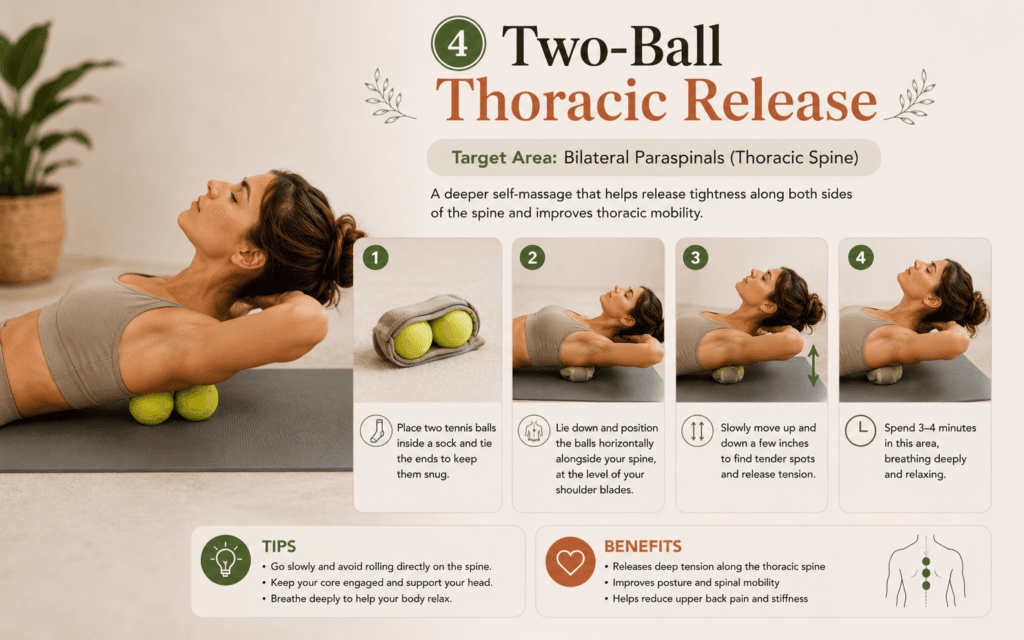
Place two tennis balls in a sock, side by side, and tie the end. Position them so one ball sits on each side of the thoracic spine, resting on the paraspinal muscles. Sit against a wall or lie on the floor. Allow your weight to rest into the balls for 20 to 30 seconds per position, then shift slightly upward toward the shoulder blades.
This technique targets both sides of the upper back simultaneously and is particularly effective for releasing the long, vertical muscles that run alongside the spine — an area individual trigger point work struggles to cover evenly.
Targets: Bilateral paraspinal muscles, thoracic erectors.

5. Effleurage Long Strokes (Partner Technique)
Swedish massage involves long, flowing strokes, gentle kneading, and rhythmic tapping. For those dealing with stress-related upper back pain, it offers a soothing way to loosen muscle fibres without causing discomfort. If someone is massaging your upper back, starting with long, smooth strokes from the lower shoulder blades upward along each side of the spine — rather than beginning with deep pressure — warms the tissue and makes every subsequent technique more effective.
Three to four minutes of effleurage before any deeper work is not a luxury — it’s what allows the deeper techniques to produce lasting release rather than defensive tightening.
Targets: Full upper back surface, warming and circulation.
6. Trigger Point Sustained Pressure
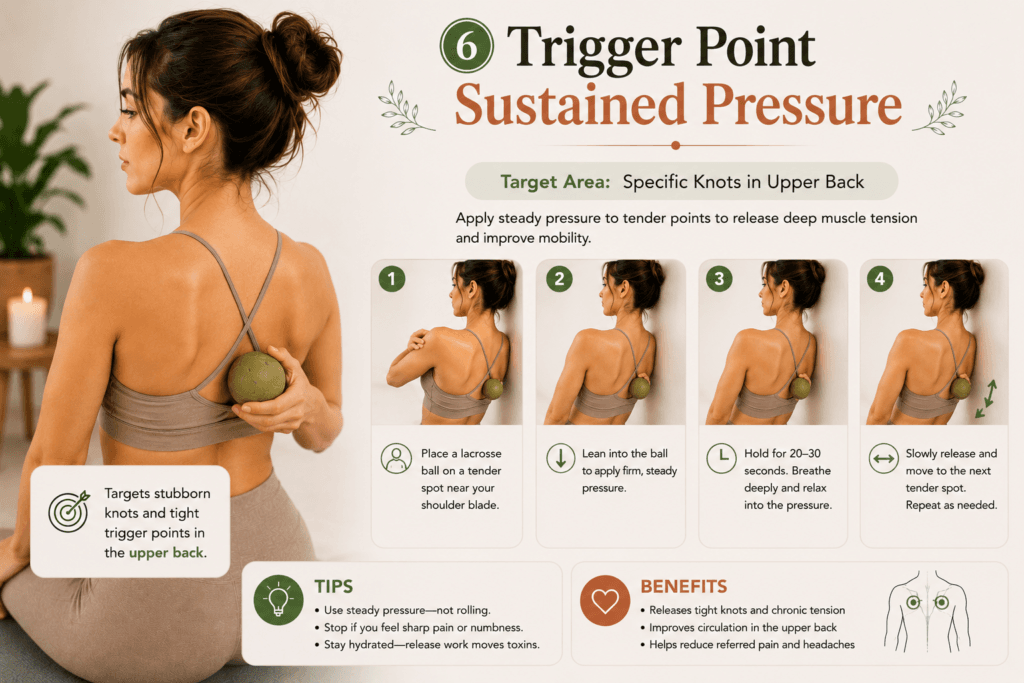
A trigger point massage uses deep pressure on targeted areas of the muscle. You’ll want to use a small, hard massage tool, like a lacrosse ball, to help work on trigger points. Focus on areas that are tight, with the intention of alleviating pain in a nearby area.
Locate a tender spot in the upper back — typically just inside the shoulder blade or between the blade and the spine. Apply firm, sustained pressure using a lacrosse ball against the wall, holding for 20 to 30 seconds without movement. The discomfort should be a “hurts so good” sensation, not sharp pain. Release slowly.
Targets: Specific trigger points in trapezius and rhomboids.
7. Scapular Retraction Finish
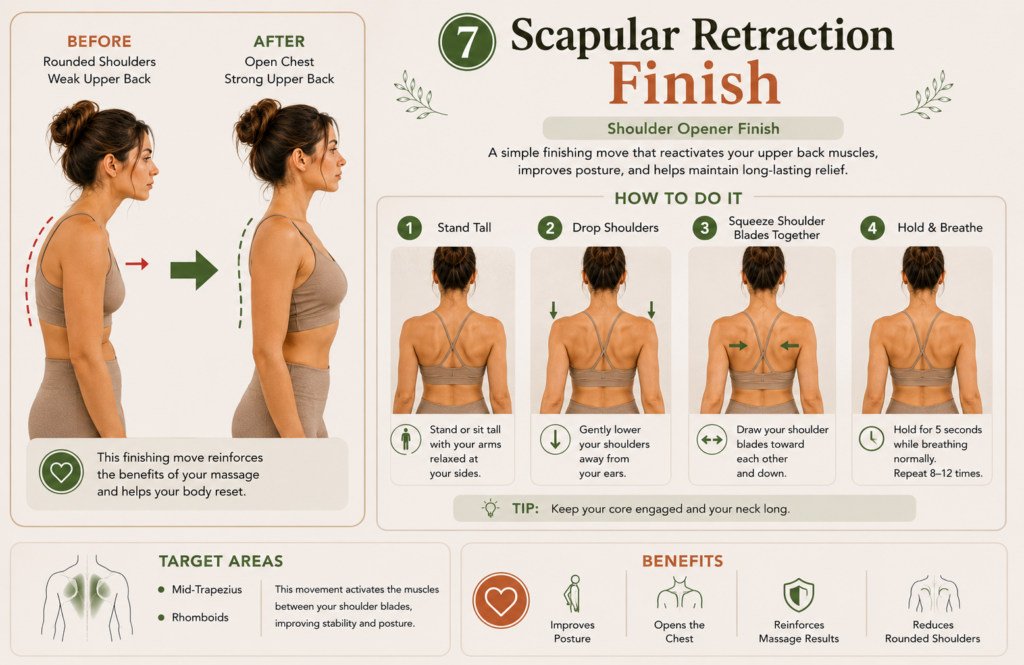
Sit tall and squeeze shoulder blades together and down as if pinching a small ball between them. Hold 5 seconds. Repeat 10 to 15 times. This isn’t a massage technique in the traditional sense — it’s an active finishing movement that resets the shoulder blade position after the passive release work of the previous techniques.
Ending an upper back massage session with scapular retraction helps the muscles settle into a more neutral position rather than returning immediately to the rounded, forward pattern. It’s a two-minute addition that extends the benefit of everything that came before it.
Targets: Mid-trapezius, rhomboids, scapular stabilizers.
Editor’s Note: A question we hear consistently is whether these techniques need to be done in order, or whether picking one or two is enough. For occasional tension, techniques 3 (tennis ball) and 7 (scapular retraction) alone produce noticeable results and take under five minutes. For significant accumulated tension — the kind that builds after weeks of desk work without any release — working through the sequence from 1 to 7 at least once produces a meaningfully deeper result than individual techniques in isolation.
Common Mistakes That Reduce Effectiveness
- Pressing on the spine itself: The spine is bone — pressure on it produces no muscular release and can cause discomfort. All pressure should go on the soft tissue to either side of the vertebrae
- Moving too fast over trigger points: Rolling continuously over a tender spot stimulates rather than releases it. Sustained, still pressure held for 20 to 30 seconds is what produces actual release
- Skipping the warm-up: Starting with a lacrosse ball on cold, tight muscle tissue tends to cause the muscle to tense defensively. Even two minutes of shoulder kneading beforehand changes how the deeper techniques feel
- Using too much pressure immediately: Upper back massage works on a pressure scale of 5 to 7 out of 10 — enough to feel firm but not enough to cause sharp pain or cause you to hold your breath
- Doing it only when pain is severe: Regular short sessions — ten minutes, three to four times per week — produce significantly better results than occasional long sessions during a crisis
Who These Upper Back Massage Techniques Are Best For
Best for: desk workers experiencing daily upper back and shoulder tension, people already using Shoulder Stretches for Desk Work or T-Spine Mobility Exercises who want to add a massage component, those wanting a self-care habit between professional massage appointments, and anyone whose upper back tension shows up as neck stiffness or base-of-skull discomfort.
Less ideal for: anyone with a diagnosed thoracic spine condition, recent injury, herniated disc, or significant structural back problem — in these cases, a registered massage therapist or physiotherapist should guide the appropriate technique rather than self-massage guidance.
If your tension is mild and clearly desk-related, techniques 1, 3, and 7 — shoulder knead, tennis ball wall release, and scapular retraction — cover the three most accessible and highest-impact areas in under five minutes.
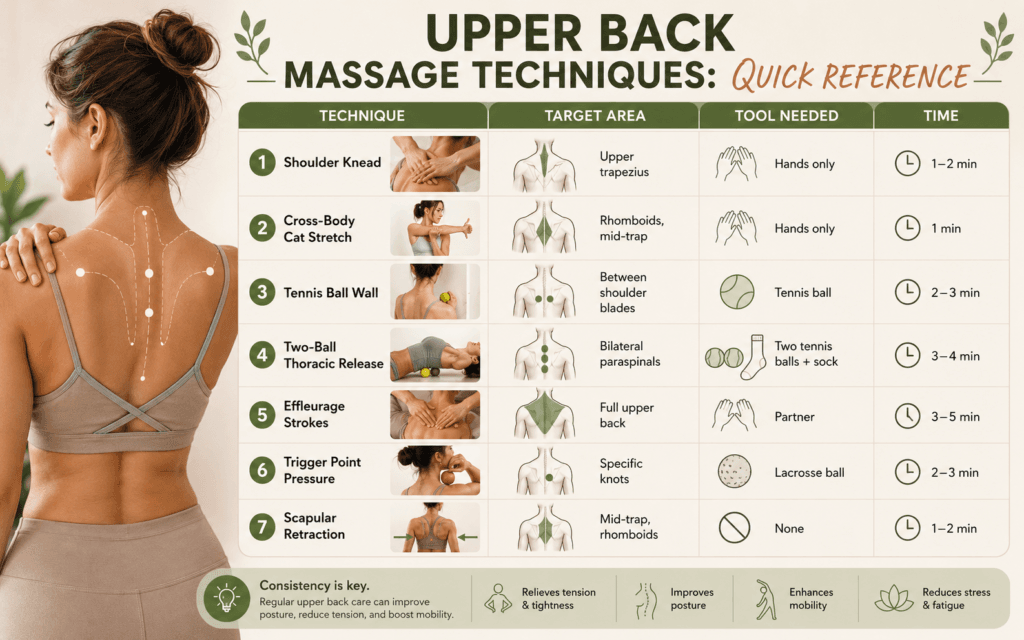
Upper Back Massage Techniques: Quick Reference
| Technique | Target Area | Tool Needed | Time |
|---|---|---|---|
| Shoulder Knead | Upper trapezius | Hands only | 1–2 min |
| Cross-Body Cat Stretch | Rhomboids, mid-trap | Hands only | 1 min |
| Tennis Ball Wall | Between shoulder blades | Tennis ball | 2–3 min |
| Two-Ball Thoracic Release | Bilateral paraspinals | Two tennis balls + sock | 3–4 min |
| Effleurage Strokes | Full upper back | Partner | 3–5 min |
| Trigger Point Pressure | Specific knots | Lacrosse ball | 2–3 min |
| Scapular Retraction | Mid-trap, rhomboids | None | 1–2 min |
Frequently Asked Questions About Upper Back Massage
How often should I do upper back massage techniques at home?
Three to four times per week is a realistic and effective frequency for ongoing desk-related tension. Daily sessions are fine for the gentler techniques like shoulder kneading and scapular retraction, while deeper trigger point work benefits from a day of rest between sessions.
Can upper back massage help with tension headaches?
It can — trigger points in the upper trapezius and rhomboids frequently refer pain into the neck and base of the skull. Releasing these points through sustained pressure often reduces referred discomfort in those areas, including some tension-type headaches. If headaches are frequent or severe, a healthcare provider should evaluate the cause.
Is it safe to use a massage gun on the upper back?
With care, yes — but avoid using a massage gun directly on the spine or shoulder bones, and use the lowest intensity setting on the upper back to start. Massage guns work best on larger muscle masses and can be too aggressive for the smaller, more delicate muscles between the shoulder blades.
What’s the difference between upper back massage and back massage?
Upper back massage specifically targets the thoracic region — from the base of the neck to roughly the middle of the back — including the trapezius, rhomboids, and muscles alongside the thoracic spine. General back massage covers a broader area including the lower back, which involves different muscles and different techniques.
Final Thoughts: Ten Minutes of Upper Back Massage Changes How the Rest of Your Day Feels
These seven upper back massage techniques won’t undo the effects of poor posture overnight — but ten minutes of consistent, targeted release work several times a week produces a noticeable and cumulative difference in how the upper back feels by the end of a desk-heavy day. Start with the tennis ball wall technique and the shoulder knead, add more as the routine becomes familiar, and pair it with Shoulder Stretches for Desk Work for a complete desk-tension toolkit.
Save this guide, try the tennis ball technique tonight, and explore more wellness guides at egella.com
Which upper back technique works best for you? Tell us in the comments below.