

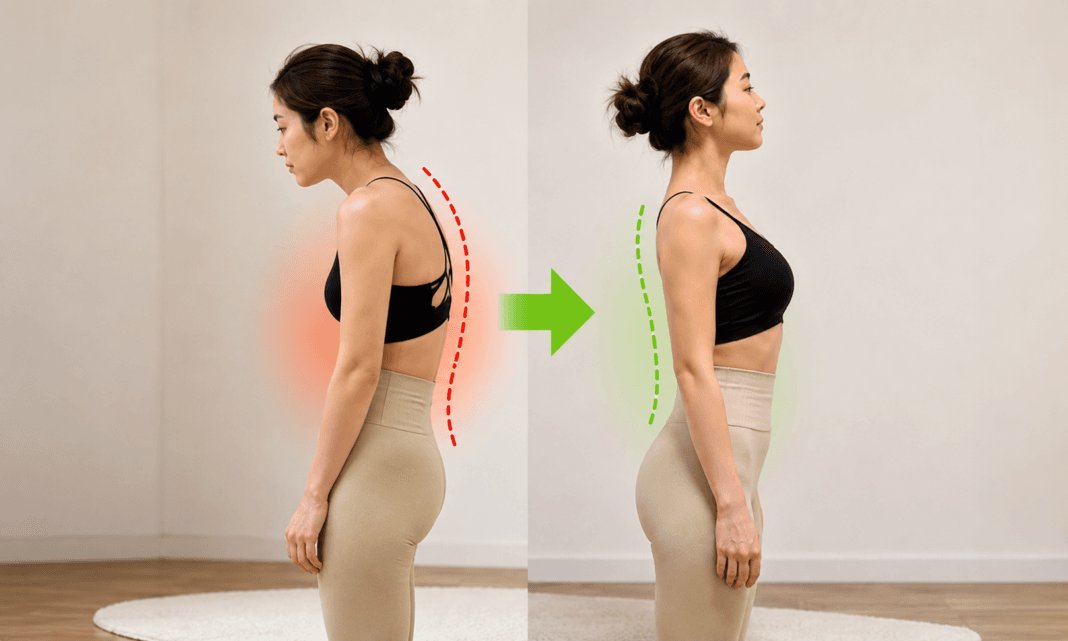

These posture correction exercises address something most people try to fix from the wrong direction. Rounded shoulders, a head that drifts forward, tension that never fully leaves the upper back — most people assume these are separate problems requiring separate solutions. They are not. They are the same pattern, playing out in different places, and they tend to share a common cause: the static, forward-leaning posture that builds up over hours of sitting, screens, and low-movement days.
Quick Summary: Six floor exercises targeting rounded shoulders, forward head posture, upper back stiffness, and glute weakness — the four most common consequences of prolonged sitting. No equipment needed. The full routine takes approximately 10 minutes. Short on time? Start with moves 1, 3, and 6 — chest, neck, and glutes — for a five-minute version that covers the highest-impact areas.
This guide covers six floor-based moves in sequence, what they’re actually correcting, the mistakes that make them less effective, and how to build them into a realistic daily routine.
Editor’s Note: We went into this routine expecting the floor-based moves to feel like the least interesting part. The opposite was true. Move 1 — the camel pose chest opener — produced an immediate, noticeable release in the upper chest that we had not felt from standing stretches. The key turned out to be the hold time: five seconds per rep, not a quick bounce. The difference in how the stretch felt with a held versus rushed tempo was significant enough that we would call it the single most important variable in this routine.
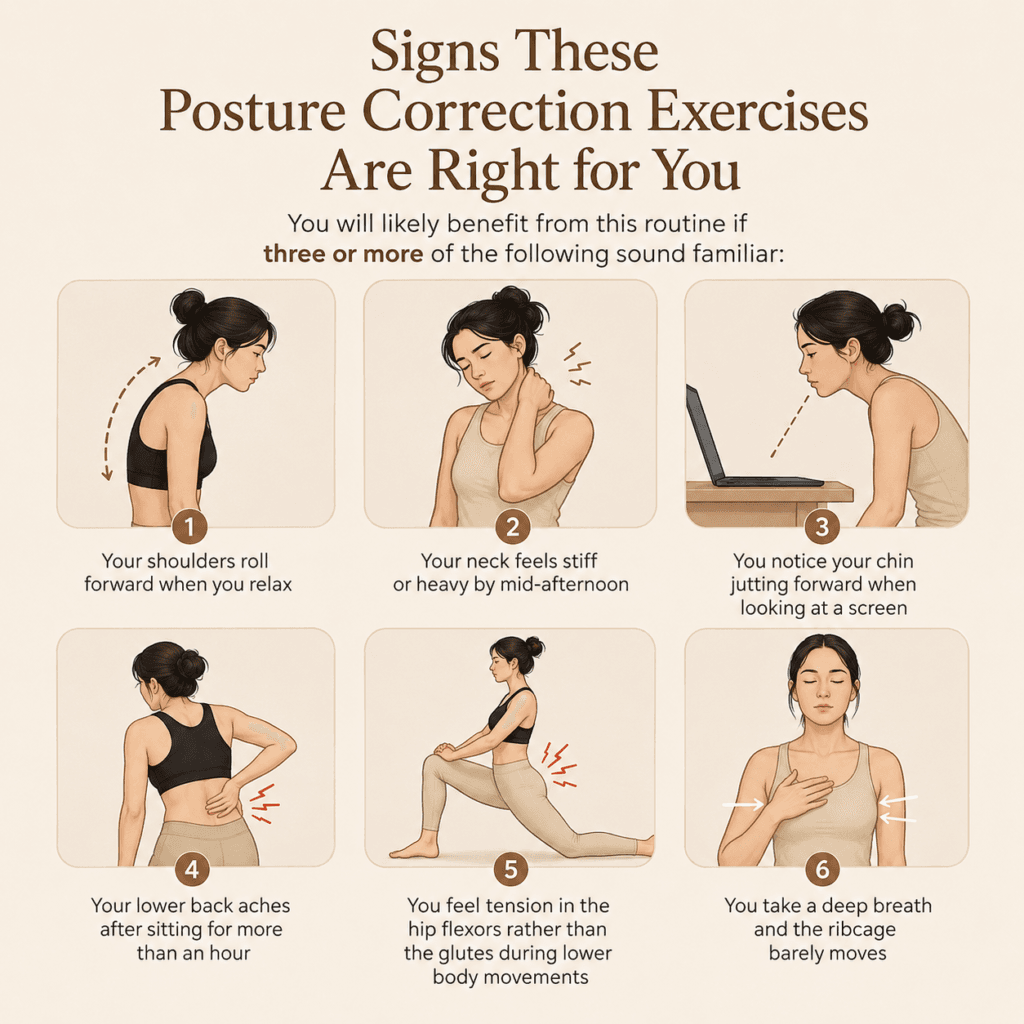
Signs These Posture Correction Exercises Are Right for You
You will likely benefit from this routine if three or more of the following sound familiar:
- Your shoulders roll forward when you relax
- Your neck feels stiff or heavy by mid-afternoon
- You notice your chin jutting forward when looking at a screen
- Your lower back aches after sitting for more than an hour
- You feel tension in the hip flexors rather than the glutes during lower body movements
- You take a deep breath and the ribcage barely moves
What These Posture Correction Exercises Actually Target
Before getting into the exercises, it helps to understand what they are correcting — because the visible symptoms are downstream effects of a postural pattern, not isolated problems.
Rounded shoulders and a tight chest develop when the muscles across the front of the chest become shortened from sustained forward-leaning posture, while the muscles between the shoulder blades weaken from underuse. The result is the characteristic forward-caved upper body that most people recognize in themselves by afternoon.
Forward head posture is closely related. For every inch the head drifts forward of its neutral position, the effective load on the cervical spine increases significantly — meaning a head that sits two inches forward creates dramatically more strain on the neck than one sitting directly above the shoulders.
Glute weakness and anterior pelvic tilt often accompany rounded-shoulder posture — the hips tilt forward, the lower back arches, and the glutes disengage. Strengthening the posterior chain directly counteracts this pattern, which is why glute work belongs in a posture routine rather than only in a lower body workout.
6 Posture Correction Exercises — Step by Step
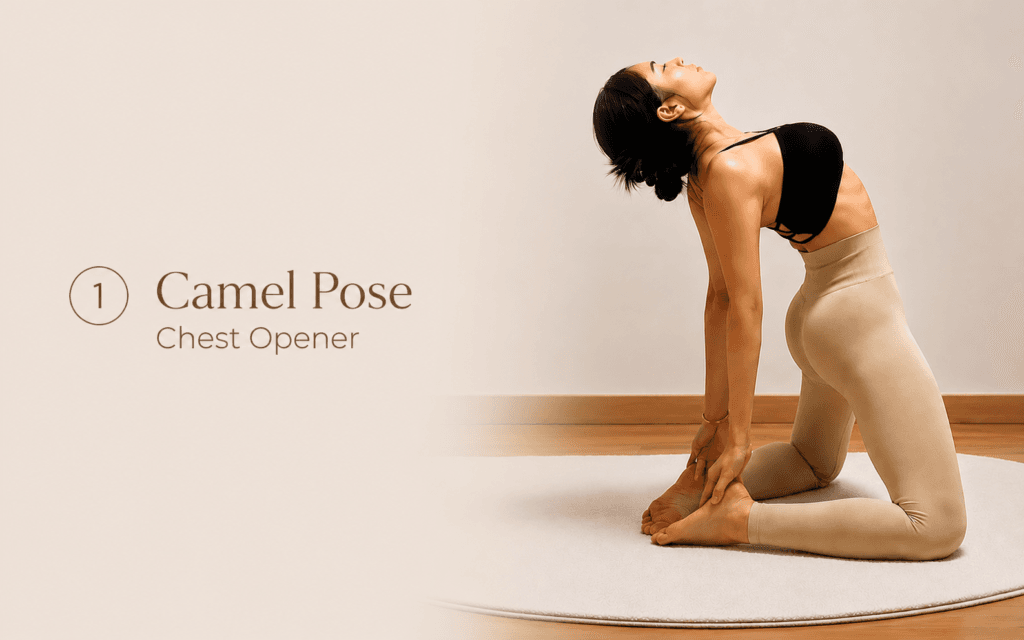
Move 1 — Camel Pose Chest Opener
Begin kneeling with hips over knees. Place hands on your lower back or reach back to hold your heels. Lift your chest toward the ceiling, draw your shoulder blades together, and let your head follow the extension naturally — not dropping back aggressively, but allowing a gentle opening through the throat and upper chest. Hold five seconds, then return to neutral slowly.
This targets rounded shoulders and chest tightness most directly and responds well to deliberate, slow repetitions rather than quick pulses.
Sets/reps: x10, hold 5 seconds each.
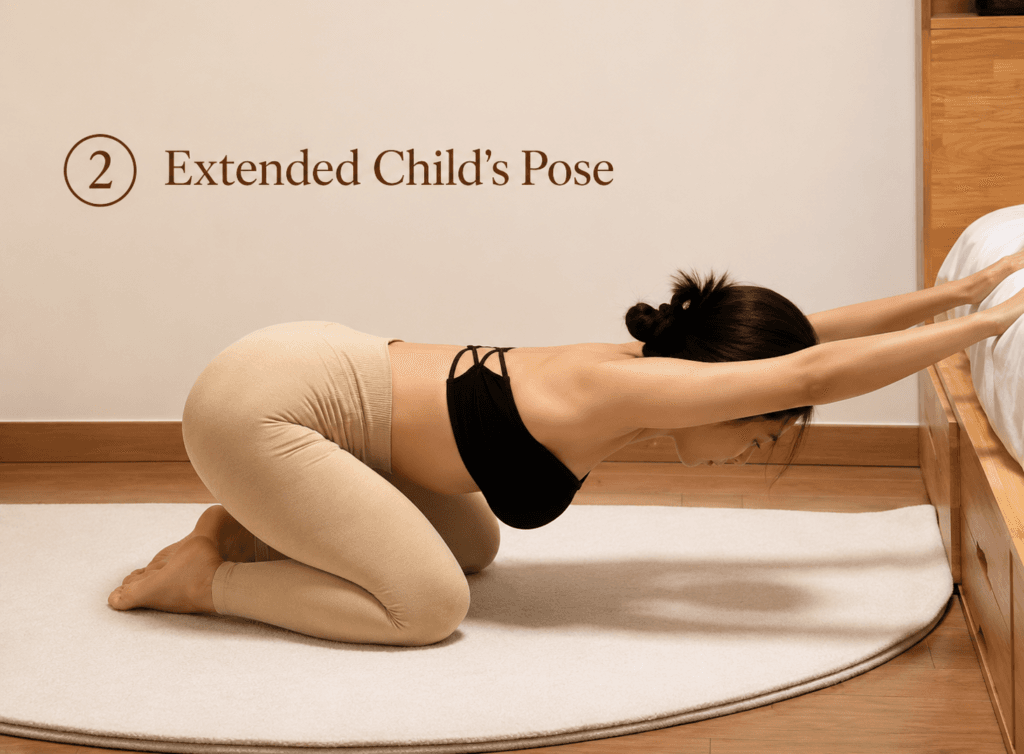
Move 2 — Extended Child’s Pose
From all fours, walk your hands forward and lower your chest toward the floor, keeping hips over or behind your knees. Arms extend fully in front, forehead resting on the mat. Allow your upper back to relax completely into the stretch — passive release rather than active effort.
This counterbalances the chest opener by stretching the lats and upper back in the opposite direction and gently decompresses the thoracic spine.
Sets/reps: x10, hold 5 seconds each.
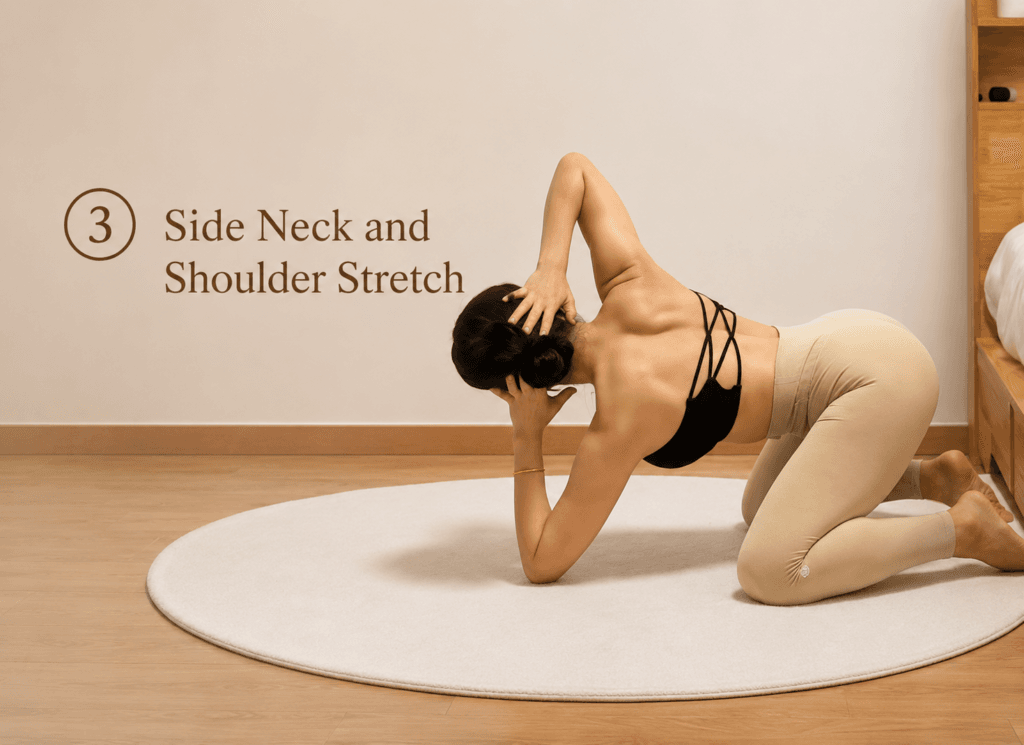
Move 3 — Side Neck and Shoulder Stretch
From all fours, bring one hand behind your head with the elbow pointing out to the side. Rotate your upper body so the elbow moves toward the ceiling, then slowly lower it back down. Keep your hips stable and let the movement come from the thoracic spine and shoulder rather than the lower back.
This targets the lateral neck, top of the trapezius, and shoulder blade area — the zones most commonly loaded by screen work.
Sets/reps: x20, hold 3 seconds at the top of each rotation.
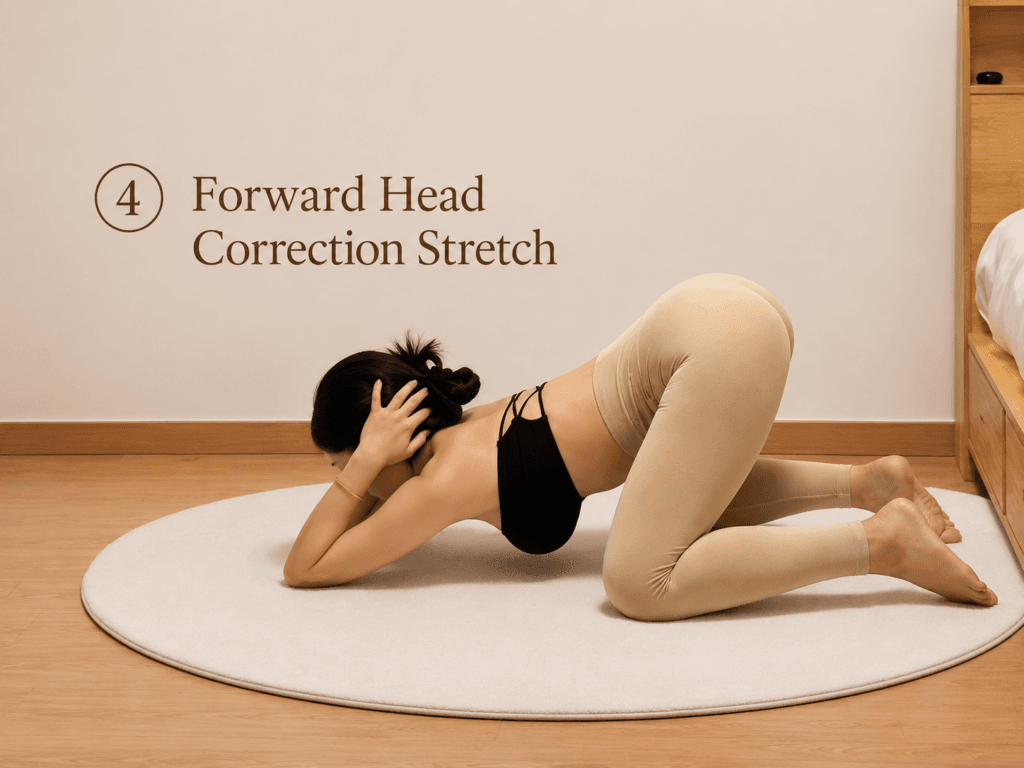
Move 4 — Forward Head Correction Stretch
Still on all fours, interlace your hands behind your head. Tuck your chin gently toward your chest, feeling the stretch across the back of the neck and upper cervical spine. Hold five seconds, then release.
This is a direct countermovement to forward head posture — it lengthens the muscles at the base of the skull that become chronically shortened when the head sits in a forward position. Keep hand pressure gentle rather than pulling forcefully.
Sets/reps: x10, hold 5 seconds each.
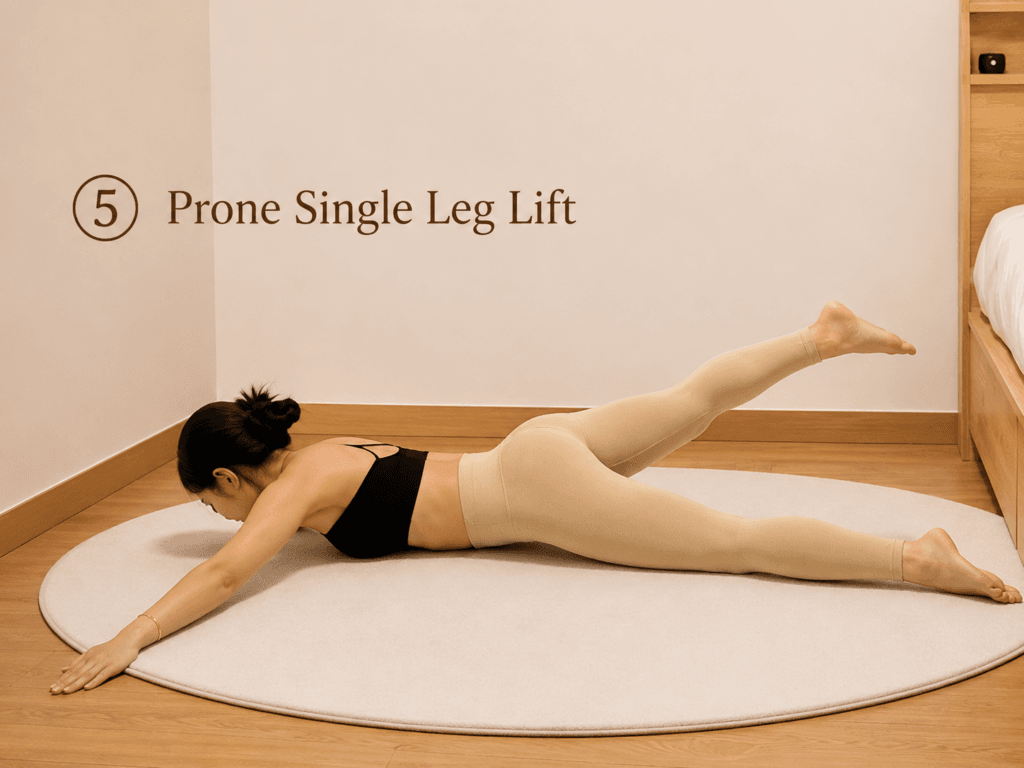
Move 5 — Prone Single Leg Lift
Lie face down with arms extended along your sides. Keeping your hips level and core lightly engaged, lift one leg a few inches off the floor — knee straight — and hold. Lower slowly and repeat on the other side.
This targets the glutes and posterior chain from a position that prevents the lower back from compensating, which is a common problem in standing glute exercises when the hip flexors are tight.
Sets/reps: x10 each side, hold 7 seconds each.
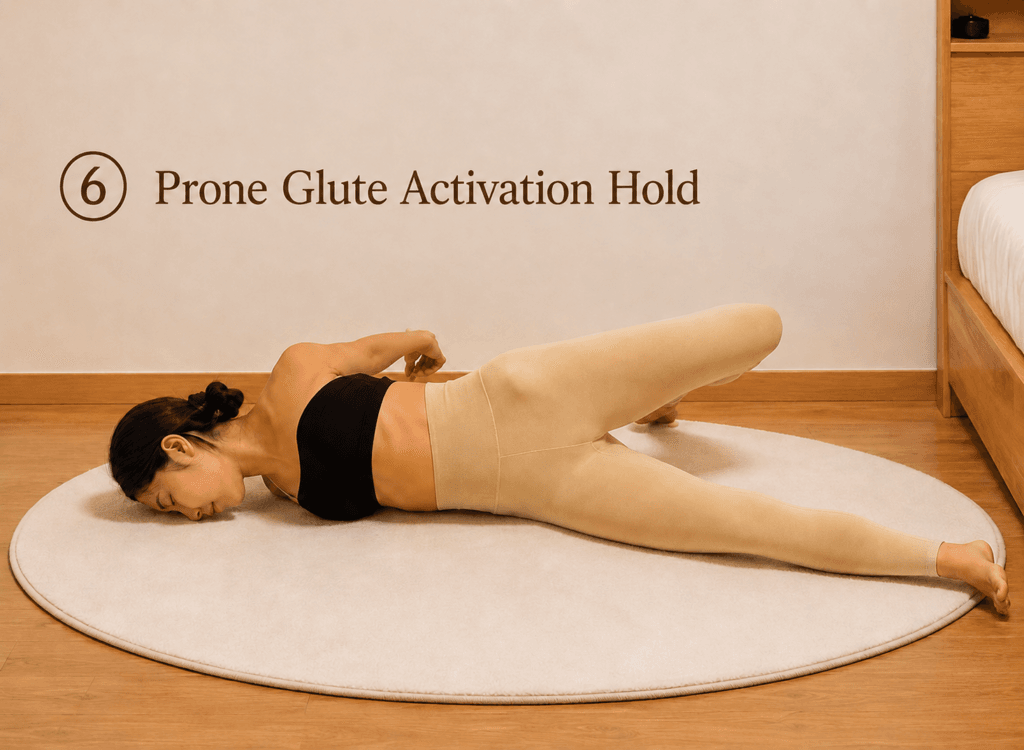
Move 6 — Prone Glute Activation Hold
Lie face down with your forehead resting comfortably on the floor. Keep one leg extended and slowly lift it a few inches while allowing a slight outward angle from the hip. Focus on squeezing the glute rather than arching the lower back. Hold for 10 seconds, then lower with control and repeat on the other side.
This movement helps activate the glutes — muscles that often become underactive from prolonged sitting. Improved glute engagement can reduce compensation through the lower back and support better pelvic alignment during standing and walking.
Sets/reps: Hold 10 seconds, x8 to x10 repetitions.
Editor’s Note: The most common reason people stop floor-based posture routines after a week is that they do not see visible change quickly enough. What actually changes first — and what keeps most people going — is how the body feels: less neck heaviness by afternoon, shoulders that do not pull forward as urgently, deeper breaths that feel less effortful. These shifts typically appear within the first ten days of consistent practice. The visible postural changes take longer, usually six to eight weeks, but they build on the functional improvements that come first.
Common Mistakes That Reduce Effectiveness
- Rushing the hold times: Every move specifies a hold duration. The muscles targeted here respond to time under tension rather than speed. A five-second hold done slowly recruits significantly more muscle fiber than a quick pulse — the holds are what make this routine work
- Moving from the lower back instead of the target area: In moves 1, 3, and 4, the lower back will try to compensate if the target area is stiff. Keep the lower back relatively neutral and consciously initiate movement from the shoulder blades and ribcage
- Skipping the prone moves: Moves 5 and 6 are among the most important. Glute weakness drives anterior pelvic tilt, which contributes to the forward-leaning posture the upper body moves compensate for — missing them makes the routine incomplete
- Only doing the routine on bad days: Posture correction works through accumulated small inputs. Daily consistency produces results that occasional longer sessions simply do not replicate
How to Build This Into Your Day
Morning (10 minutes): The full six-move sequence works well immediately after waking, before sitting down for the day. It gives the body a full range of motion before the day’s posture patterns begin to set in.
Midday break (5 minutes): Moves 1, 3, and 6 cover chest, neck, and glutes in five minutes and work well as a desk-break reset alongside Shoulder Stretches for Desk Work.
Evening (10 minutes): The prone moves pair naturally with Back Massage Techniques or T-Spine Mobility Exercises as part of a longer evening floor routine.
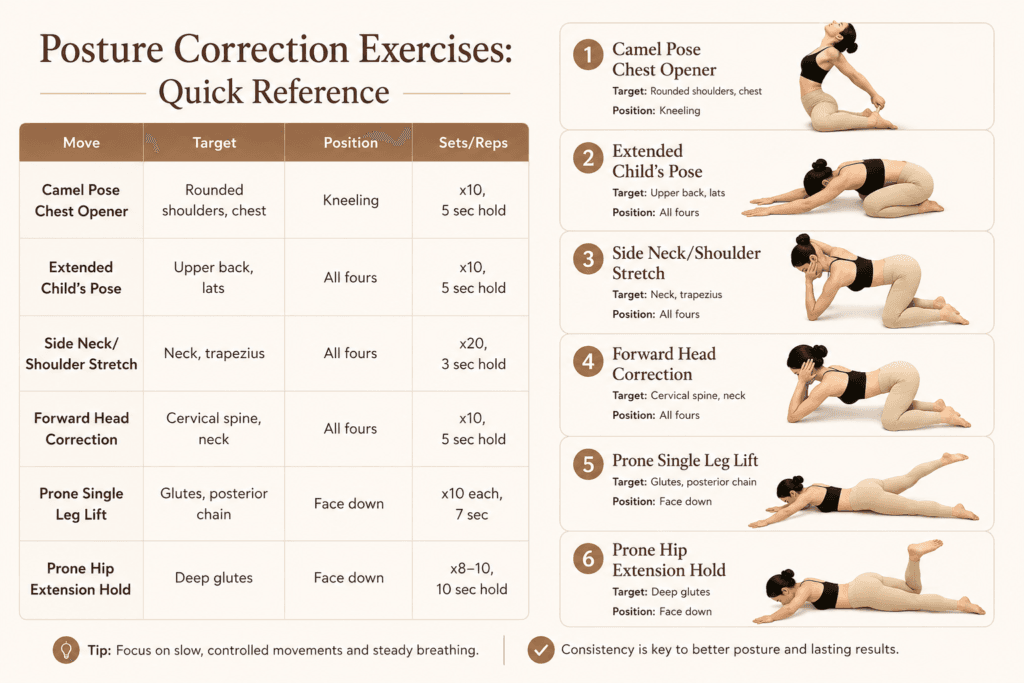
Posture Correction Exercises: Quick Reference
| Move | Target | Position | Sets/Reps |
|---|---|---|---|
| Camel Pose Chest Opener | Rounded shoulders, chest | Kneeling | x10, 5 sec hold |
| Extended Child’s Pose | Upper back, lats | All fours | x10, 5 sec hold |
| Side Neck/Shoulder Stretch | Neck, trapezius | All fours | x20, 3 sec hold |
| Forward Head Correction | Cervical spine, neck | All fours | x10, 5 sec hold |
| Prone Single Leg Lift | Glutes, posterior chain | Face down | x10 each, 7 sec |
| Prone Hip Extension Hold | Deep glutes | Face down | x8–10, 10 sec hold |
Who These Posture Correction Exercises Are Best For
Best for: anyone who sits for most of the working day, people who notice their shoulders rounding forward by afternoon, those combining this with T-Spine Mobility Exercises or Shoulder Stretches for Desk Work as part of a broader posture practice, and anyone who wants a floor-based, no-equipment routine that addresses upper and lower body together.
Less ideal for: anyone with a diagnosed spinal condition, a recent back or neck injury, or any movement that causes sharp or worsening pain — in those cases, a physiotherapist should design the appropriate program rather than a general exercise guide.
If starting from scratch, moves 1, 3, and 6 — chest, neck, and glutes — make a strong five-minute starting point before adding the full six-move sequence.
Frequently Asked Questions About Posture Correction Exercises
How long does it take to see results from posture correction exercises?
Most people notice functional changes — less afternoon neck tension, shoulders that don’t pull forward as insistently — within one to two weeks of daily practice. Visible postural change typically takes six to eight weeks of consistent daily work.
Can I do this routine every day?
Yes. This routine uses low-load, sustained-hold movements that don’t create muscle fatigue requiring recovery days. Daily consistency produces significantly better results than occasional longer sessions.
Do I need a mat?
A yoga or exercise mat makes the prone moves more comfortable, but any carpeted surface works. The kneeling and all-fours positions can also be done on a folded blanket if knee comfort is a consideration.
Will these exercises help with lower back pain?
Indirectly, for many people. Rounded shoulders, forward head posture, and weak glutes all contribute to lower back strain through compensatory patterns. Correcting these upstream issues often reduces lower back discomfort over time — however, if lower back pain is significant or persistent, consult a healthcare provider before starting any new routine.
How often should I do this routine to see posture improvement?
Daily is ideal, even if only the five-minute version (moves 1, 3, and 6). Consistency matters far more than duration — ten minutes every day outperforms thirty minutes twice a week for postural change.
Final Thoughts: Ten Minutes That Change How Your Body Feels
These six posture correction exercises won’t undo years of forward-leaning habits overnight — but ten minutes a day, done consistently, has a disproportionate effect on how the neck, shoulders, and lower back feel. The chest opener loosens what sitting tightens, the glute holds strengthen what sitting switches off, and the neck stretches address the head-forward drift that most people have stopped noticing entirely.
Start with the camel pose tonight, work through the full sequence tomorrow morning, and save this for your daily floor routine.
Which move surprised you most? Tell us in the comments below.
Explore more posture and wellness guides at egella.com