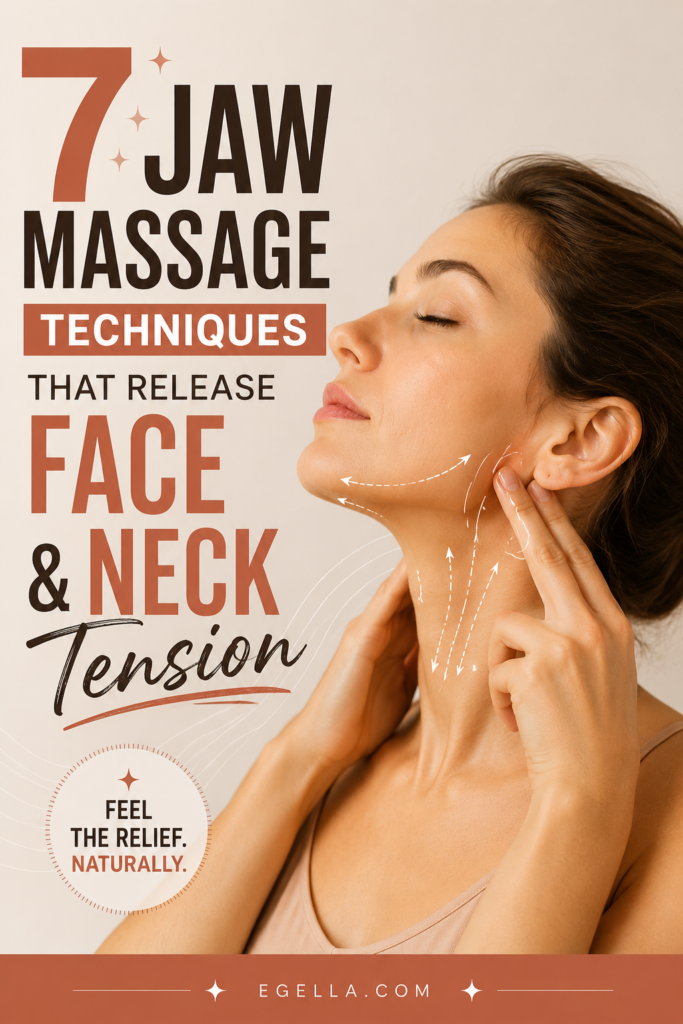
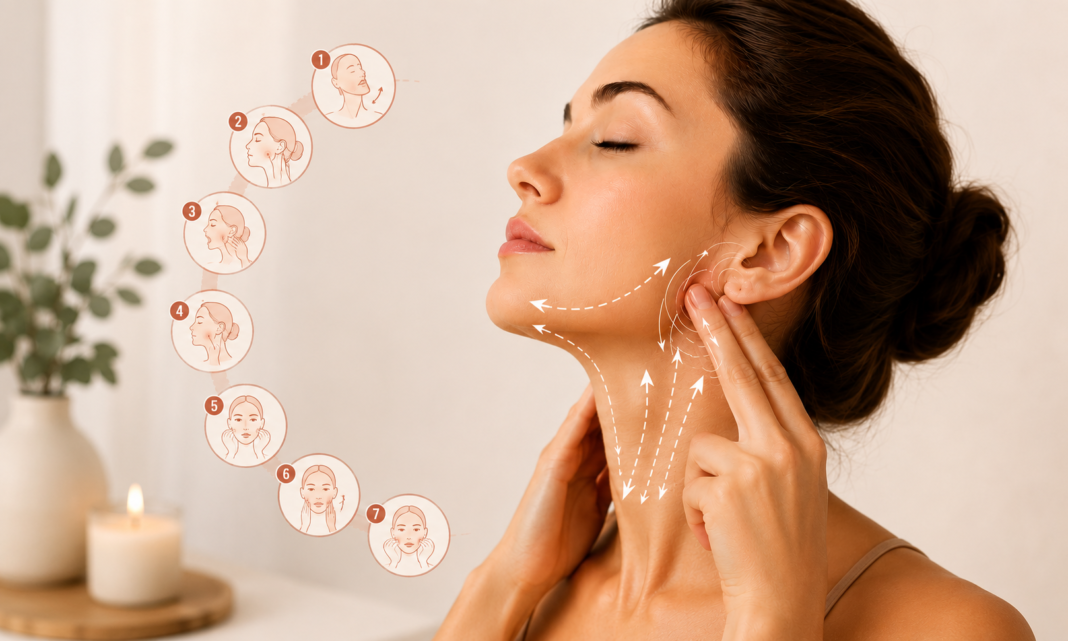
These jaw massage techniques address one of the most overlooked areas where the body holds daily tension. The jaw doesn’t work in isolation — tightness in the masseter and temporalis muscles connects directly to the neck, temples, and upper back, which is why jaw tension so often shows up as headaches, ear discomfort, or a face that feels generally heavy and contracted by the end of a long day.
Quick Summary: These 7 jaw massage techniques work through the masseter, temporalis, mandible, and connected neck muscles to release the holding patterns that build up from stress, clenching, and screen time. All techniques use hands only, take 5 to 10 minutes total, and work best done gently — pressure is never the goal here, release is. Short on time? Techniques 1, 3, and 6 cover the three highest-impact areas in under three minutes.
This guide covers all seven techniques with clear form cues, the anatomy behind why they work, common mistakes, and when self-massage isn’t enough and professional evaluation is the better choice.
Editor’s Note: The most important thing we learned from researching jaw massage is that more pressure almost never means more relief — and in a sensitive area like the jaw, it can cause the opposite. The masseter muscle responds to sustained, gentle circular pressure far better than to firm pressing or digging. The first time we tried these techniques properly — slowly, lightly, with full jaw relaxation — the difference compared to harder approaches was immediate and significant.
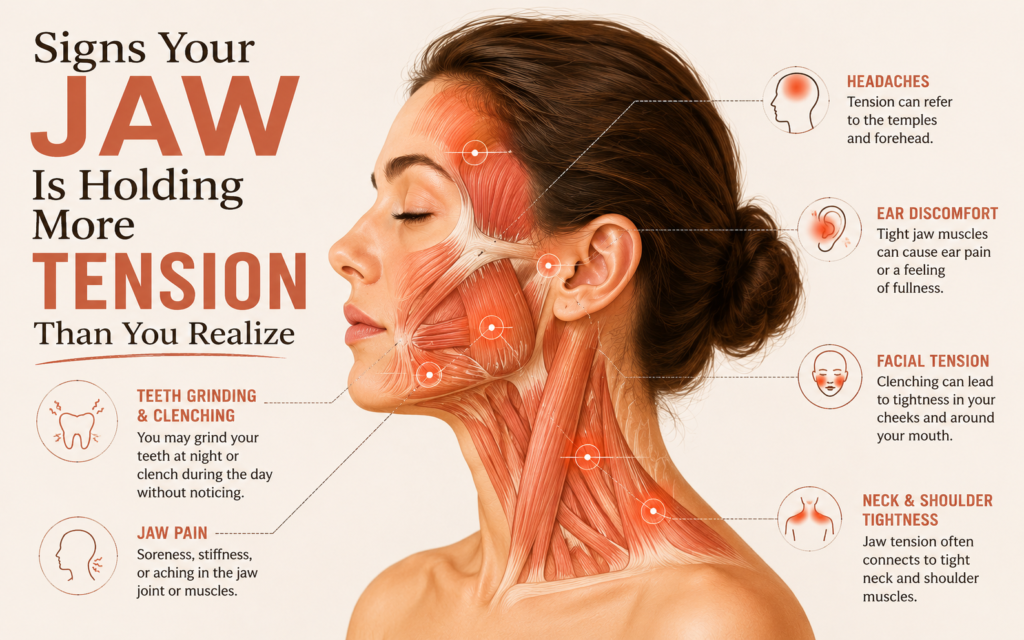
Signs Your Jaw Is Holding More Tension Than You Realize
The jaw is one of the places the body stores stress most silently — many people clench throughout the day without noticing. These signs suggest your jaw muscles may be carrying more tension than is comfortable:
- A jaw that feels tight or tired by mid-afternoon, especially after long calls or screen time
- A clicking or popping sound when opening or closing the mouth
- Headaches that begin at the temples or base of the skull and don’t have a clear cause
- A feeling of fullness or pressure in or around the ears without an infection
- Facial tenderness across the cheeks or along the jawline when pressing gently
- Waking up with a sore jaw, teeth, or face — a common sign of nighttime clenching
Why Jaw Massage Works — The Anatomy
The jaw is powered by several muscles working in close coordination. The masseter — a thick, powerful muscle running from the cheekbone to the lower jaw — is the primary chewing muscle and the most common location for jaw tension. You can find it by placing your fingers on your jaw about halfway between your ear and chin and clenching briefly — you’ll feel it bulge.
The temporalis is a fan-shaped muscle across the temple. The pterygoid muscles sit deeper, controlling side-to-side jaw movement. And critically, the sternocleidomastoid in the neck and the upper trapezius in the shoulders connect directly to the jaw’s functional chain — meaning tension in the neck frequently contributes to jaw massage needs, and vice versa.
When these muscles become tight from stress, clenching, or repetitive use, they develop trigger points — small, irritable knots that can refer pain into surrounding areas. A tight masseter can send referred discomfort into the ear, the temple, or even the teeth. This is why releasing jaw tension often reduces headaches and neck discomfort that seem unrelated on the surface.
7 Jaw Massage Techniques That Release Face Tension
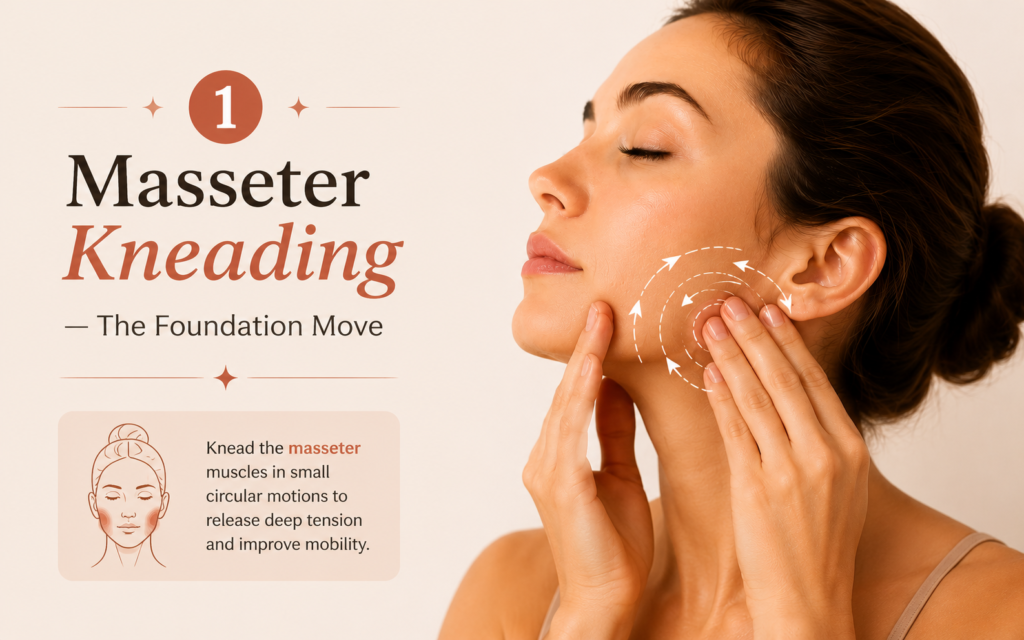
1. Masseter Kneading — The Foundation Move
Locate your masseter muscle below your cheekbone, about halfway between your mouth and ear. Relax your jaw completely — lips slightly parted, teeth not touching. Using two or three fingers, apply gentle circular pressure to the masseter and move your fingers in slow circles, kneading from the top of the muscle downward and back again.
This is the foundational jaw massage technique recommended by Cleveland Clinic chiropractor Dr. Andrew Bang. The key variables are jaw relaxation (the muscle must be passive to release) and gentle pressure — this is not a technique that benefits from firm pressing.
Duration: 60 seconds per side. Pressure: Light to moderate — 4 to 5 out of 10.
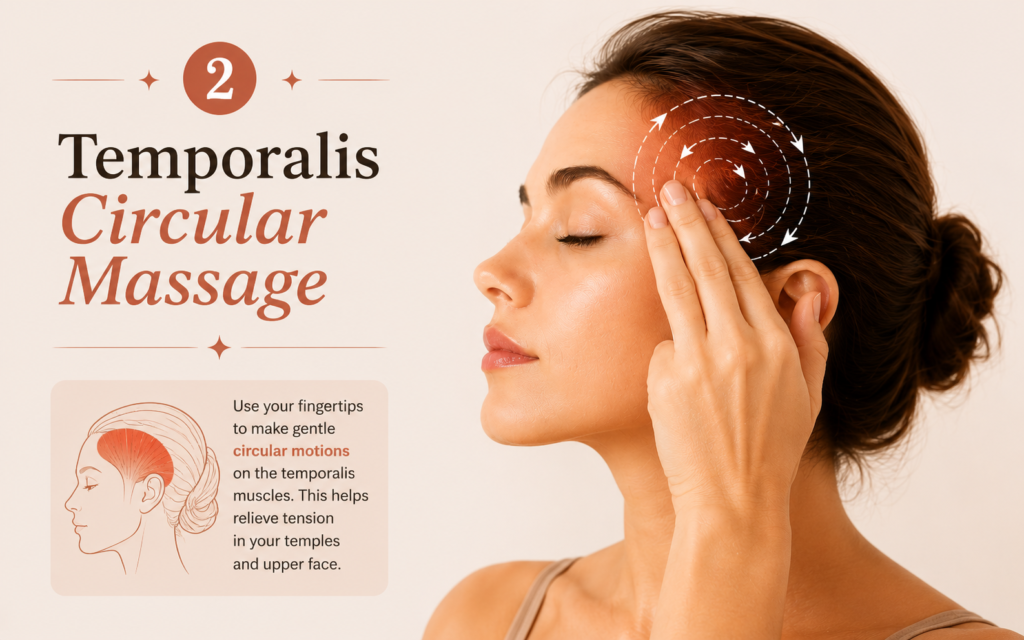
2. Temporalis Circular Massage
Place your entire hand — palm and fingers — against the side of your head at the temple. Clench your jaw briefly to feel the temporalis muscle activate under your hand, then fully relax. Apply gentle circular pressure across the full temporalis, working from the front of the temple toward the ear and slightly above it.
The temporalis is often overlooked in favor of the masseter, but it’s a major contributor to temple headaches and facial tension. Working both muscles in the same session produces significantly better results than targeting either one in isolation.
Duration: 60 seconds per side. Pressure: Light — the temporalis is sensitive.
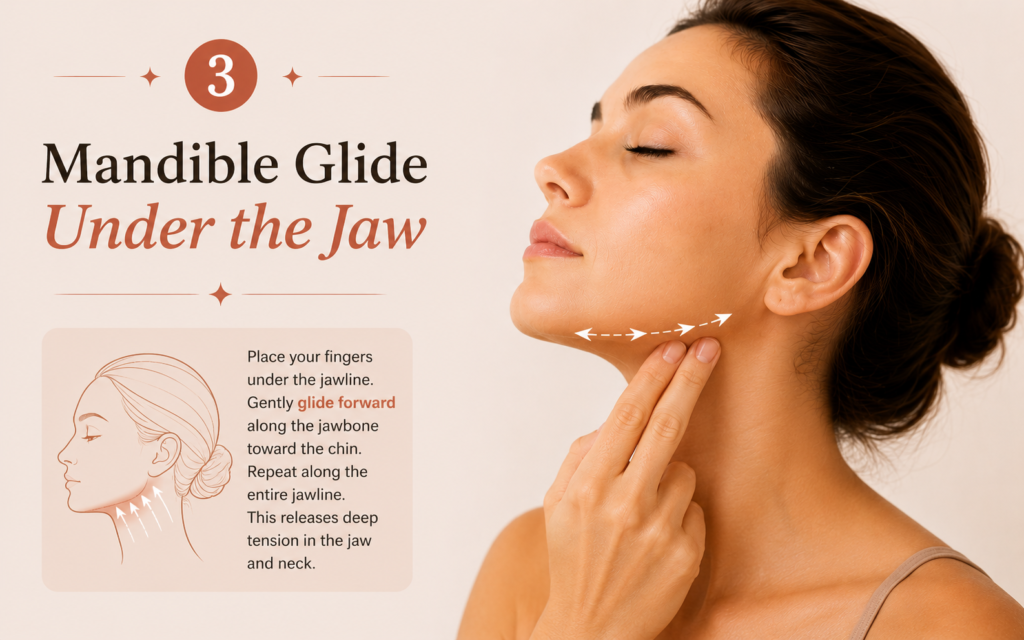
3. Mandible Glide — Under the Jaw
Place your thumbs under your mandible (lower jaw), starting just below your ears. Gently glide your thumbs forward along the underside of the jawbone toward your chin. You should notice the tissue softening as you massage. Always pull away from the TMJ joint rather than pressing into it.
This technique reaches the muscles underneath the jaw that kneading from the outside doesn’t access, and it’s particularly useful for people who feel tension “deep” in the jaw rather than on the surface.
Duration: 5 to 10 slow glides. Pressure: Very gentle — guide rather than press.
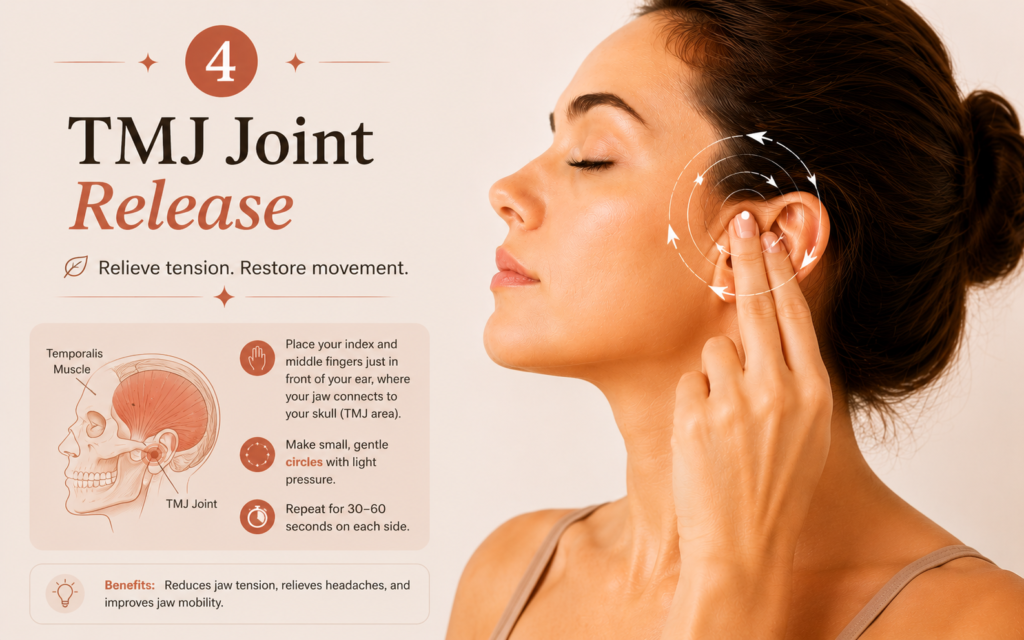
4. TMJ Joint Release
Place your fingers on the TMJ joint itself — located just in front of your ear, where you can feel a small indentation when you open your mouth. Apply gentle, steady pressure here. Slowly open and close your mouth while maintaining that light fingertip pressure, allowing the joint to move naturally through its range without force.
This technique helps improve joint mobility and relieve tension directly at the hinge point of the jaw. Keep the movement slow and controlled — this is not a stretch, it’s a guided release.
Duration: 5 to 8 slow open-and-close cycles per side.
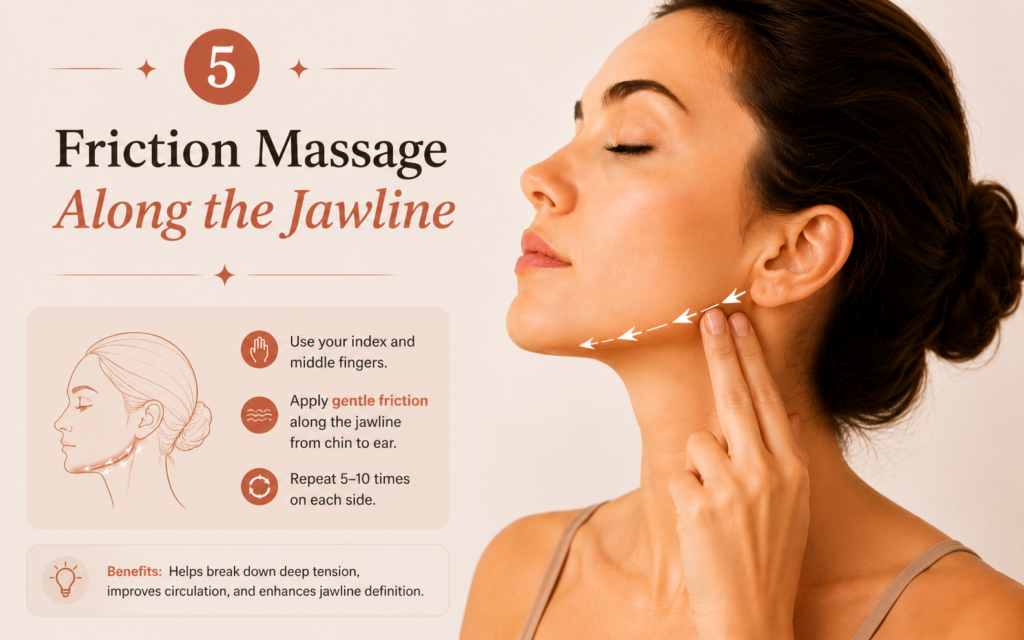
5. Friction Massage Along the Jawline
Using your index finger, apply gentle, constant pressure to the mandible muscle along the lower jawline — starting below the masseter and tracing toward the chin. Maintain steady pressure as you glide, experimenting with the exact placement that feels most relieving. Avoid pressing hard into the bone itself — the target is the soft tissue layered over it.
This technique from Colgate’s dental health guidance targets the muscles that don’t respond as well to circular kneading, reaching the lower jaw more specifically.
Duration: 3 to 5 slow passes per side.
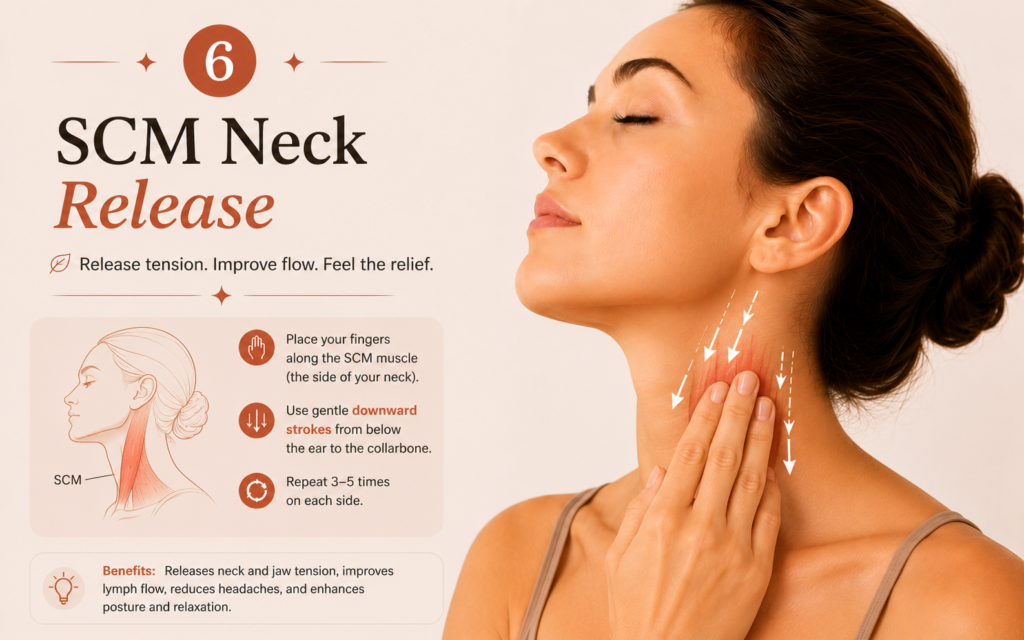
6. SCM Neck Release
The sternocleidomastoid — the rope-like muscle running from behind your ear down to your collarbone — is one of the most commonly overlooked contributors to jaw tension. Turn your head to one side and you’ll see it pop out on the opposite side of the neck. Using two fingers, apply gentle pinching pressure along the muscle, working from the base of the skull downward toward the collarbone.
As one TMJ specialist notes, jaw pain that doesn’t fully resolve with jaw treatment alone is often coming from the SCM. Addressing the neck as part of a jaw massage routine — rather than only the jaw itself — tends to produce more complete and lasting relief. This also pairs naturally with Shoulder Stretches for Desk Work for a comprehensive neck-and-jaw reset.
Duration: 60 seconds per side, working slowly down the muscle.
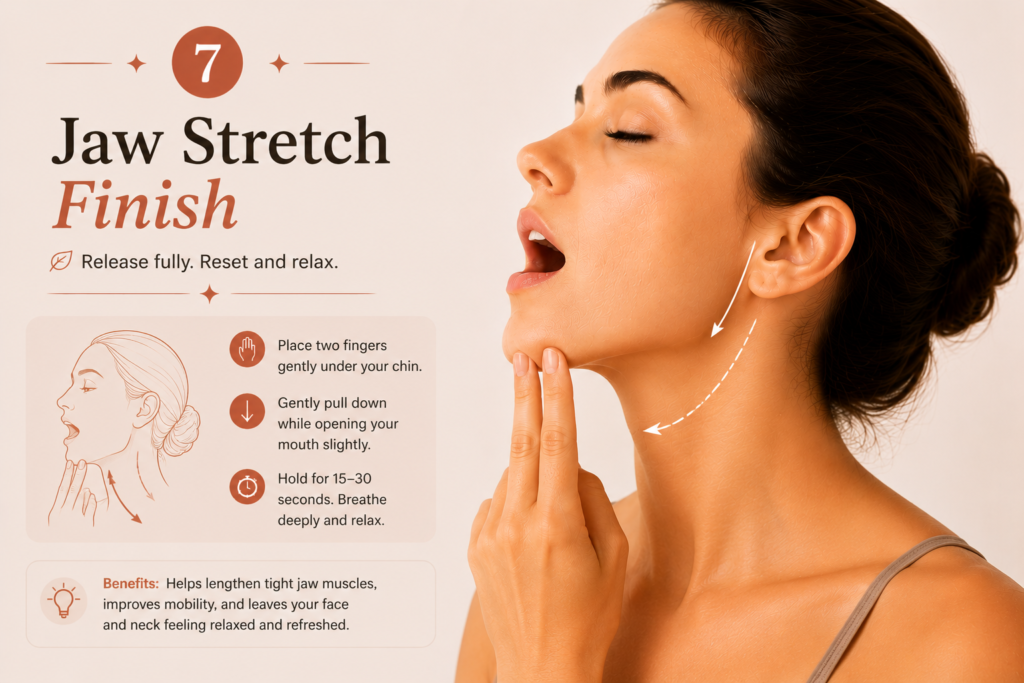
7. Jaw Stretch Finish
Gently open your mouth as wide as is comfortable — not to the point of pain, just until you feel a mild stretch in the masseter and surrounding muscles. Hold for three seconds, then slowly close. Repeat five to eight times. This closing movement after the massage work helps the muscles settle into a more relaxed, neutral resting length rather than returning immediately to their held position.
If you hear clicking during the stretch, that’s generally normal for people with jaw tension — but if the clicking is accompanied by pain or locking, that’s a signal to stop and check with a healthcare provider.
Duration: 5 to 8 gentle repetitions.
Editor’s Note: A warm compress on the jaw for a few minutes before starting these techniques makes a noticeable difference — warm tissue releases more readily than cold, tight muscle. A warm, damp cloth held against the jaw for two to three minutes before beginning technique 1 is a simple addition that meaningfully improves how every subsequent technique feels. Cold can be useful after, particularly if the jaw feels inflamed or swollen, but warmth before is almost always the better call for tension-related tightness rather than acute injury.
Common Jaw Massage Mistakes
- Keeping the jaw tense during massage: The muscle must be in a passive, relaxed state to release — teeth slightly apart, lips soft, jaw hanging loose. Pressing on a tensed masseter produces almost no benefit
- Using too much pressure: The jaw area is sensitive. Firm digging into the masseter tends to cause the muscle to tense defensively rather than release — lighter, sustained pressure consistently outperforms harder approaches
- Pressing directly on the TMJ joint: The joint itself is not the target — the surrounding muscles are. Pressing hard into the joint can increase irritation
- Skipping the neck: Treating only the jaw while ignoring the SCM and upper trapezius misses one of the most significant contributors to jaw tension, particularly for people whose discomfort is stress-related or desk-related
- Doing this during a flare: If the jaw is acutely painful, inflamed, or locked, rest and professional evaluation come before self-massage. These techniques are for ongoing tension management, not acute pain episodes
Who These Jaw Massage Techniques Are Best For
Best for: people who notice end-of-day jaw or face tension, those who clench or grind mildly, desk workers whose jaw tension is linked to screen time and stress, and anyone pairing this with a broader tension-relief routine including Upper Back Massage or Lymphatic Drainage for the face.
Less ideal for: those with a diagnosed TMJ disorder (TMD), significant jaw locking or limited opening, acute jaw pain following injury, or persistent clicking accompanied by pain — these situations call for evaluation by a dentist, physical therapist, or TMJ specialist rather than self-massage alone. Nearly 1 in 5 adults report experiencing a painful TMJ episode annually — if yours is recurrent or worsening, professional guidance produces better long-term outcomes than self-care alone.
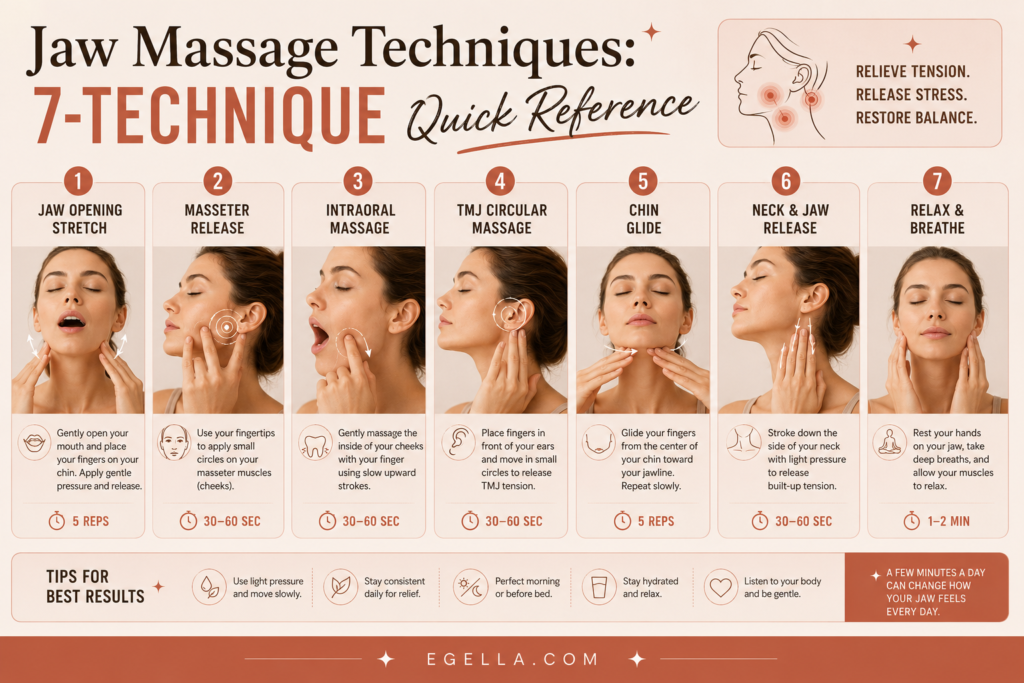
Jaw Massage Techniques: Quick Reference
| Technique | Target Muscle | Pressure | Duration |
|---|---|---|---|
| Masseter Kneading | Masseter (cheek/jaw) | Light-moderate | 60 sec per side |
| Temporalis Circles | Temporalis (temple) | Light | 60 sec per side |
| Mandible Glide | Under jawbone | Very gentle | 5–10 glides |
| TMJ Joint Release | TMJ joint | Light | 5–8 cycles |
| Friction Jawline | Lower jaw muscles | Gentle | 3–5 passes |
| SCM Neck Release | Sternocleidomastoid | Gentle pinch | 60 sec per side |
| Jaw Stretch Finish | Full jaw | Gentle stretch | 5–8 reps |
Frequently Asked Questions About Jaw Massage
How often should I do jaw massage techniques?
Daily practice for mild ongoing tension is reasonable and safe — the muscles involved are small and the techniques are gentle enough not to require recovery days. Many people find morning and evening sessions most useful: morning to address nighttime clenching, and evening to release the day’s accumulated tension.
Can jaw massage help with tension headaches?
It can — trigger points in the masseter and temporalis frequently refer pain into the temples and base of the skull, producing headaches that feel like tension headaches but actually originate in the jaw. Releasing these trigger points through gentle sustained pressure sometimes reduces or resolves headaches that don’t respond to other interventions. Persistent or severe headaches should still be evaluated medically.
Is jaw massage safe during pregnancy?
The gentle techniques in this guide are generally considered safe, but it’s worth checking with a healthcare provider if you have any concerns, particularly if your jaw tension is accompanied by any unusual symptoms.
What’s the difference between jaw massage and TMJ treatment?
Jaw self-massage is appropriate for mild, daily tension related to stress and clenching. Clinical TMJ treatment — from a dentist, physical therapist, or specialist — addresses structural issues, joint dysfunction, severe pain, or cases where self-massage hasn’t produced relief after several weeks of consistent practice.
Final Thoughts: Your Jaw Deserves the Same Attention as Your Shoulders
Most people invest time in releasing neck and shoulder tension but never think to address the jaw — even though it’s working constantly throughout the day and holding stress as efficiently as any other muscle. These seven jaw massage techniques take less than ten minutes, require no equipment, and address not just the jaw itself but the connected muscles in the face, temples, and neck that share the tension load.
Save this guide, try the masseter kneading technique tonight, and explore more wellness guides at egella.com
Does stress show up in your jaw? Tell us in the comments below.