

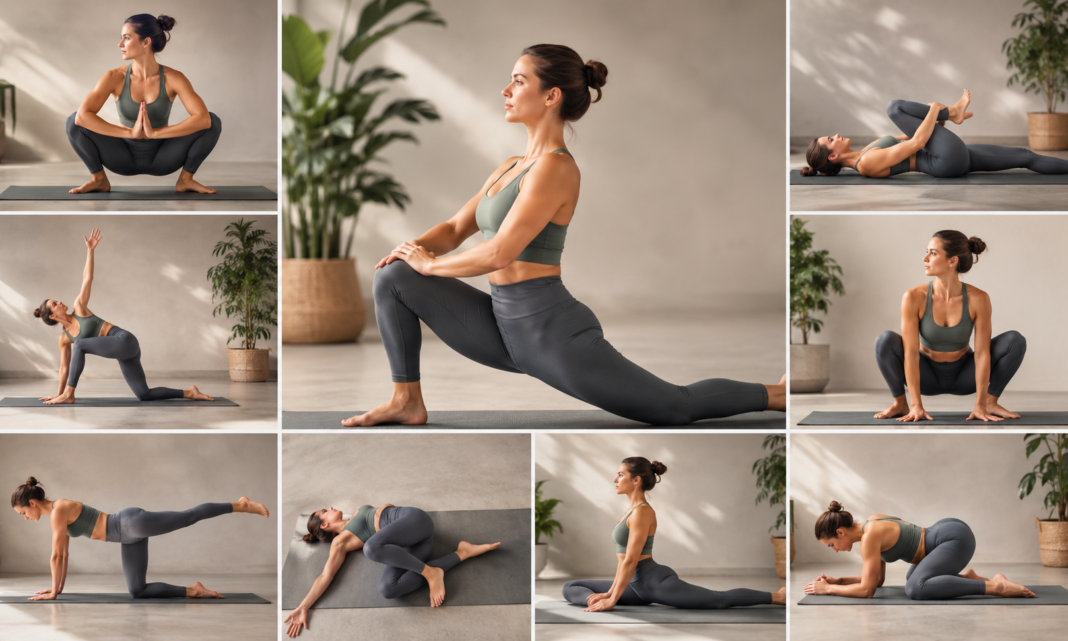
These hip mobility exercises address what prolonged sitting does to the hip joint better than almost anything else you can do in ten minutes. When the hips spend hours in a fixed position, the surrounding muscles stop firing efficiently, the joint’s range of motion narrows, and the lower back starts compensating for movement the hips should be providing — which is why lower back pain and hip stiffness so often arrive together.
Quick Summary: These 8 hip mobility exercises work through the hip flexors, external and internal rotators, and glutes — the four areas most restricted by sitting. All floor-based, no equipment needed, and 10 minutes is enough to notice a difference. Short on time? Exercises 1, 4, and 7 — 90/90, hip flexor lunge, and figure-four — cover the three most impactful areas in under 5 minutes.
This guide covers all eight exercises with form cues, what each targets, common mistakes, and how to build this into a daily habit that sticks.
Editor’s Note: The single most useful thing we learned researching hip mobility is that the hip is a ball-and-socket joint designed to move in multiple directions — and sitting restricts all of them simultaneously. Most people stretch in one direction (typically forward into a hip flexor stretch) and wonder why their hips still feel stiff. A complete routine needs to address internal rotation, external rotation, and extension — not just hip flexor length. That’s the organizing principle behind this sequence.
Signs Your Hip Mobility Needs Work
Hip stiffness often shows up in places that seem unrelated to the hips themselves:
- Lower back pain or tightness that develops after sitting for more than an hour
- Difficulty crossing your legs or sitting cross-legged comfortably
- A feeling of tightness across the front of the hips when standing after sitting
- Reduced stride length when walking — shorter steps than feel natural
- Knee discomfort during squatting movements, often caused by limited hip rotation upstream
- A general sense that your hips feel “stuck” or restricted when you change position
What Sitting Does to Hip Mobility
The hip joint is a ball-and-socket design that the body uses constantly — walking, climbing stairs, getting in and out of chairs — but extended sitting keeps the hip in a narrow fixed position for hours at a time. The hip flexors at the front of the hip shorten from being held in a flexed position. The glutes and hip external rotators on the back and sides disengage from lack of demand. And the joint itself becomes less lubricated through the reduced movement, contributing to the stiffness that feels worse when standing up after a long period of sitting.
Effective hip mobility work addresses all three affected directions — hip flexion, extension, and rotation — rather than only stretching the flexors, which is the most common and most incomplete approach.
8 Hip Mobility Exercises — Step by Step

1. 90/90 Hip Stretch
Sit on the floor with both legs bent at 90-degree angles — one leg in front with the shin parallel to your body, one leg behind with the shin pointing away. Sit tall and hold, breathing through the stretch. This opens both internal and external hip rotation simultaneously, making it the single most comprehensive hip mobility exercise for desk workers. The side that feels more restricted tells you which rotation direction needs the most work.
Duration: Hold 45 to 60 seconds per side. Sets: 2 to 3 rounds. Common mistake: Collapsing the torso — sit as tall as possible to get the full hip stretch.
2. Hip Circles
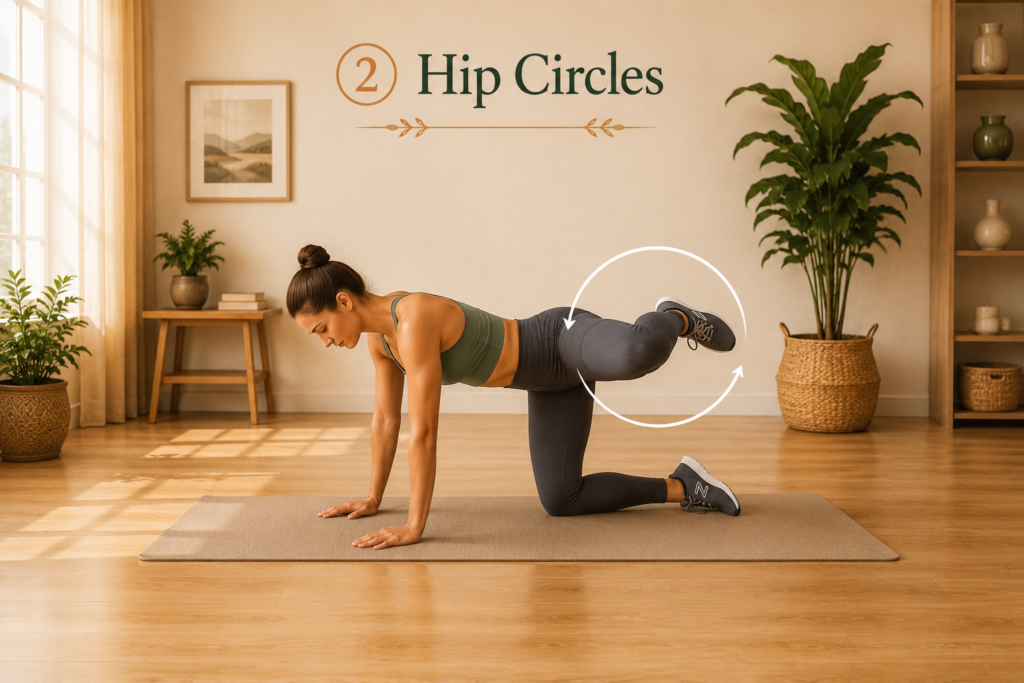
Stand with feet hip-width apart, hands on hips. Draw large, slow circles with your hips — 8 to 10 clockwise, then the same counterclockwise. This lubricates the hip joint and begins increasing range of motion in all directions before moving into held stretches. It’s the natural warm-up for the rest of this sequence.
Duration: 8 to 10 circles each direction. Common mistake: Moving too quickly — slow circles allow the joint to warm up gradually rather than rushing range of motion.
3. Kneeling Hip Flexor Stretch
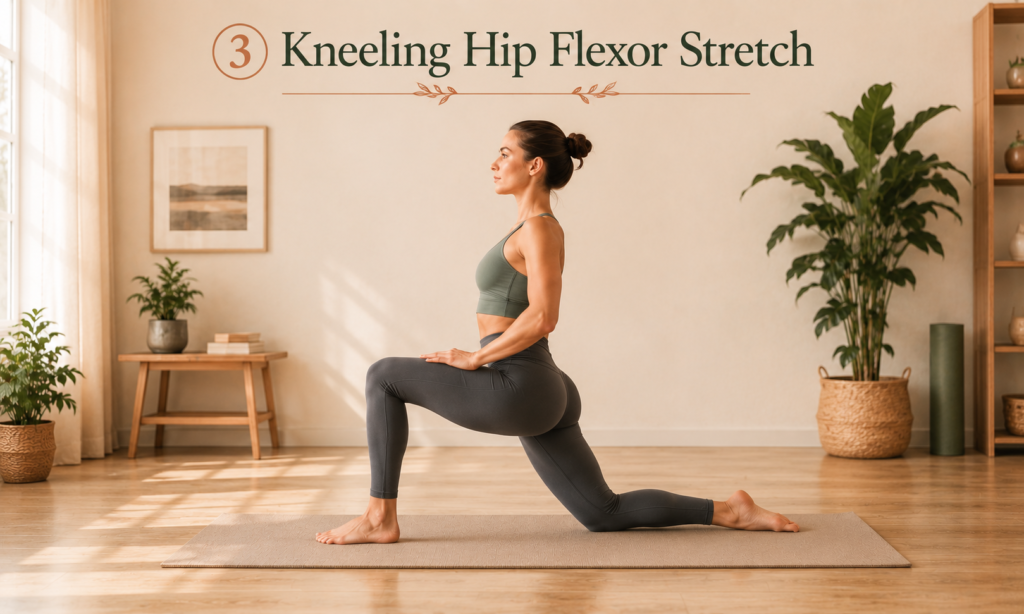
Step one foot forward into a lunge position, lower the back knee to the floor. Keep your torso upright and gently push your hips forward until you feel a stretch across the front of the back hip. To deepen: reach the arm on the same side as the back knee straight overhead, creating a long line from knee to fingertip. Hold without letting the lower back arch excessively.
Duration: Hold 30 to 45 seconds per side. Common mistake: Letting the front knee cave inward or allowing the lower back to arch to compensate for tight hip flexors.
4. Supine Figure-Four Stretch
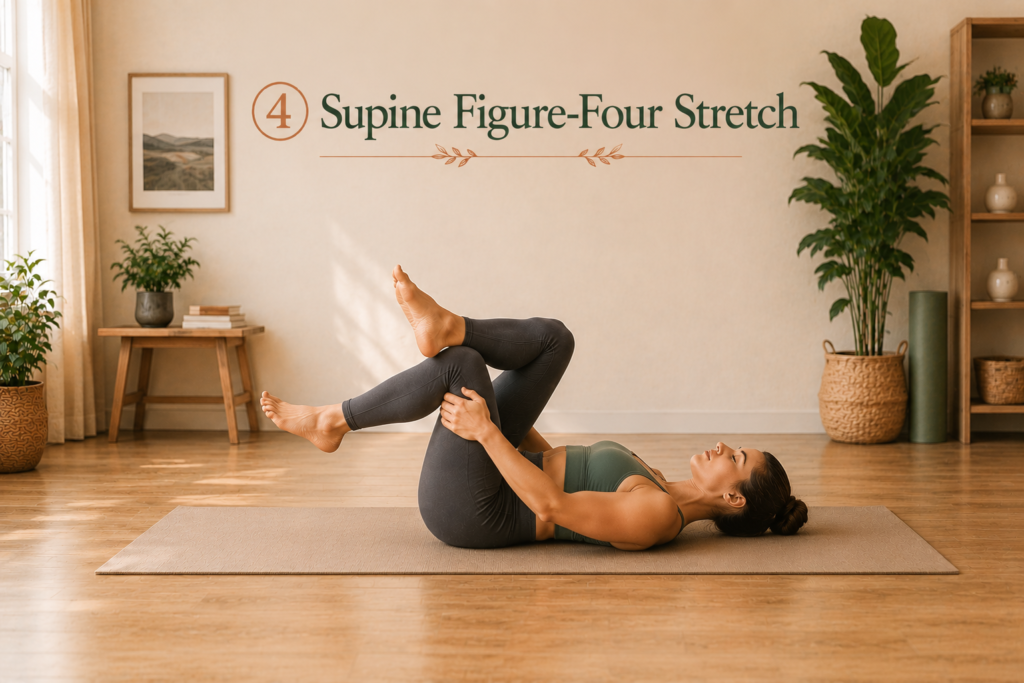
Lie on your back with knees bent. Cross one ankle over the opposite knee, creating a figure-4 shape with the legs. Gently pull the uncrossed thigh toward your chest until you feel a deep stretch in the hip and glute of the crossed leg. This targets the piriformis and external hip rotators — muscles that often contribute to sciatic-nerve-adjacent discomfort when tight.
Duration: Hold 30 to 45 seconds per side. Common mistake: Holding the shin rather than the thigh — holding the thigh produces a more controlled and effective stretch.
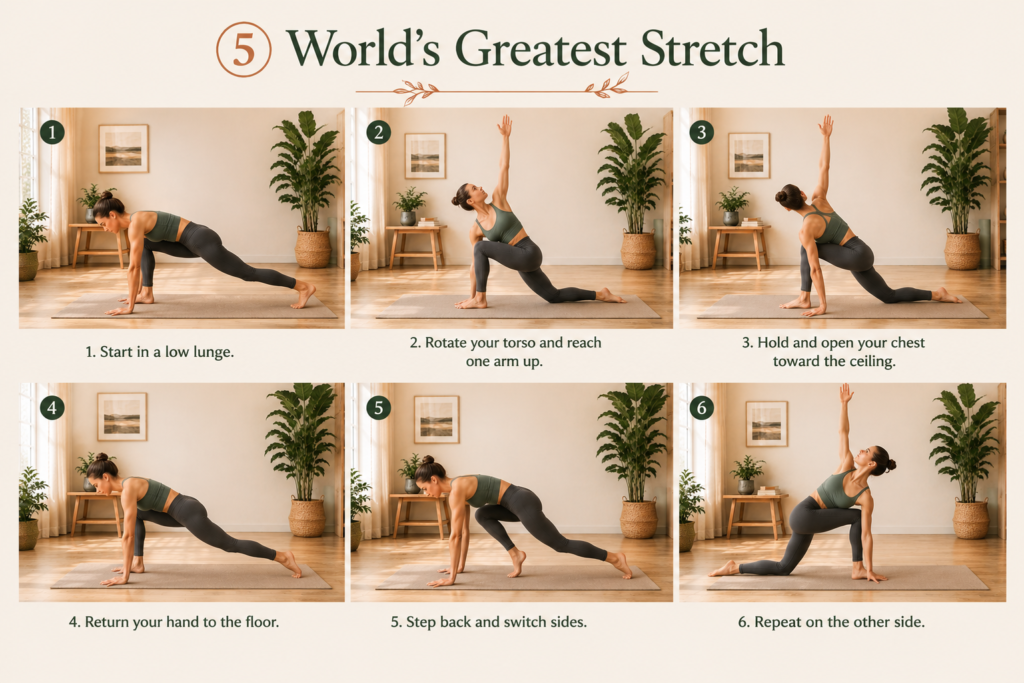
5. World’s Greatest Stretch
Step into a deep lunge. Place your inside hand on the ground at the same level as your front foot. Rotate your outside arm toward the ceiling, following your hand with your eyes. Hold for 2 seconds at the top, then return. Push back into a brief hamstring stretch before returning to the lunge. This single exercise works the hip flexors, hamstrings, thoracic rotation, and hip mobility in a continuous flow — hence the name.
Duration: 5 reps per side. Common mistake: Rushing — each rep should be slow and deliberate, pausing at the full rotation to feel the stretch.
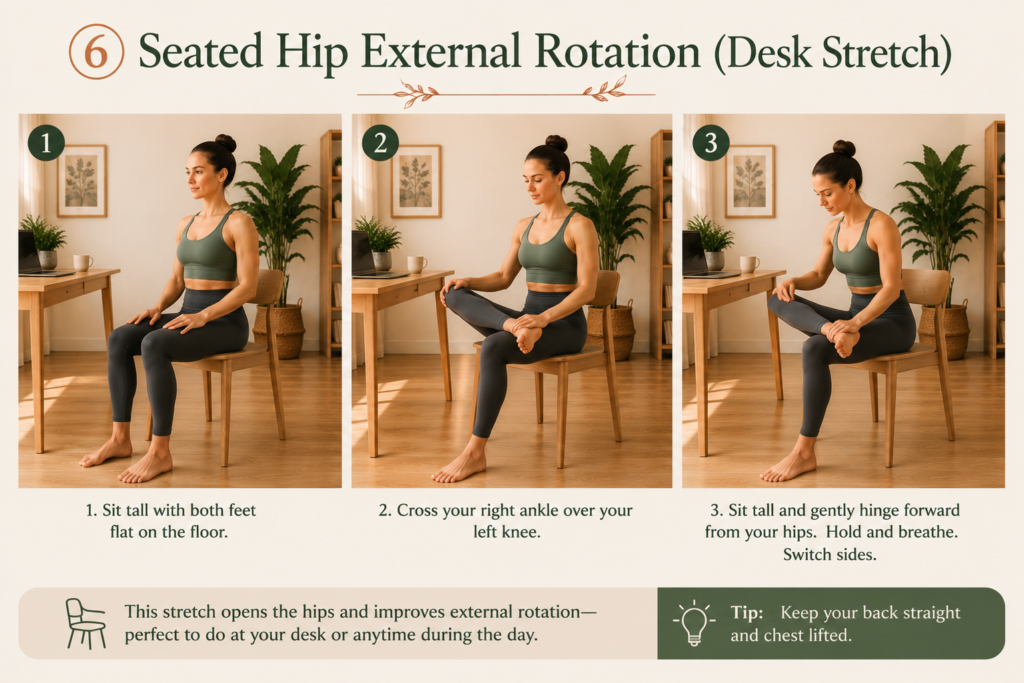
6. Seated Hip External Rotation (Desk Stretch)
Sitting on the edge of a chair, cross one ankle over the opposite knee. Sit tall, then gently press your crossed knee downward and slightly forward. You’ll feel the external rotators of the lifted hip engaging and releasing. This variation can be done at a desk without getting on the floor, making it one of the most practical hip mobility exercises for the workday.
Duration: Hold 20 to 30 seconds per side, 3 repetitions. Common mistake: Rounding forward — staying upright maintains the hip angle that makes the stretch effective.
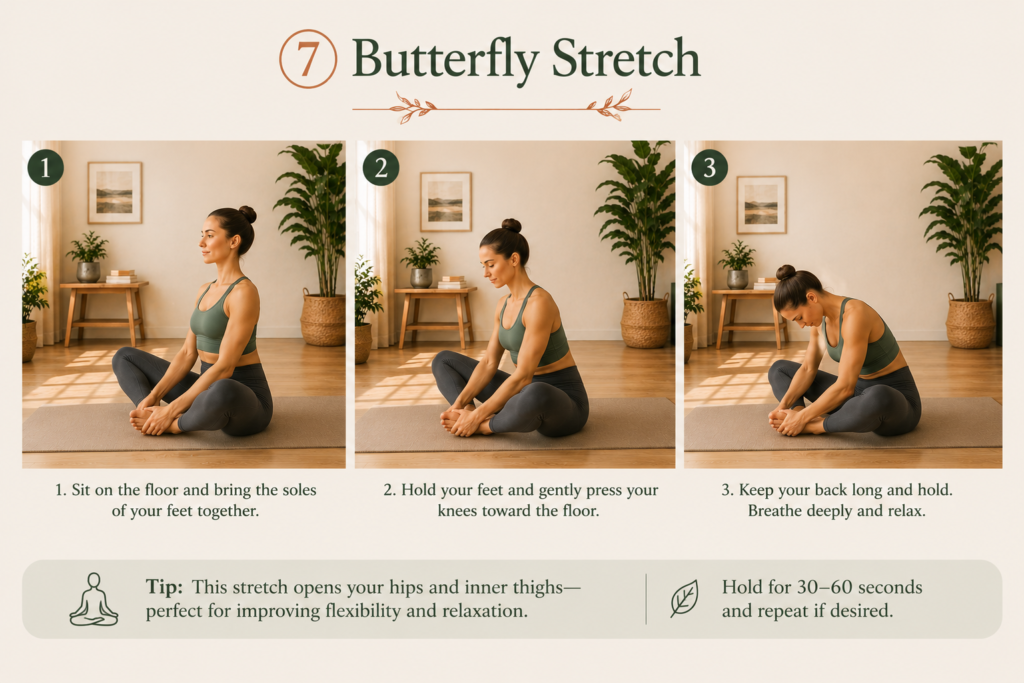
7. Butterfly Stretch
Sit on the floor and bring the soles of your feet together, letting your knees fall out to the sides. Hold your feet and gently allow gravity to open your hips, or use your elbows to gently press your knees toward the floor. This targets the groin and inner hip — areas often missed by flexor-focused stretching routines.
Duration: Hold 45 to 60 seconds. Common mistake: Forcing the knees down — passive release with gravity produces more effective and safer hip opening than active pressing.
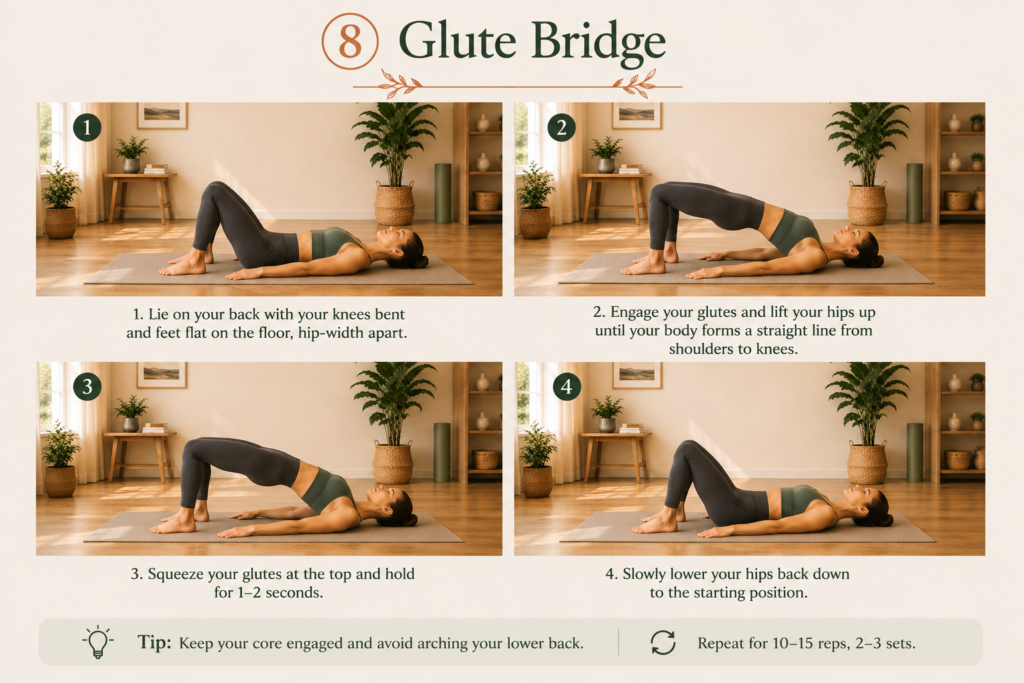
8. Glute Bridge
Lie on your back with knees bent, feet flat on the floor. Drive your hips toward the ceiling by squeezing your glutes, creating a straight line from shoulders to knees. Hold briefly at the top, then lower with control. This is a strengthening exercise rather than a stretch — it reactivates the glutes that disengage during sitting and supports the hip extension that flexor-heavy routines address from the opposite direction.
Sets/reps: 3 sets of 10 to 12 reps. Common mistake: Pushing through the lower back rather than the glutes — the effort should be felt in the posterior chain, not the lumbar spine.
Editor’s Note: The most common error in hip mobility routines is doing only stretches without the strengthening component. The glute bridge is the exercise people most often skip — and it’s also the one that makes the rest of the routine’s benefits stick. Stretching a hip flexor that’s opposing a weak glute is like stretching a rubber band held tight at both ends. Strengthening the glute changes the tension equation and makes the flexibility gains from the stretches more durable.
Common Mistakes in Hip Mobility Work
- Only stretching one direction: Most hip flexibility routines focus on hip flexor length and ignore internal and external rotation — the directions most restricted by sitting. A complete routine addresses all three
- Skipping the strengthening component: Glute activation (exercise 8) is what makes hip flexibility gains durable — without it, the stretched muscles return to their shortened state more quickly
- Holding breath during stretches: Breath is directly linked to tissue release — slow exhales during held stretches consistently produce better results than holding breath and tensing
- Doing the routine only when things hurt: Hip mobility responds to regular, gentle, consistent practice rather than occasional intensive sessions during flare-ups
Who These Hip Mobility Exercises Are Best For
Best for: anyone who sits for most of the working day, people with lower back tension that worsens after sitting, those building a broader posture and movement routine alongside Posture Correction Exercises or T-Spine Mobility Exercises, and anyone who wants to improve everyday movement quality.
Less ideal for: those with a diagnosed hip condition (labral tear, femoroacetabular impingement, hip replacement), active hip or groin injury, or any exercise that reproduces sharp joint pain rather than muscular stretch — these situations warrant physiotherapy guidance before independent mobility work.
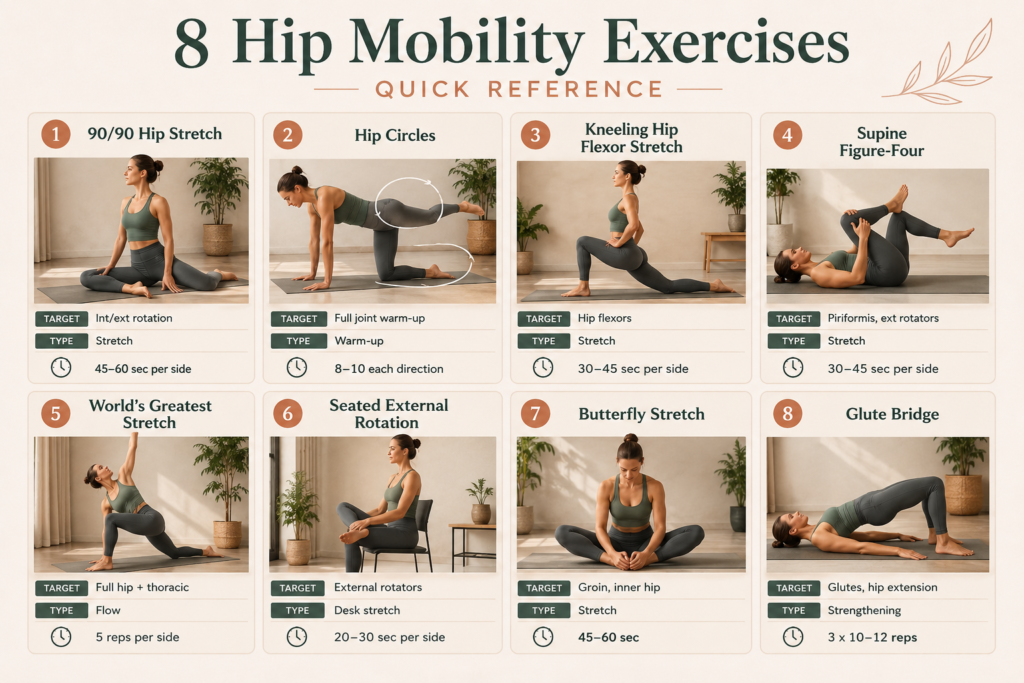
Hip Mobility Exercises: Quick Reference
| Exercise | Target | Type | Duration |
|---|---|---|---|
| 90/90 Hip Stretch | Int/ext rotation | Stretch | 45–60 sec per side |
| Hip Circles | Full joint warm-up | Warm-up | 8–10 each direction |
| Kneeling Hip Flexor Stretch | Hip flexors | Stretch | 30–45 sec per side |
| Supine Figure-Four | Piriformis, ext rotators | Stretch | 30–45 sec per side |
| World’s Greatest Stretch | Full hip + thoracic | Flow | 5 reps per side |
| Seated External Rotation | External rotators | Desk stretch | 20–30 sec per side |
| Butterfly Stretch | Groin, inner hip | Stretch | 45–60 sec |
| Glute Bridge | Glutes, hip extension | Strengthening | 3 x 10–12 reps |
Frequently Asked Questions About Hip Mobility
How quickly will I notice improvement in hip mobility?
Most people notice reduced stiffness after standing within one to two weeks of consistent daily practice. Meaningful range-of-motion changes — like being able to sit cross-legged more comfortably — typically develop over four to six weeks of regular work.
Can hip mobility exercises help with lower back pain?
Often, yes. Tight hip flexors tilt the pelvis forward and increase lumbar compression, while weak glutes allow the lower back to compensate for hip extension. Addressing both simultaneously — as this routine does — frequently reduces associated lower back tension over time, though persistent pain warrants medical evaluation.
How often should I do hip mobility exercises?
Daily practice produces the best results, but three to four times per week is still meaningfully effective. The seated external rotation exercise (number 6) can be done multiple times throughout the workday without any floor space — making it the easiest habit to build for anyone with a desk job.
Is hip mobility the same as hip flexibility?
Related but distinct. Flexibility refers to the passive length of a muscle — how far it can be stretched. Mobility refers to how well you can actively move through and control that range. True hip mobility work includes both stretching (flexibility) and the strengthening component (control), which is why the glute bridge belongs in this routine alongside the stretches.
Final Thoughts: Ten Minutes Changes How Your Hips Feel All Day
These eight hip mobility exercises take ten minutes and require no equipment — but they address the specific restrictions that sitting creates in a way that most stretching routines don’t. The 90/90 targets rotation, the kneeling lunge targets flexors, the figure-four targets rotators, and the glute bridge closes the loop with the strengthening the passive stretches can’t provide.
Save this guide, try the 90/90 stretch tonight, and explore more wellness guides at egella.com
Which hip exercise surprised you most? Tell us in the comments below.
