

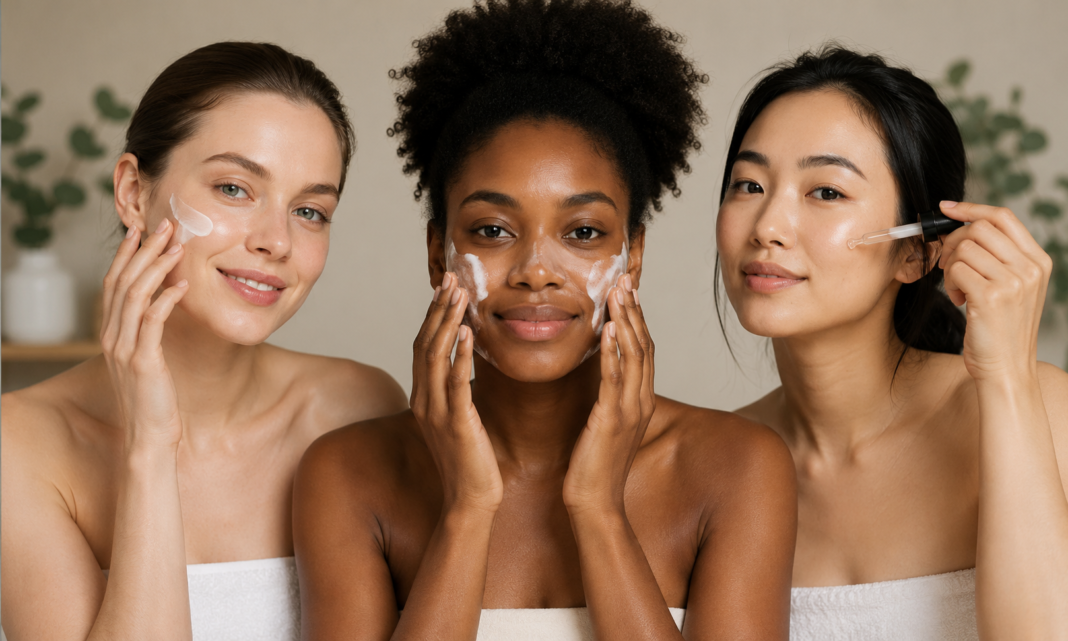
Part of the Egella Skin Intelligence Series — building a routine that works with your skin, not against it.
⚕️ Educational content — not medical advice. Full disclaimer below.
The most common reason a skincare routine stops working isn’t the products — it’s that the routine was never built for your skin type to begin with. A skincare routine by skin type looks different for dry, oily, combination, and sensitive skin, not because the five essential steps change, but because the specific formulas, textures, and active ingredients within each step do. Get the steps right for your skin type, and most products suddenly start performing better. Get them wrong, and even good products underperform.
Quick Summary: Every effective skincare routine by skin type follows the same 5 steps — cleanse, treat, moisturise, protect (morning), and repair (evening). What changes across skin types is the formula within each step: dry skin needs cream cleansers and rich occlusives; oily skin needs gel cleansers and lightweight non-comedogenic formulas; combination skin needs targeted application rather than different products; sensitive skin needs fragrance-free, minimal-ingredient formulas throughout. Most important rule: identify your skin type on a morning when you haven’t applied anything overnight — that’s when your skin shows its true baseline behaviour.
This skincare routine by skin type guide covers how to identify your skin type accurately, the 5 steps that work for every skin type, exactly how each step changes depending on whether your skin is dry, oily, combination, or sensitive, and the most common mistakes that undermine each skin type’s routine.
Editor’s Note — Harper Collins: The most useful thing I’ve learned researching skin type is that most people misidentify theirs — usually because they’re assessing after they’ve already applied products, or because they confuse dehydration (a temporary state, fixed by hydration) with dryness (a skin type, fixed by occlusion). Before building a skincare routine by skin type, take one morning to assess your skin 30 minutes after washing with just water and nothing else. What you see and feel then is your actual skin type. Everything before that, with products on, is just noise.
How to Identify Your Skin Type Accurately
Wash your face with a gentle, fragrance-free cleanser. Pat dry. Wait 30 minutes without applying anything. Then assess:
| Skin Type | What You See After 30 Minutes | What You Feel |
|---|---|---|
| Dry | Dull, possibly flaky or rough texture | Tight, uncomfortable, possibly itchy |
| Oily | Shine across the T-zone and cheeks | Slick or greasy to the touch |
| Combination | Shine on T-zone, normal or dry on cheeks | Different zones feel different simultaneously |
| Sensitive | Redness, possible blotchiness or reactivity | Stinging, itching, or tightness easily triggered |
| Normal | Balanced, minimal shine or dryness | Comfortable, no strong sensation |
The 5-Step Skincare Routine by Skin Type
Every effective skincare routine by skin type follows the same five steps in the same order. What changes is the formula within each step — not the step itself. Understanding this distinction makes building the right skincare routine by skin type significantly simpler than most product marketing suggests.
Step 1 — Cleanse
Cleansing removes dirt, excess oil, sunscreen, and environmental residue without stripping the skin’s natural barrier. The most important variable in this step is the formula’s surfactant strength — how aggressively it removes oil. Getting this wrong is the single most common reason skin type-specific routines fail before they start.
| Skin Type | Best Cleanser Formula | Avoid |
|---|---|---|
| Dry | Cream or milk cleanser, low-surfactant | Foaming cleansers, high-alcohol formulas |
| Oily | Gel or foaming cleanser with salicylic acid | Heavy cream cleansers, oil-based formulas |
| Combination | Gentle gel or low-foam cleanser | Anything too rich or too stripping |
| Sensitive | Fragrance-free, minimal-ingredient micellar or cream | Fragrance, essential oils, high-pH formulas |
Most dermatologists recommend cleansing twice daily — morning and evening — though dry and sensitive skin types often do better with a plain water rinse in the morning and a full cleanse at night only, preserving more of the natural oil barrier.
Step 2 — Treat (Serums and Actives)
Treatment is where the skincare routine by skin type diverges most significantly. Actives are concentrated ingredients targeting specific concerns — texture, pigmentation, acne, barrier function, or aging — and choosing the wrong active for your skin type either causes irritation or simply doesn’t address the actual issue.
| Skin Type | Most Useful Actives | Approach With Caution |
|---|---|---|
| Dry | Hyaluronic acid, glycerin, ceramides, niacinamide | High-strength AHAs, retinoids without buffer |
| Oily | Niacinamide, salicylic acid, retinol, zinc | Heavy occlusive serums, oils |
| Combination | Niacinamide (works across zones), light hyaluronic acid | Applying the same serum everywhere without adjusting |
| Sensitive | Centella asiatica, azelaic acid, low-strength niacinamide | Fragrance, essential oils, high-strength retinoids |
Editor’s Note — Harper Collins: Niacinamide appears in the treatment step for almost every skin type — and that’s not lazy advice, it’s because niacinamide genuinely works across dry, oily, combination, and sensitive skin with very little irritation risk. If you’re building a skincare routine by skin type from scratch and aren’t sure which active to start with, niacinamide at 4–5% is the lowest-risk, highest-versatility first active for almost any skin type. Our full niacinamide vs vitamin C guide covers when to choose which.
Step 3 — Moisturise
Moisturiser in a skincare routine by skin type serves two functions: hydration (adding water content) and occlusion (sealing it in). Every skin type needs moisturiser — including oily skin, which produces excess oil but can still be dehydrated. The texture and occlusive weight is what changes across types, not the step itself.
| Skin Type | Best Moisturiser Formula | Key Ingredients |
|---|---|---|
| Dry | Rich cream or balm, strong occlusive layer | Ceramides, shea butter, petrolatum, fatty acids |
| Oily | Lightweight gel or fluid, non-comedogenic | Hyaluronic acid, glycerin, niacinamide |
| Combination | Lightweight lotion applied lightly on T-zone, more on cheeks | Balanced humectant and light emollient blend |
| Sensitive | Fragrance-free cream, minimal ingredients | Ceramides, allantoin, colloidal oatmeal |
The barrier repair principles covered in our skin barrier repair guide apply here — particularly for dry and sensitive skin types, where moisturiser choice has the most direct impact on barrier function and long-term skin health.
Step 4 — Protect (Morning Only)
Daily broad-spectrum SPF 30 or higher is the non-negotiable final step in every morning skincare routine by skin type, regardless of skin tone, indoor or outdoor schedule, or season. UV exposure is the primary driver of both premature aging and hyperpigmentation — no treatment active in Step 2 works optimally without this protection working in parallel. Our vitamin C serum guide covers specifically why skipping SPF undermines antioxidant protection.
| Skin Type | Best SPF Formula |
|---|---|
| Dry | Cream SPF with moisturising base — can replace separate moisturiser in morning |
| Oily | Lightweight fluid or gel SPF, mattifying formulas well tolerated |
| Combination | Fluid SPF applied evenly, slight blot on T-zone after if needed |
| Sensitive | Mineral (zinc oxide/titanium dioxide) SPF — less likely to cause reactivity than chemical filters |
Step 5 — Repair (Evening Only)
The evening skincare routine by skin type replaces SPF with a focus on repair and recovery — this is when retinoids, stronger actives, and richer barrier support work most effectively, since skin cell turnover peaks overnight and there’s no UV exposure to manage. This step is where the most significant skin type differences emerge in terms of product weight and active strength.
Dry skin: A rich night cream or sleeping mask as the final step, with a retinoid introduced gradually 2–3 nights per week. Our retinol for beginners guide covers exactly how to introduce retinol for dry skin without barrier disruption — the sandwich method is particularly useful here.
Oily skin: A lightweight moisturiser or gel, with retinol or BHA as the active treatment. Oily skin generally tolerates retinol better than dry skin from the start, since the natural oil provides some buffering effect.
Combination skin: Consider targeted application — a lighter formula on the T-zone, something slightly richer on the cheeks and around the mouth where dryness is more common.
Sensitive skin: Prioritise barrier repair over treatment actives. A ceramide-rich night cream without fragrance, and introduce any new active very gradually — one new ingredient at a time, every 4 weeks minimum.
Full Skincare Routine by Skin Type — Morning
| Step | Dry | Oily | Combination | Sensitive |
|---|---|---|---|---|
| Cleanse | Cream cleanser or water rinse | Gel/foaming cleanser | Gentle gel | Fragrance-free micellar or cream |
| Treat | Hyaluronic acid + niacinamide | Niacinamide + salicylic acid | Niacinamide | Centella asiatica or azelaic acid |
| Moisturise | Rich cream | Lightweight gel | Lightweight lotion | Fragrance-free cream |
| Protect | Cream SPF 30+ | Fluid/gel SPF 30+ | Fluid SPF 30+ | Mineral SPF 30+ |
Full Skincare Routine by Skin Type — Evening
| Step | Dry | Oily | Combination | Sensitive |
|---|---|---|---|---|
| Cleanse | Cream cleanser | Gel/foaming cleanser | Gentle gel | Fragrance-free cream |
| Treat | Retinol (2-3x/week) or peptides | Retinol or BHA | Niacinamide or light retinol | Ceramides or azelaic acid only |
| Moisturise | Rich night cream or sleeping mask | Lightweight gel or lotion | Targeted application by zone | Ceramide-rich fragrance-free cream |
Most Common Skincare Routine Mistakes by Skin Type
Dry skin: Using foaming cleansers that strip the already-limited natural oil, skipping moisturiser in summer assuming the heat provides hydration, and avoiding all facial oils out of a general fear of breakouts — oils used correctly are often exactly what dry skin needs.
Oily skin: Over-cleansing or using harsh formulas that strip oil so aggressively the skin overproduces sebum in response, skipping moisturiser entirely (oily skin still needs hydration), and assuming that more product means better oil control.
Combination skin: Applying the same product uniformly across all zones rather than targeting — the T-zone and cheeks genuinely need different things, and a single compromise product rarely serves both well. Consider two moisturisers and apply appropriately rather than searching for a single “combination skin” formula.
Sensitive skin: Introducing multiple new products simultaneously, using products with fragrance or essential oils despite known reactivity, and assuming “natural” equals gentle — many natural ingredients (essential oils, citrus extracts, witch hazel) are among the most sensitising ingredients in skincare.
The Egella Take
🧴 Best for: anyone whose current routine feels wrong for their skin, those building a skincare routine by skin type from scratch, people who’ve been copying generic routines without skin-type context
🏆 The foundation: cleanse → treat → moisturise → SPF (morning) works for every skin type — only the formula within each step changes
⚠️ The honest truth: most skincare routine by skin type advice overcomplicates the picture. Five steps, skin type-appropriate formulas, consistent use over weeks — that combination outperforms any 10-step routine built without skin type in mind.
A skincare routine by skin type isn’t about finding more products — it’s about finding the right ones for how your skin actually behaves. The five steps above apply to every skin type. The tables in this guide show exactly how the formula within each step changes. Start there, maintain consistency for at least four weeks, and adjust based on how your skin responds rather than how a product is marketed.
Frequently Asked Questions About Skincare Routine by Skin Type
Can my skin type change over time?
Yes — skin type can shift with age, hormonal changes, climate, and medication. Reassessing your skincare routine by skin type annually, or when your routine suddenly seems less effective, is good practice.
Do I need different products for morning and evening?
The key difference is SPF in the morning and repair actives (retinoids) in the evening. Cleanser and moisturiser can be the same formula for most skin types, though some people prefer a lighter morning moisturiser if they use a richer night cream.
How many products does a basic skincare routine by skin type actually need?
Four products covers every essential step in the morning: cleanser, serum, moisturiser, SPF. Evening adds one active treatment. More than five to six products is usually where routines start creating problems rather than solving them.
Is oily skin a sign of dehydration?
Oily skin produces excess sebum regardless of hydration level — but oily skin can also be dehydrated simultaneously. A lightweight, non-comedogenic moisturiser addresses dehydration without making oiliness worse. Skipping moisturiser because of oiliness can worsen the oil-dehydration cycle.
What’s the difference between sensitive and sensitised skin?
Sensitive skin is a skin type — inherently reactive regardless of routine. Sensitised skin is a temporary state caused by barrier damage, over-exfoliation, or product overload. The fix for sensitised skin is simplifying the routine and allowing the barrier to repair; the approach for truly sensitive skin is permanent fragrance-free, minimal-ingredient management.
Medical Disclaimer
This article is for educational purposes only and does not constitute medical advice. If you have a diagnosed skin condition such as eczema, rosacea, psoriasis, or acne vulgaris, consult a board-certified dermatologist before building or changing your skincare routine.
Sources & References
- American Academy of Dermatology (AAD) — Skin Care Basics and Routine Building
- Journal of Cosmetic Dermatology — Skin Type Classification and Routine Formulation
- International Journal of Cosmetic Science — Surfactant Selection by Skin Type
- British Journal of Dermatology — Moisturiser Efficacy Across Skin Types
This guide was researched and written by the Egella editorial team using current dermatology guidelines and evidence-based skincare principles. Last updated: June 2026.
Save this skincare routine by skin type guide and explore more skincare guides at egella.com
Which skin type are you — and which step has made the biggest difference in your routine? Tell us in the comments.