

Part of the Egella Beauty Edit — the hair knowledge worth having before your next wash day.
Hair Care Disclaimer: This article is for educational purposes only and should not replace professional medical advice or personalised hair care recommendations. If you experience excessive hair shedding, scalp irritation, sudden texture changes, or persistent breakage, consult a board-certified dermatologist or qualified healthcare professional.
The same hair oil that someone swears transformed their hair left yours feeling greasy and flat. The deep conditioner your friend calls a holy grail makes your hair feel heavy within hours. This isn’t bad luck — it’s almost certainly hair porosity, and understanding it will explain more about your hair than any product review, hair type quiz, or ingredient label ever has.
Quick Summary: Hair porosity describes how easily your hair absorbs and retains moisture. Low porosity hair resists moisture but holds it well once inside. Medium porosity is balanced and easy to manage. High porosity absorbs moisture quickly but loses it just as fast. Knowing your porosity type is the single most useful framework for choosing shampoos, conditioners, oils, and styling products. Short on time? Take the porosity test below first, then read the routine section that matches your result.
This guide covers what hair porosity actually is, how to test yours at home, what it means for your product choices, the ingredients that work best for each type, routines for every porosity level, and the seasonal adjustments that most porosity guides skip entirely.
Editor’s Note — Sophia Bennett: I spent two years trying to fix what I thought was a frizz problem before I realised it was actually a high-porosity problem. The products I was using were fine — they just weren’t designed for hair that loses moisture as fast as it absorbs it. Once I switched to richer leave-ins and started sealing with a lightweight oil as the final step, the frizz reduced significantly without buying a single new product. Understanding porosity didn’t add steps to my routine — it removed them. That shift in understanding is what this guide is for.
What Is Hair Porosity?
Hair porosity refers to how easily water, oils, and conditioning ingredients move in and out of your hair cuticle. To visualise it, think of your hair strand as a roof made of overlapping shingles — those shingles are your cuticle layers.
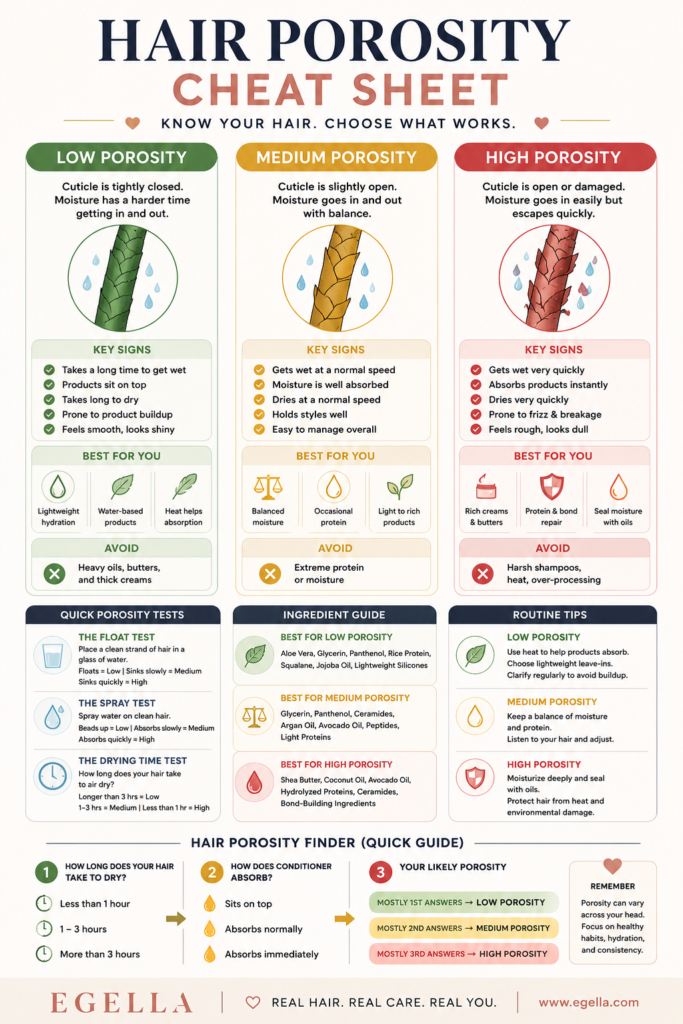
When the cuticle layers lie flat and tightly packed, moisture has difficulty entering the hair shaft. That’s low porosity. When the cuticle is slightly open and balanced, moisture enters and stays where it belongs. That’s medium porosity. When the cuticle is lifted or damaged, moisture rushes in easily — but escapes just as quickly. That’s high porosity.
This simple distinction explains why two people with the same curl pattern, the same hair length, and the same hair thickness can have completely different experiences using identical products. Hair type tells you what your hair looks like. Hair porosity tells you how it behaves.
Understanding Hair Structure
To understand porosity, it helps to understand how a single strand of hair is built:
| Layer | Purpose |
|---|---|
| Cuticle | The outer protective layer — controls moisture movement in and out |
| Cortex | Contains protein, pigment, and structural strength |
| Medulla | The innermost core, present in some hair types |
The cuticle is the layer that determines porosity. Healthy cuticles act like well-aligned roof shingles — keeping moisture where it belongs and protecting the cortex underneath. When cuticles are damaged by heat, bleaching, or chemical treatments, they lift permanently, changing how the hair behaves with every product.
The Three Hair Porosity Levels
| Porosity | Absorbs Moisture | Retains Moisture | Typical Characteristics |
|---|---|---|---|
| Low | Slowly | Very well | Product buildup, slow drying, shiny appearance |
| Medium | Balanced | Balanced | Easy to manage, responds well to most products |
| High | Very quickly | Poorly | Persistent dryness, frizz, faster colour fading |
Not sure what your porosity type is?
The Hair Porosity Test
Forget the viral glass-of-water test. While it’s widely shared online, most hairstylists and cosmetic scientists consider it unreliable — product residue, mineral buildup, hard water, and oils from yesterday’s conditioner all affect how a strand behaves in water. Observing how your hair behaves consistently over time is significantly more accurate.
Answer each set of questions honestly:
Low Porosity Indicators
- Your hair takes several hours to dry naturally
- Conditioner seems to sit on your hair rather than absorbing
- Your hair becomes greasy or weighed down easily
- Products build up quickly on the surface
- Your hair resists hair colour or chemical treatments
- Heavy oils stay on the surface rather than absorbing
Medium Porosity Indicators
- Your hair dries in about one to two hours
- Most products absorb and perform reasonably well
- Your hair holds styles for a reasonable amount of time
- Frizz is minimal under normal conditions
- Your hair has a healthy shine and good elasticity
High Porosity Indicators
- Your hair dries extremely quickly — often within 30–45 minutes
- Your hair always feels dry, even shortly after conditioning
- Frizz increases significantly in humidity
- Hair colour fades faster than expected
- Your ends split and break more easily than your roots
- Products absorb almost immediately on application
Editor’s Note — Sophia Bennett: Hair porosity isn’t permanent. Heat styling, bleaching, colouring, UV exposure, and chemical treatments can all increase porosity over time by lifting or damaging the cuticle. Newly grown roots often have lower porosity than chemically treated or heat-damaged ends — which means you can have two different porosity levels on the same strand. This is why some people find their roots feel fine but their ends are persistently dry. The ends need more moisture sealing; the roots need less.
Low Porosity Hair — Complete Guide
Low porosity hair has tightly packed cuticles that make it difficult for moisture to enter the shaft. The irony: once moisture gets inside, it stays for a long time. The challenge isn’t retention — it’s getting moisture in at all.
Common Characteristics
- Takes a long time to become fully wet in the shower
- Natural drying takes several hours
- Products sit on the surface rather than absorbing
- Heavy oils feel greasy rather than nourishing
- Product buildup happens quickly and persistently
- Hair often looks shiny and smooth even without product
Best Ingredients for Low Porosity Hair
- Glycerin — draws moisture into the hair shaft effectively
- Aloe vera — lightweight hydration that doesn’t sit on the surface
- Hydrolyzed rice protein — adds light strength without excessive weight
- Argan oil in small amounts — smooths without heavy coating
- Squalane — lightweight moisture sealing
- Water-based leave-in conditioners — absorb more readily than cream-based
Avoid for Low Porosity Hair
- Heavy butters (shea butter, mango butter)
- Excessive coconut oil — tends to sit on the surface
- Layering too many products — buildup happens faster than for other types
Low Porosity Wash Day Routine
- Wet hair with warm water — warmth helps lift the cuticle slightly and improves product absorption
- Cleanse with a gentle, clarifying-friendly shampoo every 3–4 weeks to remove buildup
- Apply a lightweight conditioner and sit with it for 5–10 minutes — a warm towel wrap helps ingredients penetrate
- Rinse thoroughly with cool water
- Apply a water-based leave-in conditioner while hair is still damp
- Finish with a lightweight serum or a small amount of argan oil on the mid-lengths and ends only
Medium Porosity Hair — Complete Guide
Medium porosity hair is generally the easiest to manage. The cuticle is healthy enough to retain moisture well while still allowing conditioners and treatments to penetrate effectively. Most mainstream hair products are formulated with medium porosity in mind.
Common Characteristics
- Healthy, natural shine
- Balanced hydration that lasts through the day
- Good elasticity — hair stretches slightly before returning to shape
- Easy styling with most product types
- Minimal frizz under normal weather conditions
Best Ingredients for Medium Porosity Hair
- Ceramides — maintain the cuticle barrier
- Panthenol (Pro-Vitamin B5) — improves softness and flexibility
- Light plant oils — jojoba, argan
- Amino acids — support strength without stiffness
- Proteins — useful occasionally, not every wash
Medium Porosity Routine
- Shampoo 2–3 times weekly with a balanced formula
- Deep condition every 1–2 weeks
- Protein treatment once monthly
- Light oil on mid-lengths and ends as needed between washes
High Porosity Hair — Complete Guide
High porosity hair has a more open or damaged cuticle. Moisture enters easily — but escapes just as quickly. This creates a cycle of dryness that no single product fully breaks. The solution isn’t adding more moisture — it’s sealing the moisture that goes in.
Common Characteristics
- Dries extremely quickly
- Frizzes easily, particularly in humidity
- Breaks more frequently, especially at the ends
- Feels rough or coarse to the touch
- Absorbs products almost immediately on application
- Hair colour fades faster than expected
Best Ingredients for High Porosity Hair
- Shea butter — seals moisture in effectively
- Ceramides — help reinforce the damaged cuticle structure
- Avocado oil — rich nourishment that penetrates effectively
- Jojoba oil — lightweight sealing
- Bond-building ingredients — support the internal hair structure
- Hydrolyzed keratin — helps reinforce weakened hair fibres
Avoid for High Porosity Hair
- Frequent clarifying shampoo — strips moisture that high porosity hair struggles to retain
- Daily heat styling — further lifts an already-open cuticle
- Harsh sulphates — increase dryness and frizz
High Porosity Wash Day Routine
- Use a moisturising, sulphate-free shampoo
- Apply a rich conditioner and leave for at least 5 minutes
- Follow with a deep conditioning mask — weekly
- Rinse with cool water — cool water helps close the cuticle slightly and reduces frizz
- Apply leave-in conditioner immediately on wet hair
- Seal with a heavier oil (avocado, jojoba, or a small amount of shea butter) as the final step — this is what prevents moisture from escaping
Complete Ingredient Guide by Porosity
| Ingredient | Low | Medium | High | Main Benefit |
|---|---|---|---|---|
| Glycerin | ✅ Best | ✅ Good | ✅ Good | Draws moisture into hair |
| Aloe Vera | ✅ Best | ✅ Good | ✅ Good | Lightweight hydration |
| Panthenol | ✅ Good | ✅ Best | ✅ Good | Softness and flexibility |
| Ceramides | ✅ Good | ✅ Best | ✅ Best | Cuticle barrier support |
| Argan Oil | ✅ Good (small amounts) | ✅ Best | ✅ Good | Shine and smoothing |
| Jojoba Oil | ✅ Good | ✅ Good | ✅ Best | Lightweight sealing |
| Coconut Oil | ⚠️ Use sparingly | ✅ Good | ✅ Good | Reduces protein loss |
| Avocado Oil | ⚠️ Too heavy | ✅ Good | ✅ Best | Rich nourishment |
| Shea Butter | ❌ Too heavy | ⚠️ Occasional | ✅ Best | Locks in moisture |
| Hydrolyzed Keratin | ⚠️ Light use | ✅ Good | ✅ Best | Reinforces weakened fibres |
| Squalane | ✅ Best | ✅ Good | ✅ Good | Lightweight softness |
| Bond-Building Ingredients | ⚠️ Rarely needed | ⚠️ Occasional | ✅ Best | Internal structure support |
Protein vs. Moisture Balance
One of the most confusing concepts in hair care is knowing whether your hair needs more protein or more moisture at any given time. Healthy hair benefits from both — but the balance shifts depending on porosity and current condition.
| If Your Hair Feels… | It May Need… |
|---|---|
| Stretchy and limp — doesn’t spring back | More protein |
| Dry, rough, or brittle | More moisture |
| Stiff and resistant after protein treatments | Less protein, more moisture |
| Soft, flexible, and resilient | Balanced — maintain current approach |
Rather than following trends, observe how your hair responds after each wash. The goal is hair that feels soft, flexible, and resilient — not overly stiff and not excessively limp.
How Seasonal Changes Affect Hair Porosity
| Season | What Happens | Recommended Adjustment |
|---|---|---|
| Winter | Cold air and indoor heating increase moisture loss | Increase deep conditioning frequency |
| Spring | Humidity begins to rise — particularly challenging for high porosity | Switch to lighter styling products |
| Summer | UV exposure, chlorine, and saltwater increase dryness and porosity | Add UV protection and hydrating masks |
| Autumn | Air becomes drier — similar to winter preparation | Focus on repairing summer damage before cold arrives |
Choose Your Routine Based on Your Hair Goal
| Your Goal | Recommended Focus |
|---|---|
| Reduce frizz | Seal moisture with lightweight oils, minimise heat styling |
| Increase shine | Clarify buildup occasionally, use smoothing serums |
| Longer-lasting hydration | Layer leave-in then seal with oil — always in that order |
| Repair bleached or coloured hair | Bond-building treatments and weekly deep conditioning |
| Protect colour from fading | Sulphate-free shampoo, reduce heat exposure |
| More volume | Lightweight styling products, avoid heavy butters entirely |
8 Common Hair Porosity Mistakes
1. Choosing products based only on hair type
Curly, straight, fine, or thick — every hair type has a porosity level. Two people with identical curl patterns can need completely different products based on porosity alone.
2. Using heavy oils on low porosity hair
Rich oils and butters sit on the surface of low porosity hair rather than absorbing, leaving it greasy without improving hydration. Lightweight, water-based products penetrate far more effectively.
3. Avoiding protein completely
Protein isn’t the enemy — it’s a matter of using the right amount for your hair’s current needs. Hair that’s overly limp, stretchy, or weak often needs more protein, not less.
4. Overusing clarifying shampoo
Clarifying shampoos are useful occasionally — particularly for low porosity hair prone to buildup — but frequent use strips moisture and is especially damaging for high porosity hair.
5. Ignoring heat protection
Repeated heat styling gradually lifts the cuticle, increasing porosity permanently over time. A heat protectant before every heat styling session is one of the most evidence-supported habits for maintaining porosity levels.
6. Expecting instant results
Changing your routine won’t transform your hair in one wash. Consistency over several weeks usually produces the most useful and accurate information about what’s working.
7. Following viral hair advice without context
A product that’s genuinely transformative for low porosity hair may cause persistent dryness on high porosity hair. Context — specifically porosity — is the missing piece in most viral hair recommendations.
8. Using too many products simultaneously
More products don’t mean healthier hair. Introducing one new product every two weeks and observing the response provides far more useful information than a complete routine overhaul.
Sophia’s Wash Day Tip: Instead of buying several new products at once, introduce only one new product every two weeks. Take a quick photo after each wash day and note how your hair feels, how long it stays hydrated, and whether frizz changes. Within a month, you’ll see clear patterns that make future product choices significantly easier. Beautiful hair isn’t about finding one miracle product — it’s about understanding how your hair responds over time.
Hair Porosity Myths vs. Facts
| Myth | Fact |
|---|---|
| The glass-of-water test is always accurate | It’s considered unreliable by most hair professionals — observing behaviour over time is more accurate |
| Only curly hair has porosity concerns | Every hair type — straight, wavy, curly, coily — has a porosity level that affects product performance |
| Low porosity hair is healthier | Each porosity level has distinct strengths and challenges — none is inherently superior |
| You can permanently lower your hair porosity | Natural porosity is largely genetic; you can improve cuticle condition but cannot permanently reverse damage |
| Expensive products work better for any porosity | The right ingredient for your porosity matters far more than price or brand reputation |
The Egella Take
💇 Best for: anyone who has tried multiple products without consistent results, those whose hair behaves unpredictably across seasons, anyone starting to build a hair routine from scratch
🏆 The insight: porosity explains behaviour, not just appearance — it’s the framework that makes every other hair care decision more logical
⚠️ The honest truth: your hair porosity can and does change — heat damage and bleaching increase porosity permanently, which is why the same routine that worked last year may no longer be working now
Hair porosity isn’t a beauty buzzword — it’s one of the most practical frameworks in modern hair care. Understanding how your hair absorbs and retains moisture explains why some products become instant favourites while others never seem to work, regardless of price or popularity. The best hair routine isn’t the most complicated one. It’s the one built around how your hair actually behaves.
Frequently Asked Questions About Hair Porosity
Can my hair porosity change over time?
Yes. Natural porosity is largely influenced by genetics, but bleaching, colouring, heat styling, UV exposure, and chemical treatments can all increase porosity by lifting or damaging the cuticle. The reverse — reducing porosity — is not permanent, though healthier habits can improve overall cuticle condition.
Is the glass-of-water test accurate?
Not reliably. Product buildup, mineral deposits from hard water, and oils from previous products all affect how a strand behaves in water. Observing how your hair behaves consistently over time — drying speed, product absorption, frizz in humidity — gives a far more accurate picture.
Can I have different porosity levels on the same head?
Yes. Newly grown roots often have lower porosity than chemically treated or heat-damaged ends. This is why some people find their roots feel fine while their ends are persistently dry — they’re dealing with two different porosity levels simultaneously.
Which porosity is considered healthiest?
Medium porosity is generally the easiest to manage. But every porosity level can support healthy, beautiful hair with the right routine — low and high porosity aren’t disadvantages, they’re just different starting points.
Why does my hair stay dry even after conditioning?
If hair feels dry shortly after conditioning, high porosity is likely allowing moisture to escape faster than it can be replaced. Richer conditioners and a moisture-sealing oil as the final step usually help significantly.
How often should I deep condition?
High porosity hair typically benefits from weekly deep conditioning. Low porosity hair often only needs it every one to two weeks — more frequent deep conditioning can cause buildup without additional benefit.
Do natural oils repair hair porosity?
Oils reduce moisture loss and improve softness, but they don’t permanently repair damaged cuticles. Consistent care, minimising heat and chemical damage, and using appropriate bond-building treatments are the most effective long-term strategies.
Hair Porosity Quick Reference
| Porosity | Best Choice | Avoid |
|---|---|---|
| Low | Lightweight, water-based hydration; warm water application | Heavy oils, thick butters, excessive layering |
| Medium | Balanced moisture and occasional protein; most products work | Extreme routines in either direction |
| High | Rich conditioners, bond repair treatments, sealing oils | Frequent clarifying shampoo, daily heat styling, harsh sulphates |
Sources & References
- American Academy of Dermatology (AAD) — Hair Care Recommendations
- International Journal of Trichology — Hair Fibre Structure and Cosmetic Science
- Journal of Cosmetic Science — Hair Cuticle Structure and Moisture Retention
- Society of Cosmetic Chemists — Hair Conditioning Technologies
- Robbins CR. Chemical and Physical Behavior of Human Hair
This guide was researched and written by the Egella editorial team using peer-reviewed cosmetic science literature, dermatology resources, and current hair care best practices. Last updated: June 2026.
Save this guide before your next wash day — and explore more hair guides at egella.com
Which porosity type are you — and what product changed everything for your hair? Tell us in the comments.