


Part of the Egella Skin Intelligence Series — understanding the ingredients that actually work.
If you’ve spent more than five minutes in the skincare aisle or on a beauty TikTok, you’ve encountered both niacinamide and vitamin C. They’re arguably the two most talked-about brightening and skin-tone ingredients available without a prescription. They’re also frequently confused, occasionally pitted against each other, and almost always used without a clear understanding of what each one actually does — and which one you actually need.
Quick Summary: Niacinamide (vitamin B3) and vitamin C are both brightening ingredients that work on uneven skin tone, but through different mechanisms. Vitamin C is an antioxidant that neutralizes UV damage and boosts collagen synthesis — better for hyperpigmentation prevention and visible brightening. Niacinamide regulates sebum, reduces inflammation, and strengthens the barrier — better for texture, redness, and sensitive skin. Most people benefit from both, used at different times of day.
This guide covers what each ingredient actually does, who benefits most from each, whether they can be used together (the answer is more nuanced than most guides admit), and how to choose if you can only use one.
Editor’s Note — Harper Collins: The question I get asked most often about these two ingredients is whether you can use them together — and the honest answer is: it depends on the formulations and concentrations. There was a widely circulated claim that mixing niacinamide and vitamin C creates niacin, which causes flushing. Current dermatologist consensus is that this reaction requires extremely high temperatures and concentrations that aren’t present in standard skincare products. But vitamin C is still pH-sensitive and works best in its own window — which is why using them at different times of day (vitamin C in the morning, niacinamide in the evening, or at least with a few minutes between them) is the most practical approach regardless of the flushing question.
What Niacinamide Actually Does
Niacinamide is a form of vitamin B3 — a water-soluble ingredient with an unusually broad range of well-documented skin benefits. It’s one of the most versatile active ingredients in skincare because it addresses multiple concerns simultaneously without the irritation potential of stronger actives like retinoids or high-concentration vitamin C.
Its primary mechanisms:
- Regulates sebum production — particularly useful for oily and combination skin types, where excess sebum production contributes to enlarged pores and breakouts
- Reduces inflammation — makes it well-suited to acne-prone and rosacea-prone skin, where inflammation is the underlying driver of many visible concerns
- Inhibits melanin transfer to skin cells — this is the mechanism behind its brightening effect. Rather than blocking melanin production entirely (as some ingredients do), niacinamide reduces how much existing melanin is transferred to the upper layers of skin, gradually evening tone over time
- Strengthens the skin barrier — increases ceramide production and other lipid components of the barrier, making skin more resilient to irritation and moisture loss
- Reduces the appearance of pores — through its effect on sebum regulation, regular niacinamide use reduces the accumulation of oil that makes pores appear larger
What makes niacinamide particularly useful: it’s effective at relatively low concentrations (2–5% is well-supported by research) and has a low irritation profile, making it one of the few active ingredients suitable for sensitive and reactive skin types. This also means it works well as a complement to stronger actives like retinoids or acids — it soothes while they work.
What Vitamin C Actually Does
Vitamin C (L-ascorbic acid in its most effective form) is a powerful antioxidant that protects skin from oxidative stress — the environmental damage caused by UV exposure, pollution, and other free radical sources that accelerates visible aging and pigmentation.
Its primary mechanisms:
- Neutralizes free radicals — vitamin C is the most effective topical antioxidant available, intercepting free radical damage before it affects collagen and DNA
- Inhibits tyrosinase — the enzyme that drives melanin production. This direct inhibition of pigment production makes vitamin C more immediately effective for hyperpigmentation prevention than niacinamide
- Boosts collagen synthesis — vitamin C is essential for collagen formation and stimulates its production in skin cells, contributing to the firmness and plumpness that collagen supports
- Brightens overall complexion — consistent use produces a visible brightness and evenness that is one of the most noticeable effects of daily vitamin C application
The caveat with vitamin C: it’s significantly more difficult to formulate and use effectively than niacinamide. L-ascorbic acid is unstable — it oxidizes when exposed to light and air, which is why vitamin C serums turn orange or brown when they’re degraded. It also requires a low pH (below 3.5) to absorb effectively, which can cause tingling or irritation on sensitive skin. Vitamin C derivatives (ascorbyl glucoside, magnesium ascorbyl phosphate) are more stable and gentler but also less potent.
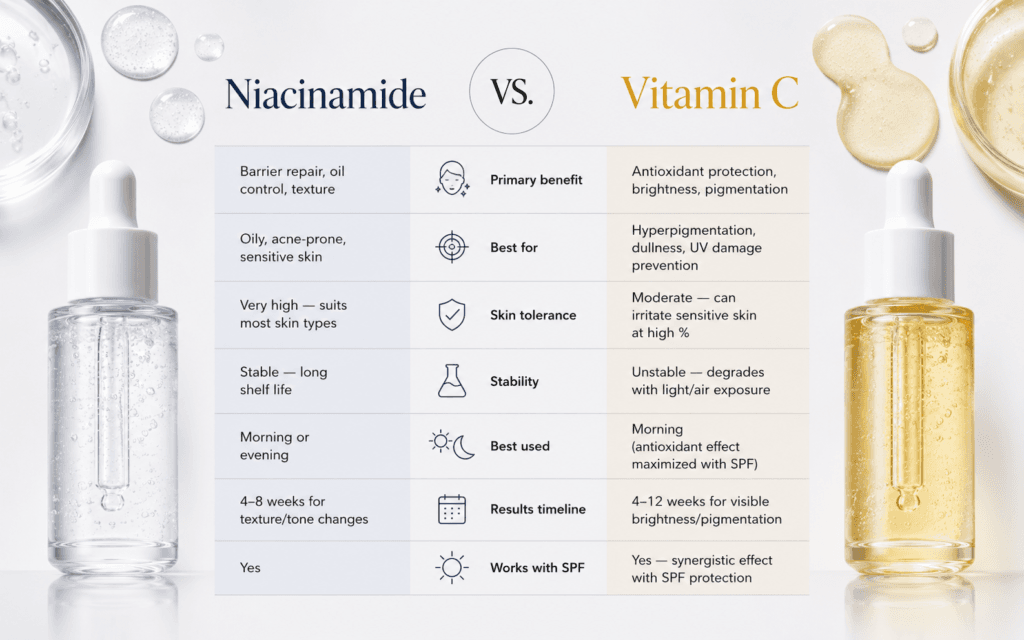
Niacinamide vs. Vitamin C: Direct Comparison
| Factor | Niacinamide | Vitamin C |
|---|---|---|
| Primary benefit | Barrier repair, oil control, texture | Antioxidant protection, brightness, pigmentation |
| Best for | Oily, acne-prone, sensitive skin | Hyperpigmentation, dullness, UV damage prevention |
| Skin tolerance | Very high — suits most skin types | Moderate — can irritate sensitive skin at high % |
| Stability | Stable — long shelf life | Unstable — degrades with light/air exposure |
| Best used | Morning or evening | Morning (antioxidant effect maximized with SPF) |
| Results timeline | 4–8 weeks for texture/tone changes | 4–12 weeks for visible brightness/pigmentation |
| Works with SPF | Yes | Yes — synergistic effect with SPF protection |
Can You Use Niacinamide and Vitamin C Together?
Yes — with a practical caveat. The concern about combining these two ingredients (that they create niacin, which causes flushing) is based on chemistry that requires temperatures and concentrations far beyond what appears in skincare products. Current dermatological consensus is that this reaction is not a meaningful concern for standard formulations.
The practical reason to separate them is different: vitamin C works optimally at a low pH (around 3–3.5), and niacinamide works at a neutral pH. Applying a neutral-pH niacinamide product immediately after a low-pH vitamin C serum slightly raises the pH of the vitamin C, reducing its effectiveness. Using them at different times — vitamin C in the morning, niacinamide in the evening — avoids this entirely and allows each to work in its optimal conditions.
If your routine doesn’t allow for separated application, waiting 10–15 minutes between them allows the pH of the vitamin C to stabilize before the niacinamide is applied.
How to Choose If You Can Only Use One
Choose niacinamide if:
- You have oily, acne-prone, or combination skin
- Your main concern is texture, pores, or redness
- You have sensitive or reactive skin that doesn’t tolerate vitamin C well
- You’re new to actives and want a low-risk starting point
- You’re using retinoids and need a soothing complement
Choose vitamin C if:
- Your main concern is dark spots, hyperpigmentation, or sun damage
- You want antioxidant protection as part of your morning SPF routine
- Your skin is generally tolerant and not prone to reactive responses
- You’re focusing on long-term collagen support and skin aging prevention
Both of these ingredients complement the broader approach to skin health covered in our guide to fading dark spots and hyperpigmentation — understanding how they work helps you apply them more effectively as part of a broader brightening routine.
Editor’s Note — Harper Collins: The most underappreciated thing about both of these ingredients: patience. Neither niacinamide nor vitamin C produces visible results in a week. Most skin studies that demonstrate meaningful tone changes are run over 8–12 weeks of consistent daily use. If you’ve tried either of these ingredients and “it didn’t work,” the most likely reason is either an insufficient application period or a degraded formulation (particularly relevant for vitamin C, which goes bad). Check the color of your vitamin C serum — if it’s orange or brown rather than pale yellow or clear, it’s oxidized and no longer effective. That’s not a failure of the ingredient; it’s a storage or formulation issue.
Who These Ingredients Are Best For
Niacinamide best for: oily and combination skin, acne-prone and post-acne scarring, sensitive and rosacea-prone skin, anyone also using retinoids who needs a calming complement, and those wanting a gentle entry point into active skincare alongside a barrier repair routine.
Vitamin C best for: hyperpigmentation and sun damage, dullness and uneven tone, anyone building an antioxidant-first morning routine alongside SPF, and people whose skin can tolerate low-pH formulas without significant reactivity.
The Egella Take
The niacinamide vs. vitamin C question is usually the wrong framing — most people’s skin benefits from both, just at different times of day. Vitamin C in the morning with SPF for antioxidant protection and pigmentation prevention. Niacinamide in the evening for barrier support, inflammation, and texture. The two ingredients address complementary aspects of skin health rather than competing for the same job. If your routine has room for only one: niacinamide is the safer, more versatile choice for most skin types; vitamin C is the more immediately impactful choice for hyperpigmentation specifically.
Frequently Asked Questions
What percentage of niacinamide is most effective?
Research supports 2–5% as the effective range for most concerns. Higher concentrations (10%+) are available but don’t show proportionally better results and can cause flushing in sensitive individuals. 5% is a reliable, well-tolerated starting point for most skin types.
How do I know if my vitamin C serum has degraded?
A fresh vitamin C serum should be pale yellow to nearly clear. Orange or brown coloration indicates oxidation — the active has degraded and the product is no longer effective for its primary purpose. Store vitamin C serums in a dark, cool location and use within 3 months of opening.
Can niacinamide make acne worse?
No — niacinamide is one of the few actives that actively supports acne-prone skin through its anti-inflammatory and sebum-regulating effects. It’s one of the most consistently well-tolerated ingredients for breakout-prone skin.
Does vitamin C work on dark spots?
Yes — it’s one of the most evidence-supported topical ingredients for hyperpigmentation, working by inhibiting the enzyme that drives melanin production. It works best as part of a complete approach that includes daily SPF, since UV exposure both creates new spots and darkens existing ones.
Two Ingredients Worth Understanding
The skincare industry produces a new “breakthrough” ingredient at a pace that makes it hard to distinguish real from noise. Niacinamide and vitamin C are two that have decades of research behind them and consistent real-world results across skin types. Understanding what each one actually does — rather than what the marketing says — is the basis for using them effectively.
Save this guide and explore more skincare guides at egella.com
Are you team niacinamide, team vitamin C, or both? Tell us your experience in the comments.
