

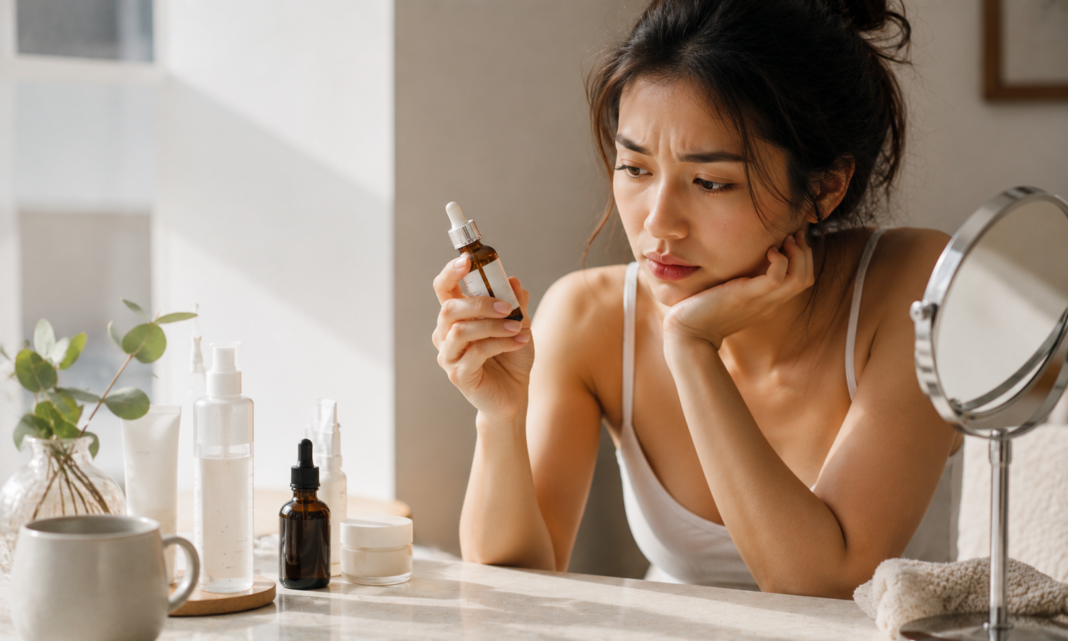
Part of the Egella Skin Intelligence Series — understanding the ingredients that actually work.
⚕️ Educational content — not medical advice. Full disclaimer below.
A vitamin C serum is one of the most evidence-backed ingredients in skincare — and one of the easiest to use incorrectly without ever realising it. The wrong concentration, the wrong storage, an oxidised bottle that’s quietly stopped working weeks ago. None of these mistakes look dramatic. They just mean you’ve been applying an expensive antioxidant that isn’t doing very much. Here are the seven that matter most.
Quick Summary: The most effective vitamin C serums use 10–20% L-ascorbic acid at a pH between 2.5 and 3.5 — concentrations above 20% don’t improve absorption, they just increase irritation risk. Oxidation is the most common reason a vitamin C serum stops working: once it turns yellow, orange, or brown, discard it. Apply in the morning, after cleansing and before moisturiser, and always follow with SPF. Most overlooked mistake: introducing too high a concentration too fast, before the skin has built tolerance.
This guide covers the seven mistakes that quietly undermine vitamin C serum results — concentration, formulation type, storage, layering, application order, timing, and the sun protection step most people treat as optional.
Editor’s Note — Harper Collins: The mistake I see most often isn’t a bad product — it’s a good product used past its expiry. Vitamin C serum oxidises whether you notice or not, and the colour change is the only reliable signal you’ll get. People keep using a serum that’s gone from pale yellow to deep orange because the texture still feels the same. It doesn’t work the same. If you can’t remember exactly when you opened the bottle, that’s already a sign to check the colour before your next application.
1. Using the Wrong Concentration
Research consistently shows that L-ascorbic acid below 8% provides surface antioxidant protection but fails to meaningfully stimulate collagen production. The clinical threshold sits between 10% and 20% — this is the range where peer-reviewed studies document measurable improvements in photoaging, hyperpigmentation, and skin firmness. Above 20%, absorption plateaus while irritation risk increases sharply, with no proportional benefit.
The right vitamin C serum concentration isn’t the highest number on the label — it’s the highest percentage your skin can tolerate without barrier compromise. Sensitive skin or anyone with active barrier issues should start at 10% and build upward; resilient skin types can move toward 15–20%, particularly for stubborn hyperpigmentation. Our skin barrier repair guide covers how to assess whether your barrier is ready for an active like vitamin C before introducing it.
2. Not Knowing Your Formulation Type
Vitamin C exists in several forms, and they are not interchangeable. L-ascorbic acid is the most researched and most potent — it’s also the most unstable and the most likely to irritate sensitive skin. Derivatives like sodium ascorbyl phosphate (SAP), magnesium ascorbyl phosphate, and tetrahexyldecyl ascorbate (THD ascorbate) are more stable and gentler, but generally less potent at the same percentage.
For sensitive or reactive skin, a stable derivative at a slightly higher percentage often produces a more comfortable, more consistent result than L-ascorbic acid at a lower one. For skin that already tolerates actives well, L-ascorbic acid at 10–20% with a pH of 2.5–3.5 remains the gold standard for measurable results.
3. Letting It Oxidise Without Noticing
Vitamin C is notoriously unstable — exposure to air, light, and heat causes L-ascorbic acid to oxidise, turning the serum from clear or pale straw to yellow, then amber, then brown. Oxidised vitamin C doesn’t just stop working; it can increase irritation risk because the breakdown byproducts are more reactive than the stable form.
| Colour | What It Means |
|---|---|
| Clear or pale straw | Fresh, fully potent |
| Pale yellow | Still effective, monitor closely |
| Yellow to amber | Oxidation beginning — effectiveness declining |
| Orange or brown | Significantly oxidised — discard |
A change in smell is the second warning sign — fresh vitamin C is nearly odourless, while oxidised serum often develops a metallic or faintly sulphurous scent. Store your serum away from direct light and heat, ideally in a dark, airtight bottle or airless pump, and use it within 3 months of opening regardless of how much is left.
4. Layering It with Too Many Other Actives
Combining vitamin C with exfoliating acids, retinol, and benzoyl peroxide in the same routine overwhelms the skin and increases irritation risk without adding benefit. Vitamin C and niacinamide can generally be used together without the flushing concern once attributed to the combination — our niacinamide vs vitamin C guide covers the actual science behind that claim in full.
The ingredient that consistently causes problems when layered with vitamin C is retinol — not because they’re chemically incompatible, but because using both in the same routine compounds irritation on skin that’s already adjusting to one active. Separate them by time of day: vitamin C in the morning, retinol at night.
5. Applying It in the Wrong Order
Vitamin C serum goes on after cleansing and before moisturiser — applying it over moisturiser blocks penetration, while applying it to damp skin dilutes the formula and can affect its pH stability. Most dermatologists recommend 2–3 drops, applied with light, upward patting motions rather than vigorous rubbing, followed by a 1–2 minute absorption window before layering anything else.
Using more product doesn’t accelerate results — the skin can only absorb a limited amount of any active at once, and excess serum typically just sits on the surface, increasing the chance of irritation without adding benefit.
6. Using It at the Wrong Time of Day
Vitamin C is most effective applied in the morning, where its antioxidant properties help neutralise free radical damage from UV exposure and pollution throughout the day. This timing also pairs naturally with sunscreen — the two work as complementary protection rather than redundant steps.
Evening application isn’t harmful, but it misses the antioxidant protection window that makes morning use particularly valuable. If your routine only has room for one vitamin C application, morning is the more evidence-supported choice.
7. Skipping Sunscreen Afterward
This is the mistake with the most consequence and the least awareness. Vitamin C provides antioxidant support, but it is not a substitute for SPF — daily broad-spectrum sunscreen remains essential regardless of how diligently you apply vitamin C. Skipping sunscreen after a vitamin C serum doesn’t just leave skin unprotected; it also undermines the hyperpigmentation-fading benefit the serum is meant to provide, since unprotected UV exposure continues creating new pigmentation even as the vitamin C works to fade existing spots.
Editor’s Note — Harper Collins: Vitamin C and SPF are sometimes marketed as if the serum makes sunscreen optional. It doesn’t, and no dermatologist recommends treating them as substitutes. Think of them as sequential, not interchangeable: vitamin C addresses the damage that’s already happened and helps prevent some of what’s coming; SPF prevents the new damage that vitamin C alone can’t undo.
The Egella Take
🍊 Best for: anyone targeting hyperpigmentation, dullness, or early signs of photoaging, those building an antioxidant-first morning routine
🏆 The formula: 10–20% L-ascorbic acid at pH 2.5–3.5 has the strongest clinical evidence — or a stable derivative if your skin is sensitive
⚠️ The honest truth: most vitamin C serum disappointment isn’t the ingredient failing — it’s an oxidised bottle, the wrong concentration, or a missing SPF step undoing the work.
A vitamin C serum used correctly — fresh, properly concentrated, applied in the right order, protected by daily SPF — is one of the few skincare investments with genuinely strong evidence behind it. The seven mistakes above are also the seven most common reasons people conclude an effective ingredient “didn’t work” for them.
Frequently Asked Questions About Vitamin C Serum
What percentage of vitamin C serum is best?
10–20% L-ascorbic acid is the clinically supported range. Below 8% provides limited benefit; above 20% increases irritation without improving absorption, since penetration plateaus around that point.
How do I know if my vitamin C serum has gone bad?
Colour is the most reliable indicator — fresh serum is clear or pale straw; yellow to amber signals oxidation beginning; orange or brown means it’s significantly degraded and should be discarded. A metallic or sulphurous smell is a secondary warning sign.
Can I use vitamin C serum every day?
Most skin types tolerate daily use well. If you’re new to vitamin C, start every other day for two to four weeks to assess tolerance before moving to daily application.
Should I use vitamin C in the morning or at night?
Morning is the more evidence-supported choice, since the antioxidant protection pairs with daytime UV and pollution exposure. Evening use isn’t harmful but misses this specific benefit.
Can vitamin C serum cause breakouts?
Vitamin C itself rarely causes breakouts — but an oxidised serum, a formulation with comedogenic oils, or layering it with too many other actives at once can irritate skin in ways that resemble breakouts. A water-based, lightweight formula reduces this risk for acne-prone skin.
Can I use vitamin C and retinol together?
Yes, but not in the same application. Use vitamin C in the morning and retinol at night to avoid compounding irritation on skin that’s adjusting to either ingredient. Our retinol for beginners guide covers how to introduce retinol safely alongside an existing vitamin C routine.
Medical Disclaimer
This article is for educational purposes only and does not constitute medical advice. Patch test new vitamin C products before full-face application, and consult a board-certified dermatologist if you have a diagnosed skin condition such as eczema, rosacea, or psoriasis before introducing high-concentration actives.
Sources & References
- Cleveland Clinic — Vitamin C Serum: Benefits and How to Apply
- Journal of the American Academy of Dermatology (JAAD) — L-Ascorbic Acid Percentage and Skin Penetration
- Pharmaceutical Development and Technology — Vitamin C Serum Stability and Storage Conditions
- Harvard Health Publishing — Topical Antioxidants and Skin Protection
This guide was researched and written by the Egella editorial team using current dermatology guidelines and peer-reviewed cosmetic science literature. Last updated: June 2026.
Save this guide and explore more skincare guides at egella.com
Which of these mistakes were you making? Tell us in the comments.