

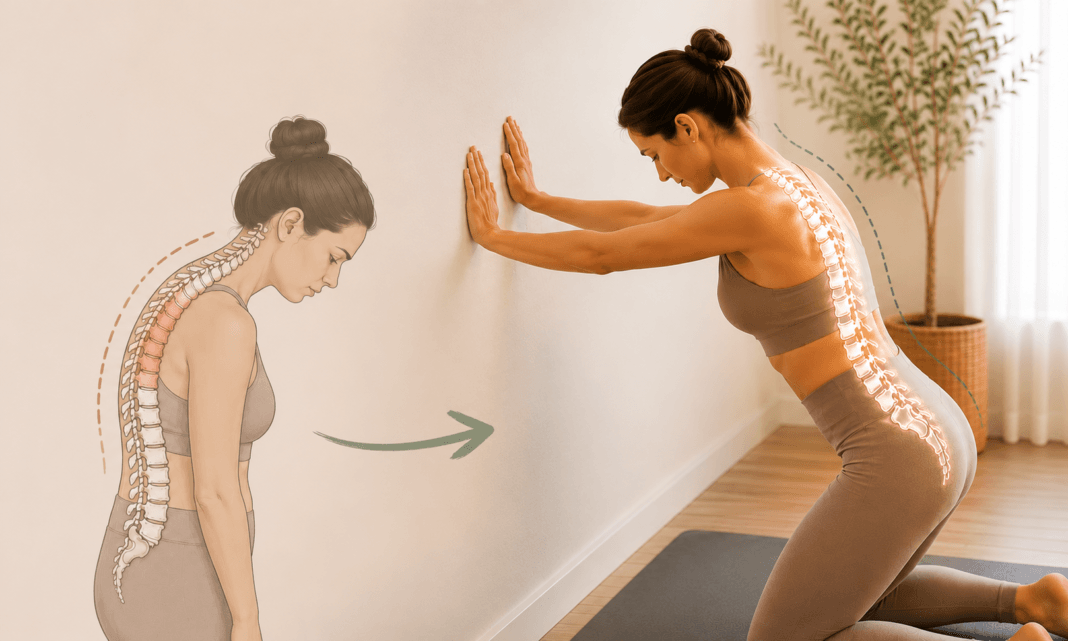

These t-spine mobility exercises target one of the most commonly neglected areas of the body — the thoracic spine, or T-spine, the stretch of twelve vertebrae running through your mid and upper back. Most people don’t realize their upper back is stiff until they try to rotate their torso fully and can’t, or until their neck and shoulders start compensating for movement the T-spine should be doing on its own.
Quick Summary: The thoracic spine is designed to extend, flex, rotate, and bend sideways — but modern sitting habits restrict all four directions. These 7 exercises take 10 to 15 minutes and require minimal equipment. Consistency matters more than intensity: small, daily movement beats an occasional long session. Short on time? Start with just 3: Seated Trunk Rotation → Open Book → Foam Roller Extension. Five minutes, no equipment needed for the first two.
This guide covers seven exercises that address T-spine stiffness from multiple directions, why the area gets restricted in the first place, and when it’s worth seeing a physical therapist rather than working through it alone.
Editor’s Note: The first time we tried foam rolling the thoracic spine, we positioned the roller too low and ended up mobilizing the lumbar spine instead — which is not where you want extra movement. The foam roller should sit across the mid and upper back, roughly between the shoulder blades and the bottom of the ribcage. Getting the placement right made an immediate difference in how the exercise actually felt.
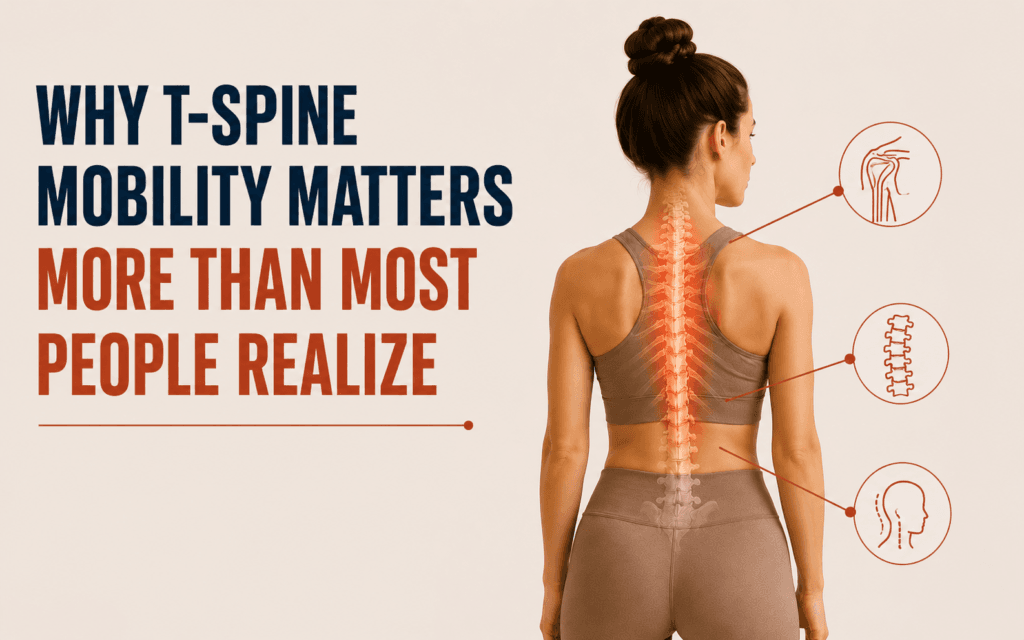
Why T-Spine Mobility Matters More Than Most People Realize
The thoracic spine is the longest segment of the spine, connecting the neck above and the lower back below. When it becomes stiff — which is extremely common given how much time most people spend sitting — the body compensates by asking the neck, shoulders, and lower back to pick up the movement the T-spine should be handling.
This compensation creates a chain reaction: a stiff T-spine forces the shoulder to work harder during overhead movements (contributing to rotator cuff problems), pushes the lower back to rotate more than it’s designed to (increasing disc compression), and contributes to the forward head posture that makes screen-heavy days feel so draining. Improving T-spine mobility doesn’t just help the upper back — it takes load off almost everything connected to it.
Signs You May Have Poor T-Spine Mobility
Most people don’t connect their neck tension or lower back pain to a stiff upper back — but the signs are often visible in everyday posture and movement:
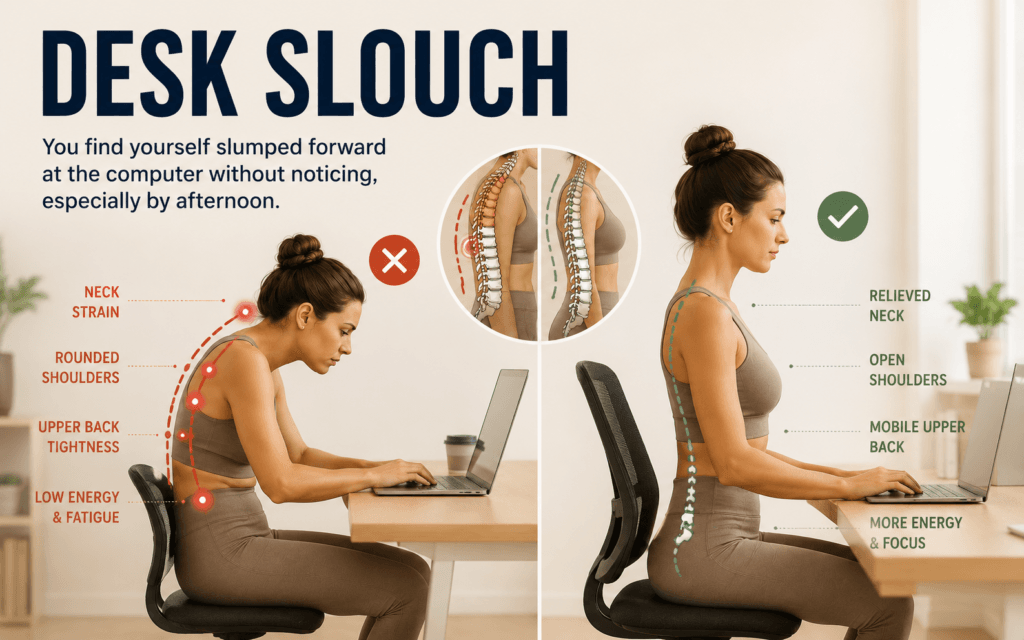
Desk slouch:
You find yourself slumped forward at the computer without noticing, especially by afternoon
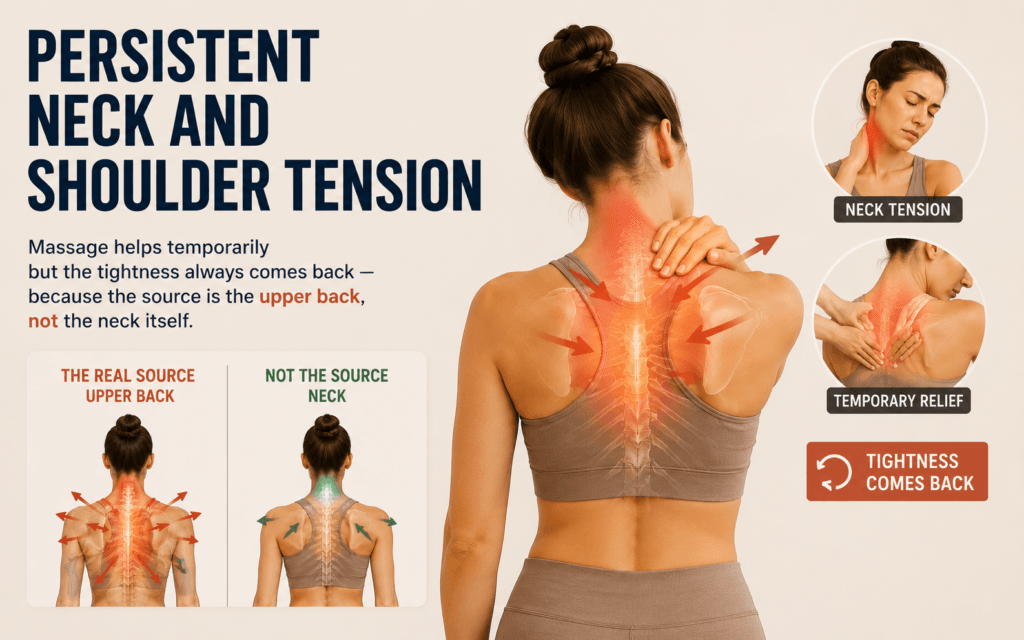
Persistent neck and shoulder tension:
Massage helps temporarily but the tightness always comes back — because the source is the upper back, not the neck itself

Shallow breathing:
A compressed thoracic spine limits chest expansion, making deep breaths feel effortful
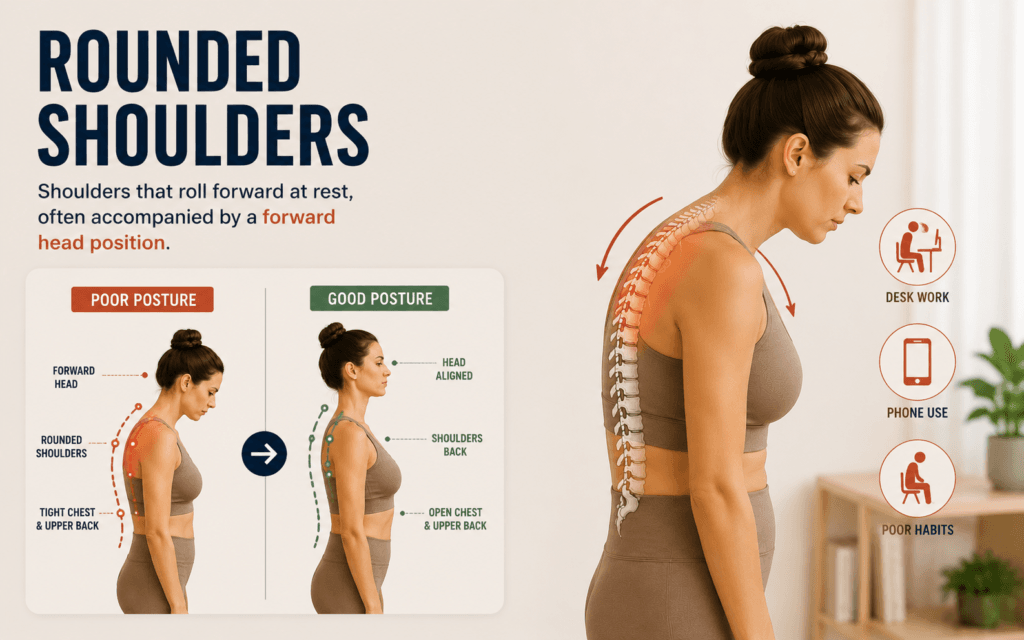
Rounded shoulders:
Shoulders that roll forward at rest, often accompanied by a forward head position
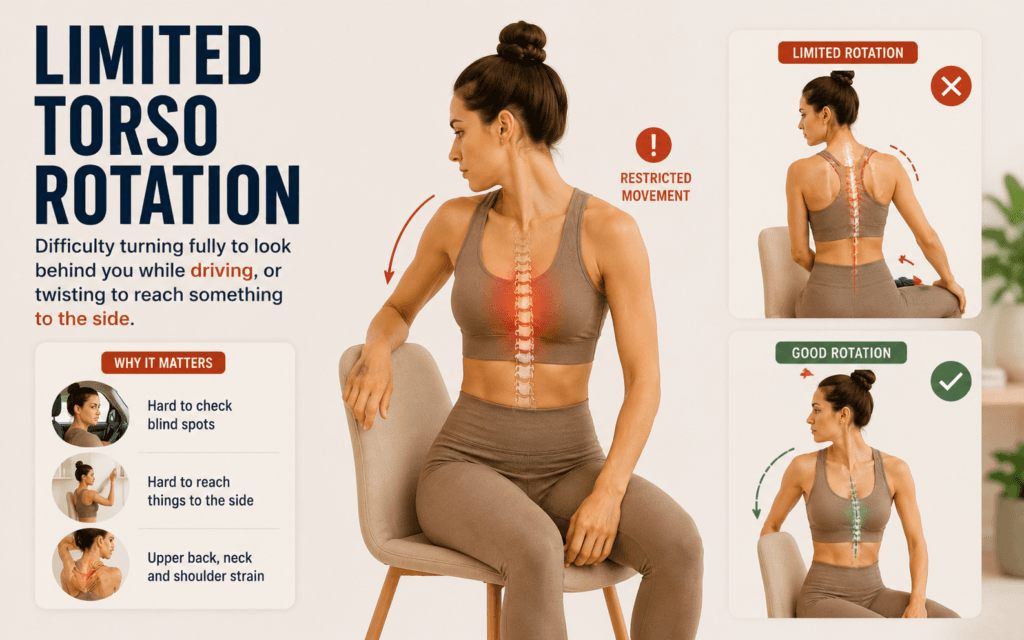
Limited torso rotation:
Difficulty turning fully to look behind you while driving, or twisting to reach something to the side
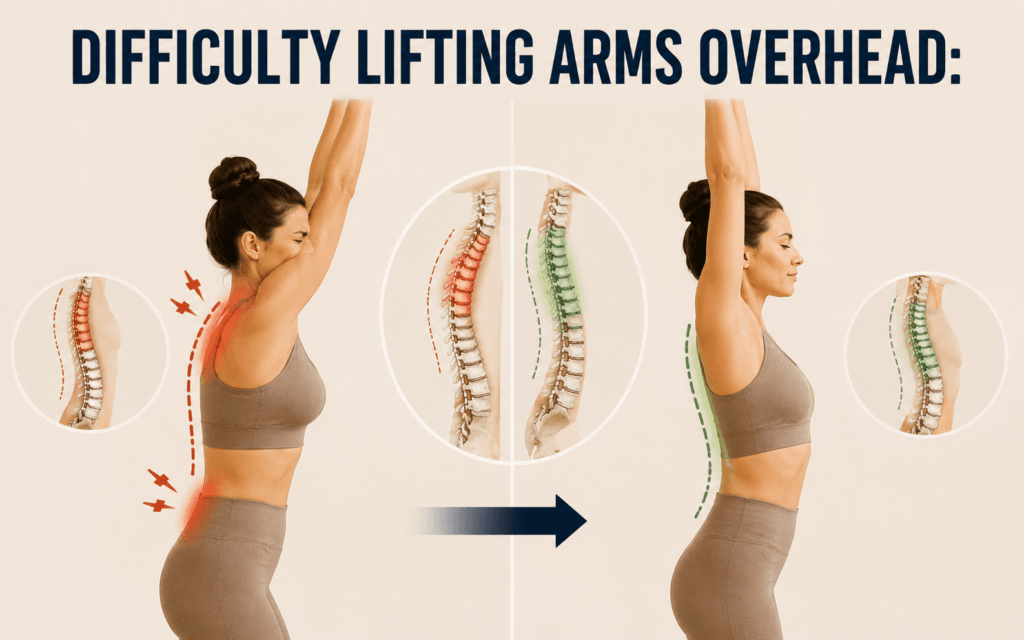
Difficulty lifting arms overhead:
Tightness or compensation in the lower back when reaching straight up, because the T-spine isn’t contributing its share of the movement
If three or more of these sound familiar, a consistent T-spine mobility practice is likely to make a noticeable difference — not just in your upper back, but in how connected areas feel too.
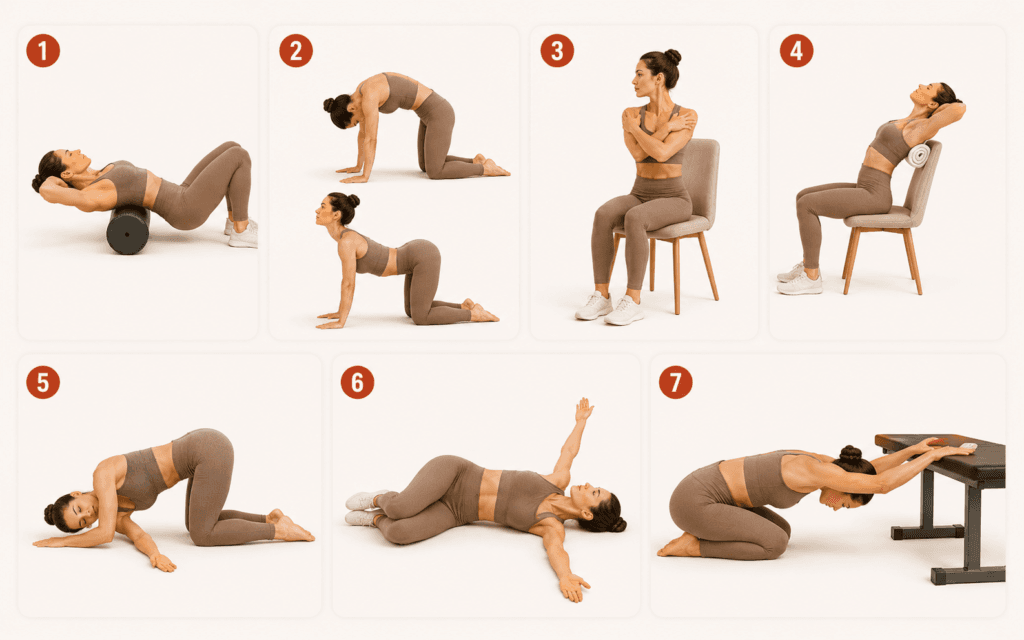
7 T-Spine Mobility Exercises to Try Today
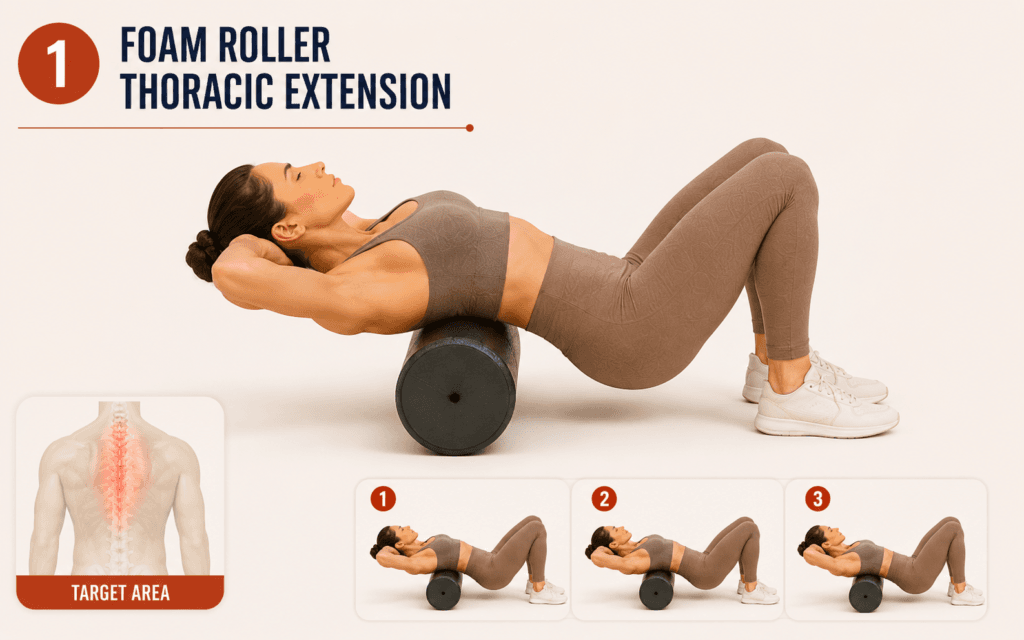
1. Foam Roller Thoracic Extension
Place a foam roller horizontally across your mid-back, roughly at the level of your shoulder blades. Support your head with your hands interlaced behind your neck. Gently extend back over the roller, letting your upper back open toward the floor, and hold for a breath or two before shifting the roller slightly upward to the next segment.
This is consistently described as the single most effective exercise for thoracic extension — it targets the T-spine directly and allows gravity to do most of the work. Move in small increments rather than rolling continuously.
Sets/reps: 3 to 4 positions along the mid and upper back, 2 to 3 breath holds per position.

2. Cat-Cow (Upper Back Focus)
On all fours with hands under shoulders and knees under hips, round your upper back toward the ceiling (cow position), then drop your chest toward the floor while lifting your tailbone (cat position). The key distinction from a standard cat-cow: consciously initiate the movement from the upper back rather than the lower back.
This teaches segmental spinal movement and improves both flexion and extension through the T-spine in a controlled, low-load way that suits beginners and as a warm-up for more demanding exercises.
Sets/reps: 8 to 10 slow, deliberate repetitions.
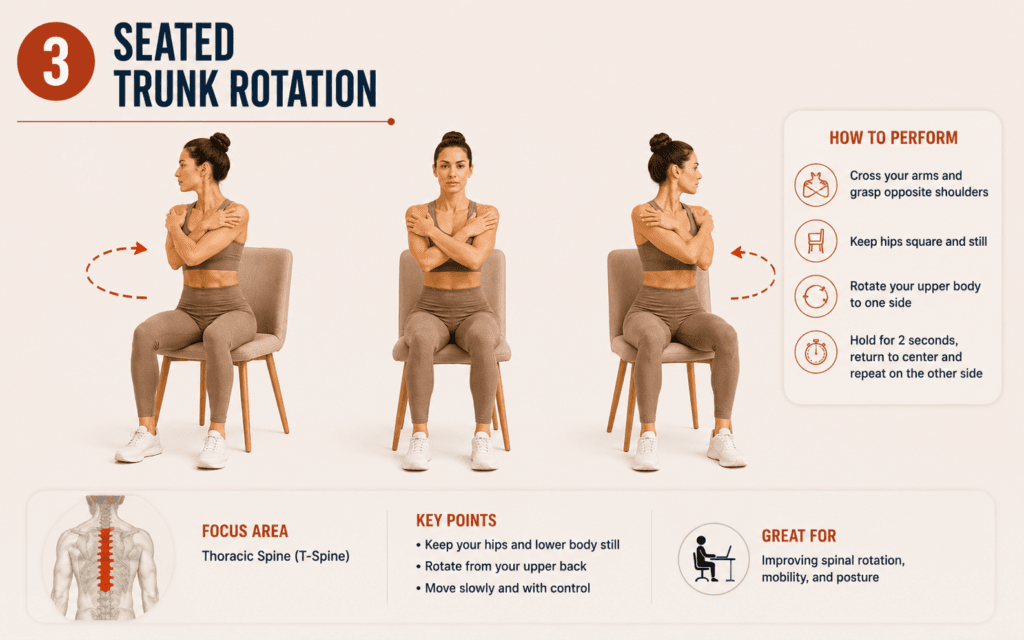
3. Seated Trunk Rotation
Sit on a chair with your feet flat on the floor and cross your arms over your chest, grasping the opposite shoulders. Keeping your hips square and still, rotate your upper body slowly to one side as far as comfortable — hold for two seconds — then return to center and repeat on the other side.
Rotation is one of the primary movements the T-spine is designed for, and it’s one of the first to be lost with prolonged sitting. This exercise can be done at a desk without getting on the floor, making it genuinely easy to fit into a workday.
Sets/reps: 8 to 10 rotations each side.
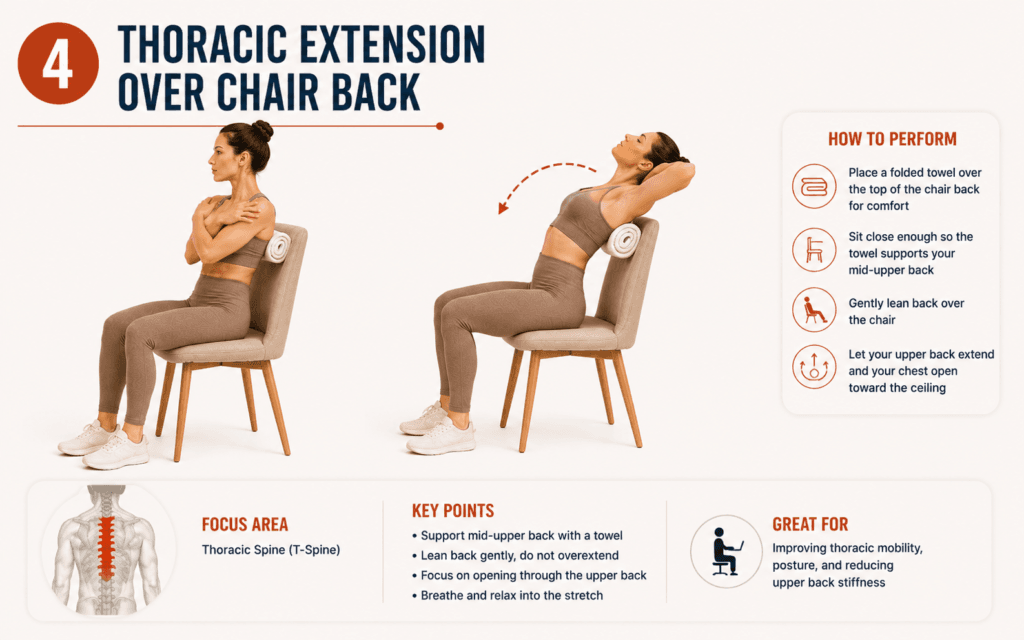
4. Thoracic Extension Over Chair Back
Sit in a chair with a firm, medium-height back. Place a folded towel over the top of the chair back for comfort. Sit close enough that the top of the chair back aligns with your mid-upper back, then gently lean back over it, letting your upper back extend and your chest open toward the ceiling.
This is a useful alternative to the foam roller for anyone who finds floor work difficult — it achieves a similar thoracic extension effect from a seated position.
Sets/reps: Hold 15 to 20 seconds, repeat 3 times.

5. Thread the Needle
Start on all fours. Slide one arm along the floor under your body, rotating your upper back until your shoulder and the side of your head rest on the floor. Hold for two to three breaths, then return and repeat on the other side.
Thread the needle is one of the most effective exercises for thoracic rotation specifically, reaching the part of the movement that seated rotation doesn’t fully access. It also gently stretches the muscles between the shoulder blades.
Sets/reps: 5 to 6 repetitions per side.
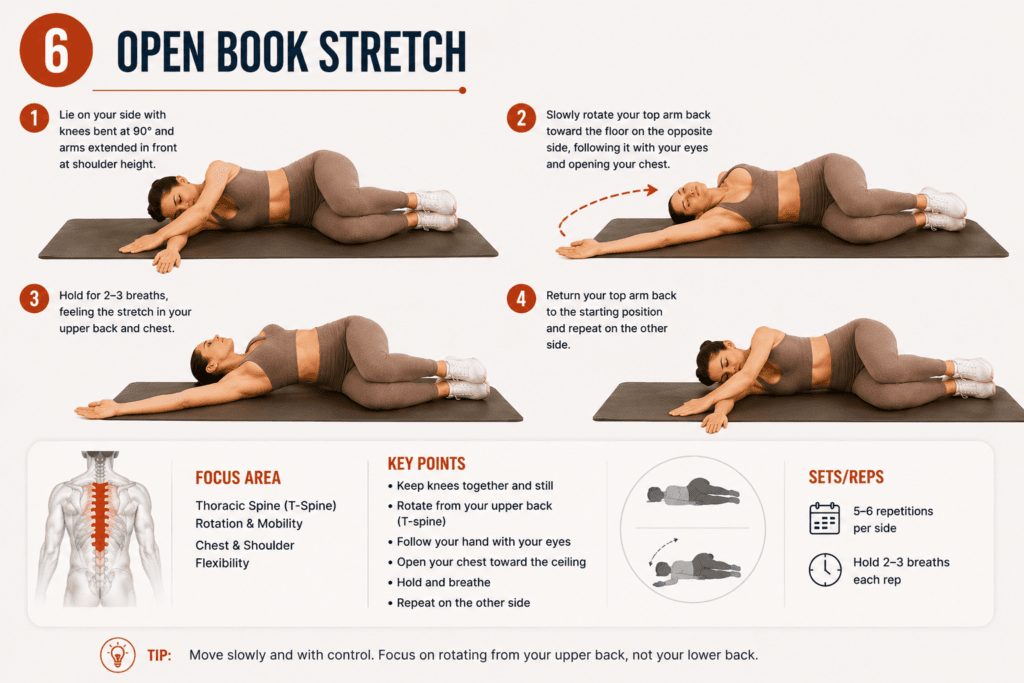
6. Open Book Stretch
Lie on your side with your knees stacked and bent at roughly 90 degrees, arms extended in front of you at shoulder height. Keeping your knees together and your lower body still, slowly rotate your top arm back toward the floor on the opposite side, following it with your eyes and opening your chest toward the ceiling. Hold for two to three breaths, then return.
Open book is particularly effective for thoracic rotation combined with a gentle chest and shoulder stretch — and the side-lying position naturally limits lumbar movement, meaning the rotation comes from the T-spine rather than compensating through the lower back.
Sets/reps: 5 to 6 repetitions per side.
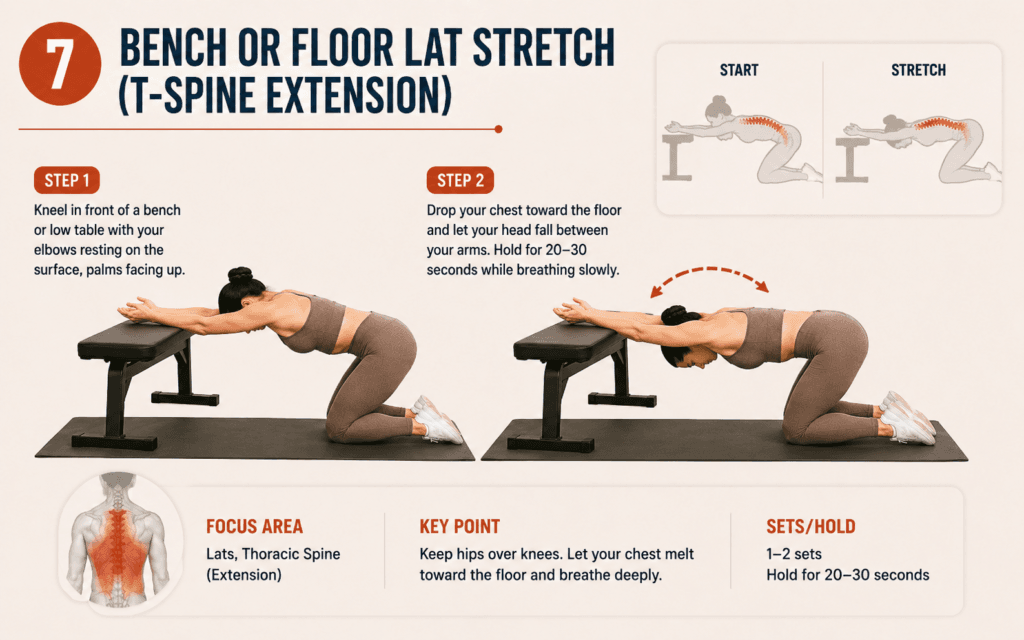
7. Bench or Floor Lat Stretch (T-Spine Extension)
Kneel in front of a bench or low table with your elbows resting on the surface, palms facing up. Keeping your hips over your knees, drop your chest toward the floor and let your head fall between your arms. Hold for 20 to 30 seconds while breathing slowly.
This exercise simultaneously targets the lats — which, when tight, directly restrict thoracic extension — and opens the upper back into extension. It’s particularly useful after a desk-heavy day or after upper body training.
Sets/reps: Hold 20 to 30 seconds, repeat 3 times.
Editor’s Note: A common question is how quickly T-spine mobility improvements show up. Most people notice a difference in how their upper back feels within one to two weeks of consistent daily practice — but meaningful, lasting postural change takes longer, typically six to eight weeks of regular work. Setting the expectation that this is a gradual process (rather than a quick fix) makes it much easier to stay consistent.
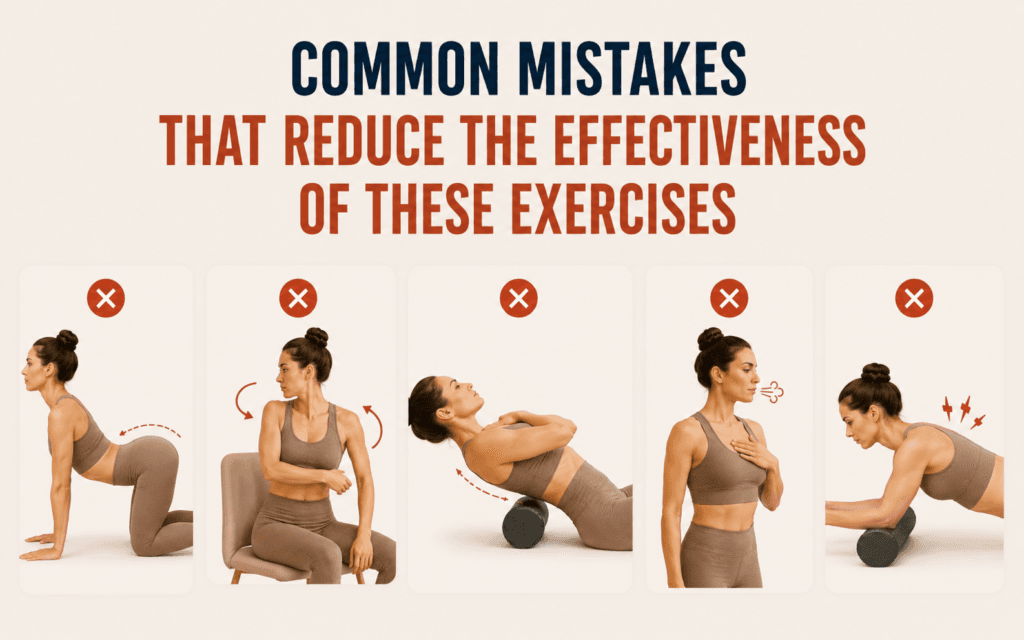
Common Mistakes That Reduce the Effectiveness of These Exercises
- Moving from the lower back instead of the upper back: The most common error in cat-cow and seated rotation — the lumbar spine compensates because it’s more mobile, so the T-spine gets bypassed entirely. Consciously focus on initiating movement from the shoulder blades and ribcage.
- Rushing through rotations: Fast, momentum-driven movement doesn’t give the muscles and fascia time to release. Slow, deliberate repetitions with a brief hold at the end range produce far better results.
- Foam roller too low: Placing the roller on the lower back targets the lumbar spine, which doesn’t need extra mobility — it needs stability. The roller belongs between the shoulder blades and the bottom of the ribcage.
- Holding your breath: Breath and thoracic mobility are directly linked. Holding your breath during these exercises keeps the ribcage rigid, limiting range of motion. Slow exhales during the movement open the chest more effectively.
- Doing too much too soon: Aggressive, daily deep foam rolling of a very stiff T-spine can cause temporary soreness. Starting with shorter sessions and building gradually reduces this and makes consistency easier to maintain.
How to Build These Into a Daily Routine
Morning (5 minutes): Cat-cow and seated trunk rotation are both floor or chair-based and work well as a morning movement habit before sitting down for the day.
Midday desk break (3 minutes): Seated trunk rotation and thoracic extension over a chair back require no floor work and fit naturally into a short break from screen time — similar to the [[Shoulder Stretches for Desk Work]] habit.
Evening (10 minutes): Foam roller extension, thread the needle, open book, and the bench lat stretch work well together as a longer evening mobility session.
Who These T-Spine Mobility Exercises Are Best For
Best for: anyone who sits for most of the day, people noticing stiffness when rotating their upper body, those with neck or shoulder tension that persists despite stretching those areas directly, anyone combining this with Back Massage Techniques or [[Shoulder Stretches for Desk Work]] as part of a broader self-care routine.
Less ideal for: those with a diagnosed thoracic spine condition, recent vertebral fracture, significant disc herniation, or any exercise that increases pain rather than easing it — in these cases, a physical therapist should design the appropriate mobility program rather than general exercise guidance.
If you’re starting from scratch, exercises 1 (foam roller extension), 3 (seated trunk rotation), and 6 (open book) cover the three primary movement directions of the T-spine and make a strong three-exercise starting point before adding the full routine.
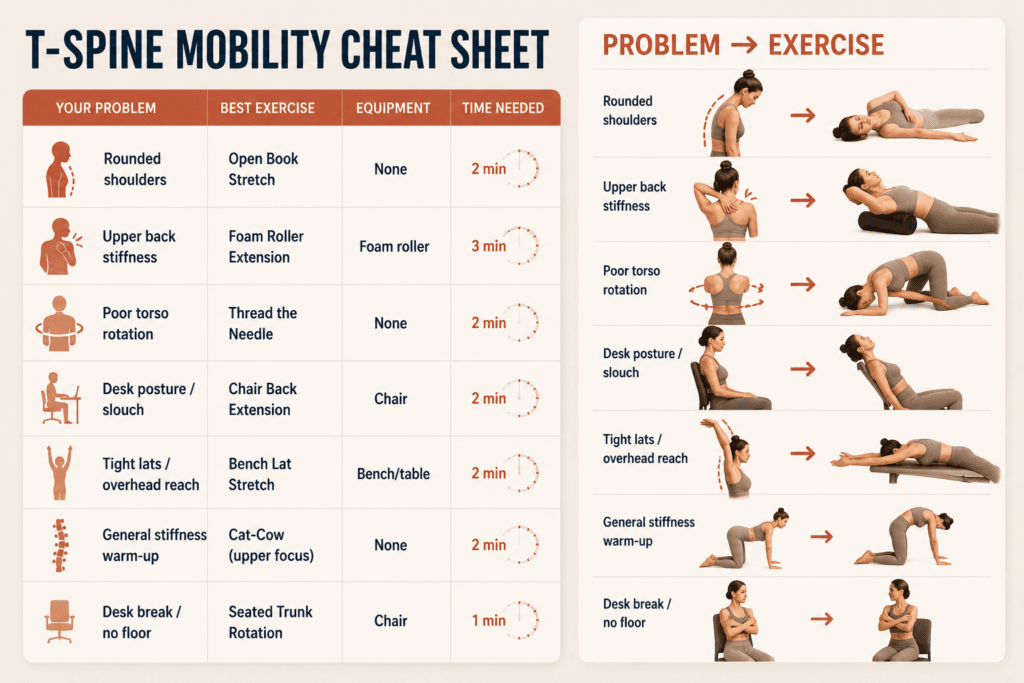
T-Spine Mobility Cheat Sheet
| Your Problem | Best Exercise | Equipment | Time Needed |
|---|---|---|---|
| Rounded shoulders | Open Book Stretch | None | 2 min |
| Upper back stiffness | Foam Roller Extension | Foam roller | 3 min |
| Poor torso rotation | Thread the Needle | None | 2 min |
| Desk posture / slouch | Chair Back Extension | Chair | 2 min |
| Tight lats / overhead reach | Bench Lat Stretch | Bench/table | 2 min |
| General stiffness warm-up | Cat-Cow (upper focus) | None | 2 min |
| Desk break / no floor | Seated Trunk Rotation | Chair | 1 min |
Who These T-Spine Mobility Exercises Are Best For
Best for: anyone who sits for most of the day, people noticing stiffness when rotating their upper body, those with neck or shoulder tension that persists despite stretching those areas directly, anyone combining this with Back Massage Techniques or Shoulder Stretches as part
of a broader self-care routine.
Less ideal for: those with a diagnosed thoracic spine condition, recent vertebral fracture, significant disc herniation, or any exercise that increases pain — in these cases, a physical therapist should design the appropriateprogram.
Frequently Asked Questions About T-Spine Mobility Exercises
What is the T-spine and why does it get stiff?
The thoracic spine (T-spine) is the section of twelve vertebrae running through the mid and upper back, between the neck and the lower back. It becomes stiff primarily from prolonged sitting and poor posture, which keeps it locked in a rounded, forward-flexed position for hours at a time.
How long does it take to improve T-spine mobility?
Most people notice their upper back feeling less tight within one to two weeks of consistent daily practice. Meaningful postural improvement typically takes six to eight weeks of regular work.
Can poor T-spine mobility cause neck or shoulder pain?
Yes — when the thoracic spine is stiff, the neck and shoulders compensate by working harder than they’re designed to. Improving T-spine mobility often reduces tension in surrounding areas even without directly targeting them.
Should these exercises feel painful?
A sensation of gentle stretch or mild pressure is normal. Sharp pain, or discomfort that worsens after a session, is a signal to stop and check with a healthcare provider rather than pushing through.
T-Spine Mobility Cheat Sheet
| Problem | Best Exercise | Equipment | Time Needed |
|---|---|---|---|
| Rounded shoulders | Open Book Stretch | None | 2 min |
| Upper back stiffness | Foam Roller Extension | Foam roller | 3 min |
| Poor torso rotation | Thread the Needle | None | 2 min |
| Desk posture / slouch | Chair Back Extension | Chair | 2 min |
| Tight lats / overhead | Bench Lat Stretch | Bench/table | 2 min |
| General warm-up | Cat-Cow (upper focus) | None | 2 min |
| Desk break / no floor | Seated Trunk Rotation | Chair | 1 min |
You May Also Like
→ Back Massage Techniques: 7 Moves Most People Get Wrong
→ 7 Foot Massage Techniques to Try Tonight
Final Thoughts: Ten Minutes a Day Changes More Than You’d Expect
These t-spine mobility exercises won’t undo years of poor posture overnight, but ten minutes of consistent daily movement in this area has a disproportionate effect on how your neck, shoulders, and lower back feel — because the T-spine connects to all of them. Start with the three foundational exercises, add more as the routine becomes familiar, and give it at least six weeks before judging the results.
Which T-Spine Mobility Exercise Feels Best for You? Let us know in the comments below!
Save this guide, try the foam roller extension tonight, and explore more wellness tips at egella.com