

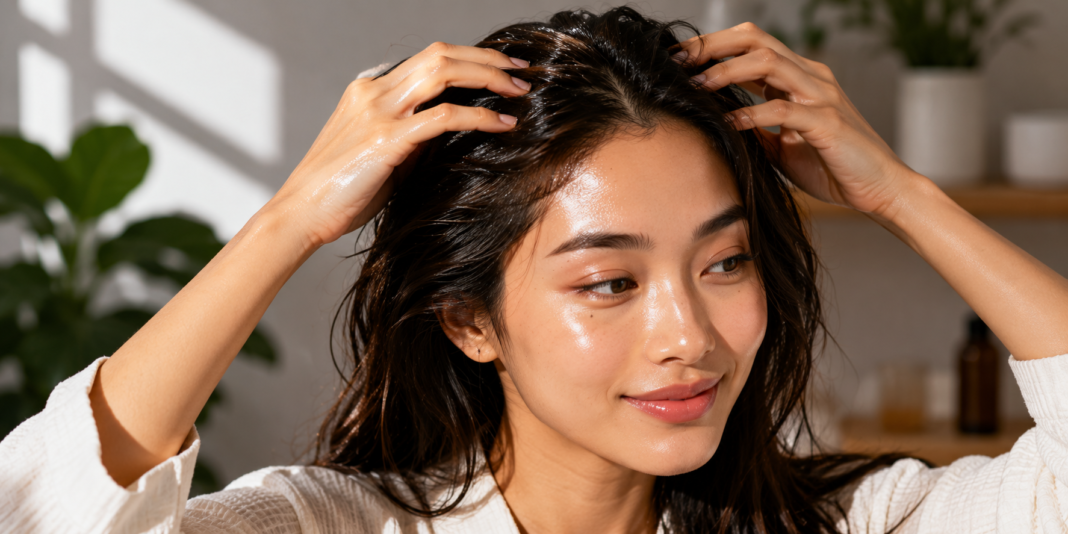
You spend significant time and money caring for your hair. But the health of every strand you’re trying to protect originates entirely in the scalp you’re probably ignoring. It’s time to treat your scalp like the skin it is.
The Scalp as a Skin Organ
The scalp is not a separate category from your skincare concerns — it is skin, with all the complexity that implies. It has sebaceous glands that produce oil, a microbiome of bacteria and fungi that requires balance, a barrier function that can be compromised, and a sensitivity to pH, temperature, and ingredient interactions that is, in some respects, greater than the skin on your face. The difference is that the consequences of neglecting scalp health aren’t immediately visible in the mirror. They show up weeks or months later in the form of hair that is thinner, duller, slower to grow, and more prone to breakage than it should be.
Every hair follicle lives in the scalp, and the condition of the follicle environment directly determines the quality of the hair it produces. A scalp that is chronically inflamed, overly dry, congested with product buildup, or out of microbial balance produces weaker, finer hair with a shorter growth cycle. Addressing the root — in every sense — is the most leveraged investment you can make in your hair.
The Most Common Scalp Problems
Dandruff is by far the most prevalent scalp condition, affecting roughly half of the adult population at some point. It is not caused by dryness, despite the persistent popular belief. Dandruff is primarily caused by an overgrowth of a yeast called Malassezia globosa, which is a normal inhabitant of the scalp microbiome but becomes problematic when it proliferates. Malassezia feeds on sebum and produces oleic acid as a byproduct, which triggers an inflammatory response in susceptible individuals, leading to the accelerated skin cell shedding that appears as flakes. Dry scalp — a separate and much simpler condition — produces smaller, finer white flakes and is caused by insufficient hydration or over-stripping cleansers. Treating dandruff with a rich moisturizing conditioner, as many people intuitively attempt, typically worsens it because it feeds the yeast.
Scalp psoriasis produces thicker, silvery, adherent plaques rather than loose flakes and is an autoimmune condition requiring dermatological care rather than cosmetic management. Seborrheic dermatitis sits on a spectrum with dandruff and produces yellowish, greasy flakes, often accompanied by redness. Contact dermatitis — an allergic or irritant reaction to a hair product ingredient — is increasingly common and frequently misdiagnosed as dandruff or sensitivity.
How to Cleanse the Scalp Properly
Most people shampoo their hair rather than their scalp, applying product to the mid-lengths and ends and relying on rinse-off to clean the scalp incidentally. The scalp is where oil, sweat, product buildup, and environmental debris accumulate, and it requires direct, intentional cleansing. Apply shampoo to the scalp specifically, use the pads of your fingers — never your nails — to work it in with gentle, circular motions, and let it sit for at least sixty seconds before rinsing. The mid-lengths and ends of the hair need only the diluted rinse-off from the scalp cleanse, not direct shampoo application, which causes the dryness and frizz that many people incorrectly attribute to their hair type.
Scalp Exfoliation
Just as the skin on your face benefits from periodic exfoliation to remove dead cell buildup and unclog pores, the scalp benefits from occasional exfoliation to remove the accumulation of dead skin cells, excess sebum, and product residue that standard shampooing leaves behind. Scalp scrubs with physical exfoliants like sugar or salt work well for oily scalps without sensitivity. Chemical scalp exfoliants containing salicylic acid are particularly effective for dandruff-prone scalps because salicylic acid addresses both the physical buildup and the fungal environment that drives flaking. Exfoliate once a week at most, and always follow with a conditioner applied from the mid-lengths down.
Scalp Serums and Treatments
The scalp serum category has expanded significantly, and several ingredients with genuine efficacy are now widely available in targeted scalp formulas. Minoxidil remains the gold standard for hair thinning with robust clinical evidence behind it. Caffeine applied topically has shown modest but consistent results in stimulating follicle activity in multiple studies. Peptide complexes and growth factors are the subject of considerable ongoing research. Niacinamide applied to the scalp improves microcirculation and reduces inflammation. Whatever treatment you choose, consistency is the non-negotiable variable — scalp treatments work on the timescale of the hair growth cycle, meaning visible results require a minimum of three to four months of regular application before any meaningful assessment is possible.