

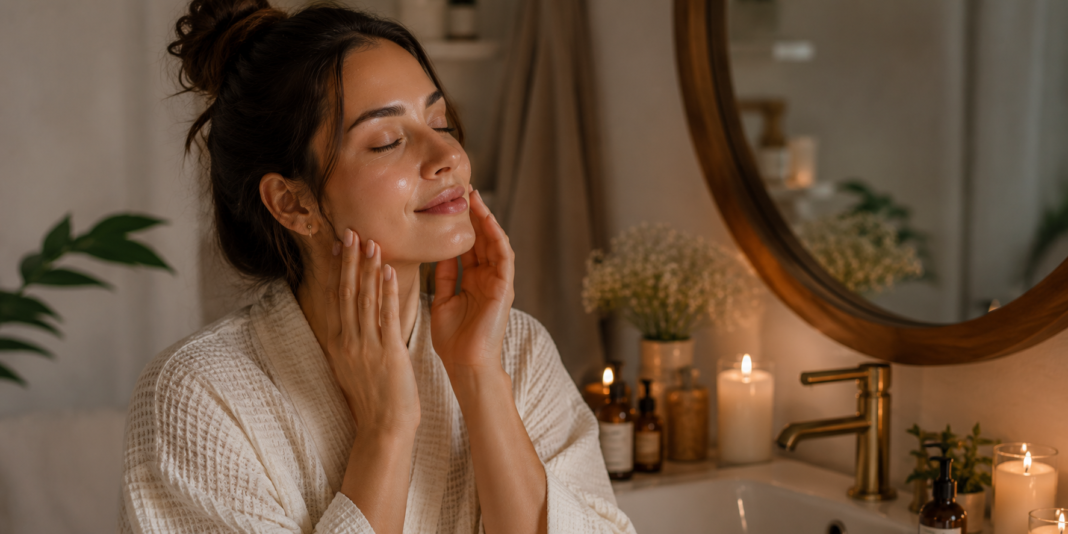
There’s a profound difference between rushing through skincare at 7am and genuinely caring for yourself. Mindful beauty isn’t a trend — it’s a science-backed practice with measurable results.
What Mindful Beauty Actually Means
Mindful beauty is the practice of being fully present during your skincare and self-care routines — noticing the textures, temperatures, and sensations involved, rather than rushing through a product checklist while simultaneously checking your phone, rehearsing your day, or processing last night’s argument. It sounds simple to the point of being obvious, and yet it describes almost nothing like how most people actually engage with their beauty routines.
The scientific case for this shift is more substantive than the language around it sometimes suggests. Research on mindfulness-based stress reduction consistently demonstrates reductions in salivary cortisol — the primary stress hormone — with surprisingly brief and accessible practices. Elevated cortisol is directly tied to a range of skin concerns: increased sebum production that feeds acne bacteria, heightened inflammatory signaling that triggers or worsens rosacea, impaired skin barrier function that drives sensitivity and dryness, and delayed wound healing. Chronic low-grade stress doesn’t just affect how you feel; it literally degrades the architecture of your skin over time. A beauty routine practiced with genuine presence is, among other things, a cortisol management tool.
- The Phone-Free First Ten Minutes
The single highest-impact change most people can make to their morning beauty routine is completing it before looking at any screen. The cortisol spike that occurs within the first few minutes of checking notifications — news, emails, social media, messages — is well-documented, and it sets a biochemical tone for the first several hours of your day. Protecting your skincare routine from this spike doesn’t require a dramatic lifestyle overhaul. It requires leaving your phone on the other side of the bathroom door for ten minutes. The routine becomes genuinely calming rather than one more thing competing for attention in an already fragmented morning.
- Ritualizing Facial Massage
Most people apply moisturizer in approximately fifteen seconds — a quick distribution across the face before moving on. Extending this step to two or three minutes using a gua sha stone or a jade roller, with slow, deliberate strokes following the lymphatic pathways of the face, transforms it into something meaningfully different. The physical benefits are real: consistent facial massage supports lymphatic drainage, reduces morning puffiness, and improves local circulation in a way that contributes to a visible glow over time. But the practice also serves as a form of body-based mindfulness — a period of deliberate, attentive physical contact with your own face that most adults almost never experience. The repetitive, rhythmic quality of the strokes makes it a natural container for presence.
- Choosing Scents with Intention
The olfactory system has a more direct pathway to the limbic brain — the emotional and memory center — than any other sense. This is not metaphor; it’s neuroanatomy. Lavender’s capacity to reduce heart rate and lower anxiety has been confirmed in clinical settings. Bergamot has documented mood-elevating properties. Rose compounds have been studied in the context of emotional regulation and the reduction of stress-related physiological responses. Choosing your skincare and body care products with some awareness of their scent profiles, and pausing to actually smell them rather than applying them on autopilot, turns every product interaction into a brief, effective aromatherapeutic intervention. The scent becomes a cue that signals the nervous system: this is rest time.
- Mirror Gratitude Practice
The default relationship most people have with their reflection is surveillance — scanning for problems, tracking changes, cataloguing imperfections. This is so normalized that most people don’t notice it as a behavior pattern until they deliberately try to do something different. A mirror gratitude practice simply involves spending thirty to sixty seconds, before beginning your routine, identifying something about your face or body that you appreciate. Not something you’d like it to look like, and not something conditional on a product working — something you already have and value. This is not toxic positivity or denial; it’s cognitive reappraisal, a technique with consistent support in the psychological literature for improving body image, reducing appearance-related anxiety, and shifting habitual attention patterns over time.
- Embodied Sensory Attention
The practice of deliberately noticing physical sensations during your routine — the temperature of the water during cleansing, the texture of a balm warming between your palms, the slight coolness of a serum on freshly cleansed skin — is a form of what psychologists call somatic awareness. Grounding attention in physical sensation is one of the fastest and most reliable ways to regulate an activated nervous system, and it requires nothing beyond the steps you’re already performing. The difference is where your attention is during those steps: on the sensation in your hands and on your face, or somewhere else entirely. The former is a practice; the latter is simply completing a task.
- Setting an Intention
Before beginning your routine, take three slow, deliberate breaths — not as a performance of wellness, but as a physiological intervention. Three slow exhales activate the parasympathetic nervous system and create a brief but genuine shift in your body’s arousal state. Follow this with a single, simple statement of intention: not a goal, not a hope, but a present-tense acknowledgment of what you’re doing. “I am taking care of myself.””This time is mine.” The content matters less than the act of deliberately reframing the routine as something you are choosing to do for yourself, rather than something you must get through before the real day begins.
- Process Over Outcome
The beauty industry is, structurally, an outcome-delivery machine. Every product promises a result — fewer lines, smaller pores, brighter skin, longer lashes. This creates a relationship with your routine that is fundamentally evaluative: you are constantly measuring whether the thing is working, whether progress is visible, whether you’ve spent your money and time wisely. Mindful beauty doesn’t eliminate the desire for results — it simply shifts the primary source of value from the outcome to the experience itself. A routine that genuinely helps you slow down, feel present in your body, and treat yourself with consistent care is valuable on those terms alone, regardless of whether your current retinol is producing visible changes at week four. The skin responds to care over time. So does the person providing it.