

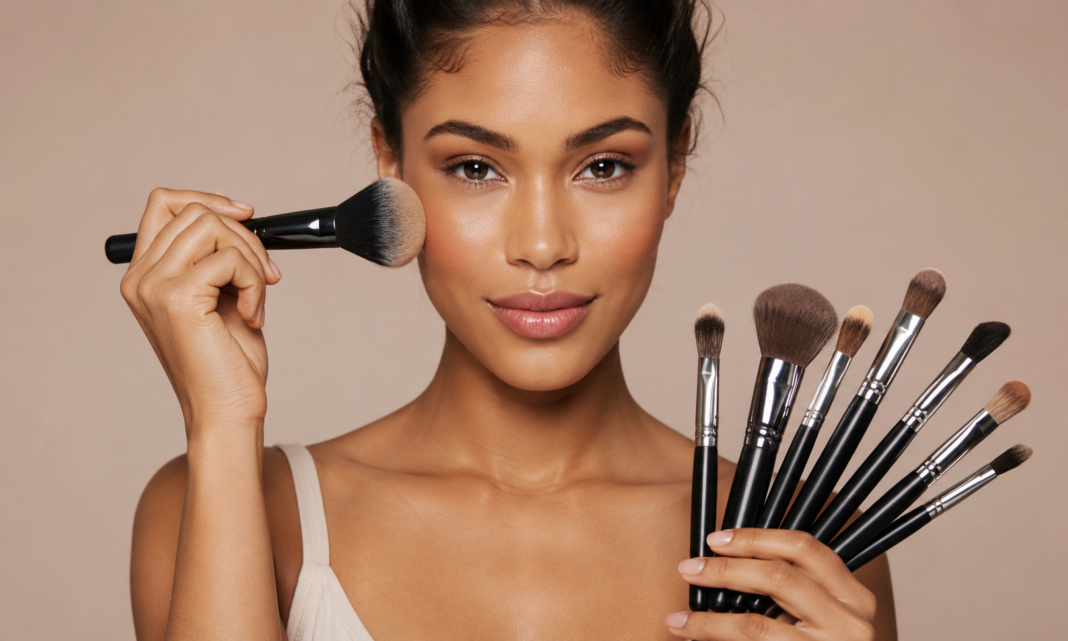
Part of the Egella Beauty Edit — the makeup knowledge worth having before your next application.
Most people own more makeup brushes than they use, use the ones they have incorrectly, and have no clear sense of which makeup brushes actually make a difference to the finished result and which are genuinely optional. This guide fixes all three problems: 12 essential makeup brushes, exactly what each one does, how to use it correctly, and which ones you can skip entirely if you’re building a brush collection from scratch on a budget.
Quick Summary: You don’t need 20 makeup brushes to achieve a polished result — you need 6 to 8 well-chosen ones. The non-negotiables are a foundation brush or sponge, a concealer brush, a powder brush, a blush brush, an eyeshadow brush, and a blending brush. Everything else — contour, highlight, fan, liner brushes — adds precision but isn’t foundational. Most important factor: how you use makeup brushes matters more than how many you own. Technique — particularly blending motion and pressure — determines 80% of the result.
This makeup brushes guide covers all 12 essential types, the correct technique for each, which makeup brushes are worth investing in versus which budget options perform equally well, and the cleaning habits that extend brush life and protect skin.
Editor’s Note — Isabella Reed: The most common makeup brushes mistake I see isn’t using the wrong brush — it’s using the right brush with the wrong motion. A blending brush used with a pressing motion instead of circular or windscreen-wiper sweeping will never blend properly, regardless of how good the brush or the product is. Before buying more makeup brushes, learn the correct motion for the ones you already own. That change alone typically produces more improvement than any new purchase.
How Makeup Brushes Work — The Basics
Makeup brushes work through three mechanisms: picking up product, depositing it onto the skin, and blending the edges. Not all makeup brushes do all three — some are specifically for picking up and depositing (flat foundation brushes, fan brushes), while others are primarily for blending (fluffy eyeshadow brushes, dome-shaped powder brushes). Understanding which function each brush serves tells you the correct motion to use it with.
| Brush Function | Correct Motion | Makeup Brushes That Use This |
|---|---|---|
| Deposit and blend | Stippling, buffing, circular | Foundation, concealer, powder |
| Deposit only | Pressing, patting | Flat eyeshadow, liner, fan |
| Blend only | Windscreen-wiper, circular, sweeping | Blending brush, fluffy eyeshadow, contour |
| Pick up and sweep | Light sweeping | Blush, highlight, powder |
The 12 Essential Makeup Brushes
Face Makeup Brushes
1. Foundation Brush
Foundation brushes come in two main forms: flat and dense (for fuller coverage, pressed application) and rounded and buffing (for a more blended, skin-like finish). The flat foundation brush is more precise and builds coverage more easily; the buffing brush blends more seamlessly but takes longer to build coverage.
Isabella Reed tested dense flat-top foundation brushes against rounded buffing brushes across liquid, serum, and stick foundation formulas over four weeks. Flat-top brushes consistently produced fuller coverage with less product waste. Buffing brushes blended more seamlessly but required more layers to reach the same coverage level — making them better suited to lighter formulas and skin-finish preferences.
How to use: apply foundation in dots across the face, then use the brush to buff or press outward from the centre. For flat brushes, use downward strokes in the direction of facial hair to avoid a cakey finish. For buffing styles, use small circular motions that gradually blend edges.
Worth investing in: yes — foundation brushes affect coverage, finish, and blending more than almost any other brush type
Budget alternative: a good damp beauty sponge produces comparable results for most foundation formulas
2. Concealer Brush
Concealer brushes are small, dense, and flat or slightly tapered — designed for precise application in small areas. The small head allows targeted coverage under the eyes, around the nose, or on individual blemishes without spreading product into areas that don’t need it.
How to use: apply concealer with a pressing and patting motion rather than dragging — dragging moves the product across the skin rather than pressing it in, which reduces coverage and disrupts any base makeup underneath.
Worth investing in: moderately — a mid-range concealer brush performs similarly to luxury options in most cases
3. Powder Brush
Powder brushes are large, fluffy, and dome-shaped — designed to pick up a light layer of powder and distribute it evenly across a large area without depositing too much product in any single spot. They’re among the most important tools for setting foundation and controlling shine without adding visible texture.
How to use: tap excess powder off the brush before applying, then use light sweeping motions rather than pressing — pressing powder brushes into the face with too much pressure creates a cakey, flat finish.
Worth investing in: yes — the quality of powder brushes directly affects whether powder looks set or heavy
4. Blush Brush
Blush brushes are medium-sized, slightly tapered, and domed — smaller than powder brushes but larger than contour brushes. They pick up pigment and sweep it across the cheek in a controlled way. The size and density determines how diffused or concentrated the colour application is.
How to use: smile lightly to find the apples of the cheeks, then sweep upward toward the temples with a light hand. For blush draping technique specifically — our blush draping guide covers the specific brush placement and motion that creates the lifting, dimensional effect.
Worth investing in: moderately — blush makeup brushes are less technique-dependent than blending brushes
5. Contour Brush
Contour brushes are angled or tapered — the angled edge follows the natural hollows of the face (below the cheekbones, along the temples, sides of the nose) more precisely than a straight-edged brush. They deposit product in a targeted line that can then be blended.
How to use: apply contour product with the angled edge of the brush following the hollows you want to deepen, then use a separate blending brush or clean fluffy brush to soften the edges. Never blend with the same contour brush used to deposit — the dense bristles will move product rather than diffuse it.
Worth investing in: moderately — technique matters more than price point here
6. Highlight Brush
Highlight brushes are typically fan-shaped or small and tapered — designed to deposit a concentrated, precise application of highlight on the high points of the face (top of cheekbones, bridge of the nose, brow bone, cupid’s bow). Fan brushes pick up less product than dome brushes, which is useful for powder highlight that can look overdone when applied too heavily.
How to use: tap excess product off the brush, then press lightly onto the high points rather than sweeping — sweeping spreads highlight beyond the intended area and reduces the precision that defines a well-placed highlight.
Worth investing in: low priority — a small eyeshadow brush performs similarly for most highlight applications
Editor’s Note — Isabella Reed: The fan brush gets a lot of attention as a highlight tool but I rarely recommend it as a priority purchase for most people’s makeup brushes collection. A small, dense eyeshadow brush pressed onto the cheekbone delivers more precise, buildable highlight than most fan brushes — and it’s a brush you already need for other purposes. Buy the fan brush if you love it, but don’t prioritise it over the blending brush or a good powder brush when building your collection.
Eye Makeup Brushes
7. Flat Eyeshadow Brush
Flat eyeshadow brushes are dense, with a flat, paddle-shaped head — designed for pressing and packing eyeshadow onto the lid with intensity. They deposit more pigment than fluffy brushes and are the correct tool when you want visible, saturated colour rather than a diffused wash.
How to use: press and pat — not sweep. Sweeping with a flat eyeshadow brush moves product rather than building it. Press the brush onto the lid, lift, reposition, press again to build colour evenly.
Worth investing in: moderately — the flat head is the key feature, not the bristle quality
8. Blending Brush
Blending brushes are fluffy, dome-shaped, and medium-sized — the most important eye tools in any collection. They soften edges, blend two colours together, and diffuse harsh lines. The quality difference between budget and mid-range blending makeup brushes is more noticeable than for almost any other brush type — cheap blending brushes either shed, feel scratchy, or don’t pick up enough product to blend effectively.
Isabella Reed tested budget blending brushes (under $10) against mid-range options ($25–45) across cream, powder, and duo-chrome eyeshadow formulas. Mid-range blending brushes produced noticeably softer edges with fewer strokes. Budget options required significantly more blending time to achieve comparable diffusion — and shed more consistently after washing.
How to use: windscreen-wiper motion (side to side) in the crease, or small circular motions on the outer corner. Use with minimal product — blending brushes work best when used dry to blend product already deposited, not to apply new product.
Worth investing in: yes — this is where mid-range brushes outperform budget options most consistently
9. Pencil Brush
Pencil brushes have a small, pointed or tapered tip — designed for precise application in tight spaces: the lower lash line, the inner corner, the waterline, or detailed cut-crease work. They’re precision tools rather than blending tools.
How to use: use with a pressing or dragging motion depending on the effect — pressing deposits concentrated pigment, while a light drag creates a smudged liner effect along the lower lash line.
Worth investing in: low priority unless you do detailed eye looks regularly
10. Liner Brush
Liner brushes are thin, flat, and stiff — designed for applying gel or cream liner with precision. They’re the most technique-dependent option in this guide: a liner brush requires a steady hand and a confident stroke, making it more challenging than most other brush types for beginners.
How to use: rest your elbow on a flat surface for stability, pull the skin taut lightly at the outer corner, and use short strokes building from the lash line outward rather than attempting a single continuous line.
Worth investing in: low priority — a felt-tip liner pen achieves similar results with significantly less technique required
11. Brow Brush
Brow brushes are typically dual-ended — a spoolie on one end and an angled or flat brush on the other. The spoolie combs and shapes brow hairs; the angled brush applies brow powder or pomade with precision. Together they’re among the most versatile tools in a collection relative to their size.
How to use: comb brows upward with the spoolie first to see the natural shape, then use the angled brush to fill sparse areas with short, hair-like strokes in the direction of natural hair growth. Finish by combing through again to blend.
Worth investing in: moderately — the spoolie end is the more important component and performs similarly across price points
12. Lip Brush
Lip brushes have a small, flat, and slightly tapered head — designed for precise application of lip colour, particularly useful for sharp edges on bold or dark lipsticks and for applying lipstick from a bullet with more control than direct application. They’re among the most optional tools for everyday use but genuinely useful for precise lip looks.
How to use: apply lip colour from the centre of the lip outward, following the natural lip line. For a sharp cupid’s bow, use the very tip of the brush rather than the full head.
Worth investing in: low priority — most people achieve satisfactory results applying lipstick directly
Which Makeup Brushes to Buy First
| Priority | Brush | Why |
|---|---|---|
| 🔴 Essential | Foundation, powder, blush, blending brush | These affect the base and finish most directly |
| 🟡 Useful | Concealer, flat eyeshadow, contour, brow | Add precision for most looks |
| 🟢 Optional | Highlight, pencil, liner, lip brush | Worth adding over time but not foundational |
How to Clean Makeup Brushes
Cleaning makeup brushes is the most skipped and most important maintenance habit for both skin health and brush longevity. Dirty brushes harbour bacteria, mix colours unintentionally, and deposit old product and bacteria onto skin alongside the current application — contributing to breakouts and patchy application.
Weekly deep clean (all makeup brushes): wet bristles with lukewarm water, apply a small amount of gentle shampoo or brush cleanser to the palm, swirl the brush in circular motions against the palm, rinse until water runs clear, reshape, and lay flat to dry. Never dry makeup brushes upright — water travels into the ferrule (the metal part) and loosens the glue holding the bristles.
Between uses (spot cleaning): a quick spray of cleaner or a swipe across a clean cloth removes most product residue for same-session colour switching. Spot cleaning isn’t a substitute for weekly washing — it’s a between-wash maintenance step.
For the connection between dirty makeup brushes and skin health, our makeup expiration guide covers exactly how contaminated products and tools contribute to skin concerns — tool hygiene is part of the same principle.
Makeup Brushes vs Fingers vs Sponges
| Tool | Best For | Limitations |
|---|---|---|
| Makeup brushes | Precision, controlled deposit, powder products | Learning curve on technique; require cleaning |
| Fingers | Cream products, natural finish, warmth aids blending | Less precise, transfer oils and bacteria |
| Sponge | Seamless foundation blend, sheer-to-medium coverage | Absorbs product; needs frequent replacement |
Makeup brushes, fingers, and sponges aren’t in competition — they work best used together. Most professional makeup applications combine all three tools at different stages.
Key Makeup Brush Comparisons
Foundation Brush vs Sponge vs Fingers
| Tool | Coverage | Finish | Best For |
|---|---|---|---|
| Flat-top foundation brush | Medium to full | Airbrushed, precise | Full coverage, stick and cream formulas |
| Buffing foundation brush | Light to medium | Skin-like, blended | Liquid and serum formulas, natural finish |
| Damp beauty sponge | Sheer to medium | Seamless, dewy | Blurring texture, sheering out coverage |
| Fingers | Sheer to light | Natural, warmed in | Cream products, touch-ups |
Dense vs Fluffy Makeup Brushes
| Factor | Dense Makeup Brushes | Fluffy Makeup Brushes |
|---|---|---|
| Product pickup | High — picks up and holds more product | Low — picks up less, distributes more evenly |
| Best use | Depositing, packing, building coverage | Blending, diffusing, sheer application |
| Eyeshadow | Flat dense brush for saturated lid colour | Fluffy brush for crease blending |
| Face products | Dense powder brush for targeted setting | Fluffy powder brush for all-over setting |
| Motion | Pressing and patting | Sweeping and circular |
Natural vs Synthetic Brush Bristles
| Factor | Natural Bristles | Synthetic Bristles |
|---|---|---|
| Best for | Powder products — picks up and releases evenly | Liquid and cream — doesn’t absorb formula |
| Powder products | Excellent — natural cuticle holds powder well | Good — may pick up less product |
| Liquid products | Poor — absorbs too much product | Excellent — deposits without waste |
| Cleaning | More delicate — requires gentle handling | More durable — withstands frequent washing |
| Vegan/cruelty-free | No | Yes |
| Price | Generally higher | Wide range — budget to luxury |
Editor’s Note — Isabella Reed: The natural vs synthetic debate has largely been resolved by improvements in synthetic bristle technology. Most high-quality synthetic makeup brushes now perform comparably to natural hair for powder products — and outperform them for liquid and cream formulas. Unless you have a specific preference for natural bristles, a well-made synthetic brush collection is the more practical and more versatile starting point.
Common Makeup Brushes Mistakes
- Using the wrong motion: the most common and most impactful mistake — a blending brush used with a pressing motion won’t blend, and a flat eyeshadow brush used with a sweeping motion won’t deposit colour efficiently
- Never cleaning makeup brushes: the single most common skincare-adjacent mistake — dirty brushes deposit old product and bacteria onto clean skin with every application
- Buying too many before learning to use a few: 6 well-used makeup brushes produce better results than 20 poorly used ones
- Using wet makeup brushes: applying product with damp brushes (not intentionally wet for specific techniques) changes the formula’s finish and can make powder products patchy
- Storing makeup brushes upright in a cup while wet: water travels into the ferrule and dissolves the glue — lay flat or bristles-down while drying
The Egella Take
💄 Non-negotiable makeup brushes: foundation or sponge, powder, blush, blending brush — these four affect daily results most directly
🏆 Worth investing in: blending brush and powder brush — quality difference is most noticeable in these two categories
⚠️ The honest truth: technique matters more than tools. Learning the correct motion for your existing makeup brushes will produce more improvement than buying new ones.
Frequently Asked Questions About Makeup Brushes
How often should I clean my makeup brushes?
Deep clean all makeup brushes weekly with gentle shampoo or brush cleanser. For makeup brushes used with liquid or cream products (foundation, concealer), cleaning after every use or every 2–3 uses reduces bacterial buildup more effectively.
What’s the difference between cheap and expensive makeup brushes?
Price difference matters most for blending brushes and powder brushes — where bristle density, softness, and how well they hold shape during use are the key quality indicators. For flat eyeshadow brushes and liner brushes, budget options often perform similarly to luxury ones.
Can I use the same brush for different products?
Yes, with spot cleaning between uses. A blush brush and a contour brush, for example, can be the same brush cleaned between applications. Avoid using eye makeup brushes on face products without washing — the smaller bristle density concentrates product differently.
Do I need different makeup brushes for cream versus powder products?
Not different types, but different approaches. Cream products generally work better with denser, flat makeup brushes or fingers that press product in; powder products work better with fluffy makeup brushes that pick up and distribute without pressing.
How long do makeup brushes last?
Well-maintained makeup brushes last 5–10 years. The main indicators that replacement is needed: shedding that doesn’t stop after washing, bristles that no longer hold their shape after cleaning, or scratchy texture that develops over time.
Sources & References
- American Academy of Dermatology (AAD) — Makeup Safety and Application
- Journal of Cosmetic Dermatology — Brush Contamination and Skin Health
- International Journal of Cosmetic Science — Brush Bristle Types and Product Application
This guide was researched and written by the Egella editorial team using current makeup application techniques and beauty editorial best practices. Last updated: June 2026.
Save this makeup brushes guide and explore more makeup guides at egella.com
Which makeup brush changed your application the most — and which one do you barely use? Tell us in the comments.