

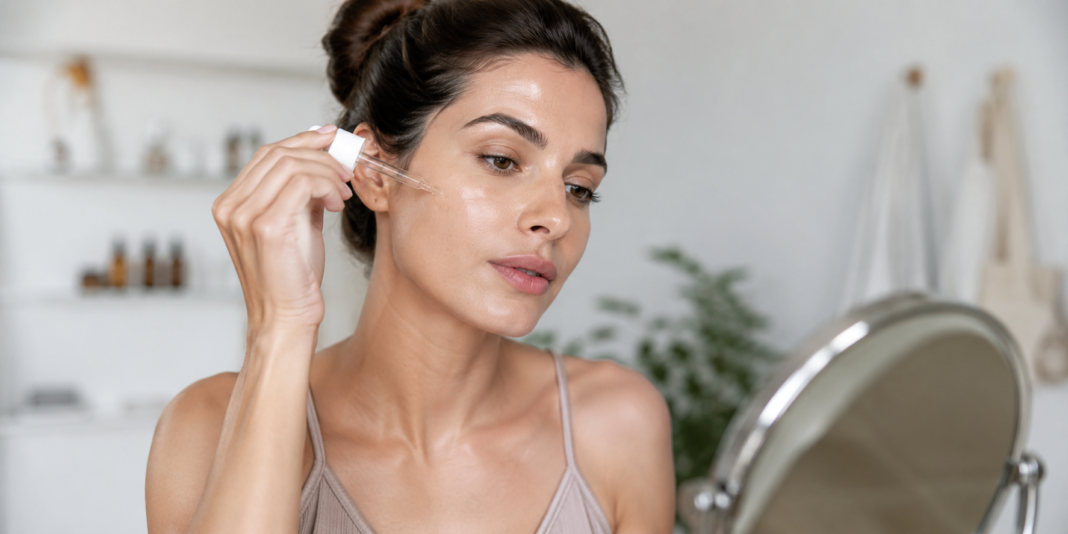
Retinol is skincare’s undisputed gold standard. But used incorrectly, it can become your skin’s worst enemy. Here’s the honest, complete beginner’s guide.
What Is Retinol and What Does It Actually Do?
Retinol is a derivative of vitamin A that your skin converts into retinoic acid — the active form that communicates directly with skin cells to trigger real, measurable change. Once converted, retinoic acid accelerates cell turnover, meaning fresher, smoother skin rises to the surface faster than it naturally would. Over time, it also stimulates collagen production, fades areas of hyperpigmentation, minimizes the visible size of pores, and helps regulate sebum production. On paper, it does everything.
But here’s what most beauty content conveniently skips: your skin needs time to build tolerance, and “more is more” absolutely does not apply here. Starting too strong or moving too fast causes the dreaded “retinol uglies” — widespread flaking, redness, stinging, and a compromised skin barrier that can take weeks to fully repair. The goal is a slow, methodical introduction, not an overnight transformation.
Understanding Retinol Concentrations
Retinol products come in a wide range of concentrations, and choosing the right starting point matters more than most people realize. The very lowest concentrations — around 0.025% to 0.05% — are designed for beginners, people with sensitive skin, those prone to rosacea, or anyone who has reacted poorly to skincare actives in the past. These feel like nothing at first, and that’s exactly the point.
The intermediate range of 0.1% to 0.3% is where most people land after six to eight weeks of tolerance building, and this is also where visible, reliable results typically begin. Fine lines look softer, skin texture evens out, and the complexion takes on a more refined quality. Moving from there into the 0.5% to 1% range represents the advanced tier — significant anti-aging and anti-acne effects, but requiring a skin that has genuinely adapted over months, not weeks.
Above and beyond over-the-counter retinol sits prescription tretinoin, which is retinoic acid itself — no conversion required. It works faster and more powerfully than any OTC product, but it also carries a much higher risk of initial irritation. A dermatologist’s guidance is non-negotiable here.
Your First 12 Weeks: A Safe Protocol
The first two weeks should involve just one application per week, always at night. Use a pea-sized amount for the entire face — no more — and wait at least 20 minutes after cleansing before applying, to ensure the skin is completely dry. Wet skin drives ingredients deeper and dramatically increases irritation risk.
If your skin tolerates the first two weeks without significant redness or peeling, move to twice a week during weeks three and four. Some mild flaking is completely normal at this stage — resist the urge to exfoliate more aggressively, and instead double down on your moisturizer. Hydration, not more retinol, is the solution.
By weeks five through eight, the skin is entering what dermatologists call retinization — the adaptation phase where purging slows, irritation decreases, and the actual benefits begin to emerge. Three to four nights per week is appropriate here. By weeks nine through twelve, daily use may be possible for most skin types, and a conversation with your dermatologist about increasing concentration can make sense if your goals require it.
Combining Retinol with Other Actives
Retinol pairs well with niacinamide, which actually helps buffer irritation and supports barrier function simultaneously. Vitamin C is best kept to the morning routine while retinol stays in the evening — not because they cancel each other out chemically, but because both can be individually destabilizing and the skin appreciates the separation. AHA and BHA exfoliants should not be used on the same night as retinol; the combination over-strips the barrier and consistently leads to setbacks. And benzoyl peroxide should never be combined with retinol — the two molecules neutralize each other and the skin pays the price for nothing.
Why SPF Is Non-Negotiable
Retinol accelerates cell turnover, which means it’s constantly surfacing fresh, new cells that have never been exposed to UV radiation before. Those cells are significantly more vulnerable to sun damage than the older, toughened cells they replace. Using retinol without daily broad-spectrum SPF 30 or higher doesn’t just reduce its effectiveness — it actively works against your skin. Existing hyperpigmentation deepens, new sun damage accumulates faster, and the anti-aging work you’re doing at night gets undone every morning you step outside
